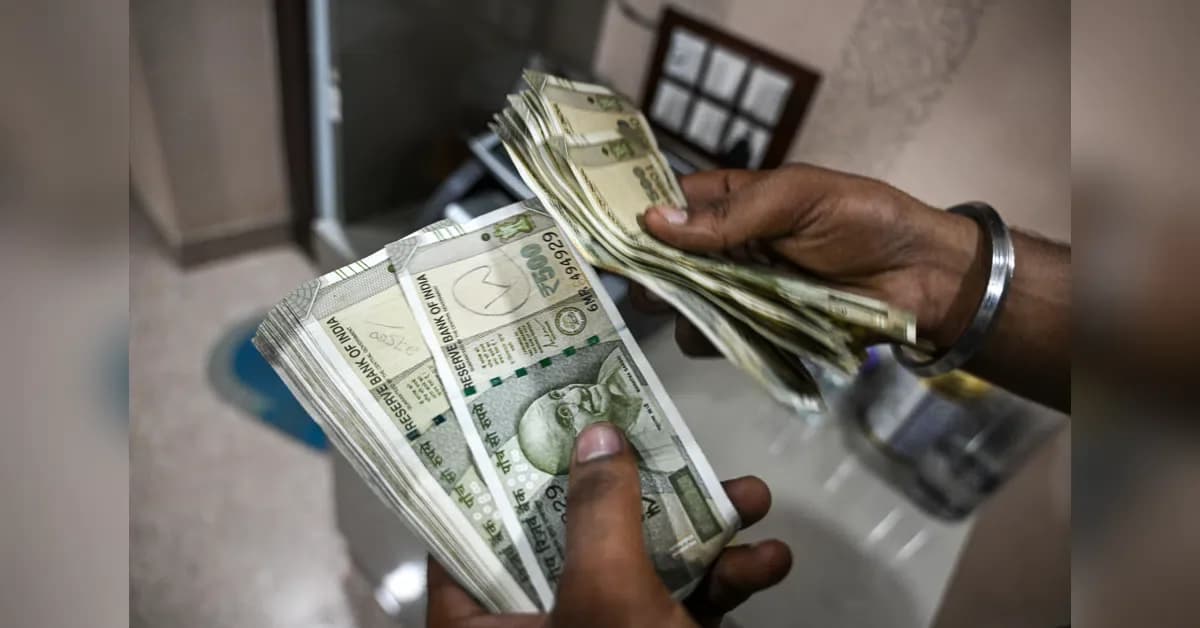
The Reserve Bank of India faces a massive $100 billion unwinding challenge after building one of the world's largest bearish dollar bets to support a persistently weak rupee. According to Business Standard, the RBI's short dollar forward position had ballooned to a record $106.7 billion in May, representing a stock of commitments to sell the greenback at future dates. The central bank has started trimming this position as part of recent measures expected to attract foreign capital, with authorities discussing how to reduce the position in internal meetings. In the past fortnight, short-term FX maturities worth about $20 billion are expected to have rolled off the central bank's forward book, as noted by DBS Bank strategists.
The Indian Rupee has depreciated by approximately 9% since January 2025, with the currency currently trading at 95.46 against the US Dollar as of July 8, 2026. According to latest data from Wise, the Rupee has shown some volatility with a 0.588% increase since yesterday and a 0.323% gain over the past week. The currency has experienced daily fluctuations, with the largest 24-hour movement occurring on July 8, 2026, with a 0.385% increase in value. The rupee has resumed declines in July and remains on track for an unprecedented ninth straight year of losses, with the currency down 0.8% against the greenback so far in July after gaining 0.4% last month. The rupee is the worst performer in Asia this year after Indonesia's rupiah, having lost close to 6%.
The Reserve Bank of India maintains headline reserves of approximately $685 billion, though due to FX intervention, the central bank holds a short forward book of around $100 billion. As reported by The Economic Times, adjusting for this forward position and gold valuation, usable reserves stand at $460 billion. The RBI has intervened heavily in foreign exchange markets, selling $87 billion in the spot market over FY24-25, including $34 billion in 2025 and $53 billion in 2026. The central bank has also increased its net short USD position in the forward market to $103 billion from a long position of $24 billion in FY23, representing a swing of $127 billion. The RBI's net short forward position is heavily front-loaded, with nearly $29 billion maturing within three months and about $51 billion over a one-year horizon as of May, according to Emkay Global Financial Services.

The Government of India and RBI have introduced comprehensive measures to augment capital flows, including the removal of withholding tax and capital gains on government bonds, bearing full hedging costs for incremental FCNR (B) deposits, and expansion of bonds in the Fully Accessible Route for FPIs. According to The Economic Times, these initiatives are expected to bring in capital flows of approximately $70 billion. A similar FCNR (B) scheme was announced in September 2013, which resulted in the INR appreciating by approximately 10% from 65.70 to 59.10 over the following months, correcting the Real Effective Exchange Rate undervaluation from 11.50% to 4.5%. The RBI has offered to fully cover hedging costs for banks raising three- to five-year foreign-currency deposits from non-resident Indians, though this will create equal future liabilities that will require repayment, as noted by former SEBI board member Ananth Narayan.
Currency forecasters see little respite for the rupee in the near term. Claudio Piron, head of Asia FX & rates strategy at BofA Global Research, estimates the rupee at 98 per dollar by the end of 2026, reflecting expectations of three US rate hikes totaling 75 basis points. The median estimate in a Bloomberg survey of forecasters is for the rupee to end the year at 95.40 per dollar, versus 95.39 on Thursday. Governor Sanjay Malhotra stated at the June post-policy briefing that the RBI does not anticipate future strain on the currency but remains prepared for any eventuality, with the central bank having adequate reserves and sufficient buffers. The balancing act lies in the pace and extent of the unwind, as leaving contracts in place for too long can be costly while scaling them back too quickly risks diluting the positive impact of fresh overseas inflows.