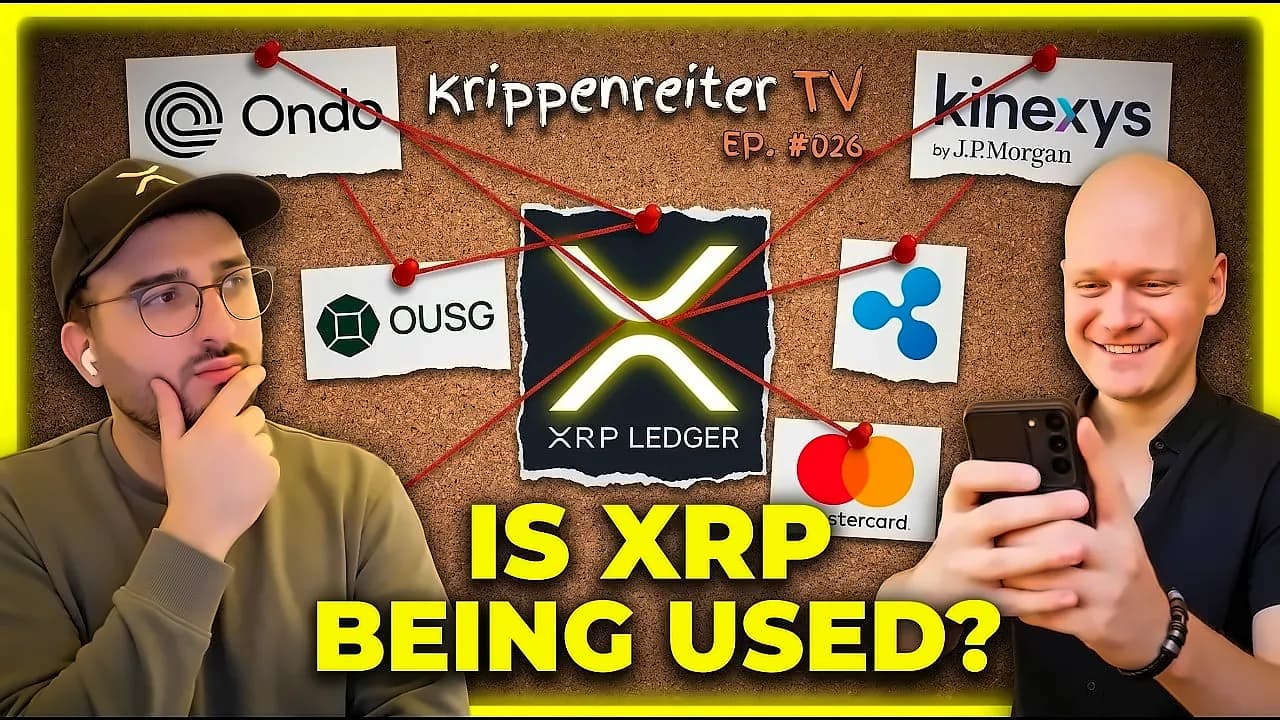
Former SWIFT Chief Innovation Officer Tom Zschach has directly rejected online claims that the global financial messaging network plans to integrate or support XRP. As reported by crypto.news, Zschach responded to posts on X claiming SWIFT would work with established public tokens rather than create its own digital asset, describing the alleged XRP integration as 'not happening' and challenging the basis of online reports. The former SWIFT executive, who previously led the company's digital asset strategy for six years before recently leaving, also asked an AI assistant whether SWIFT currently uses XRP, further questioning the foundation of unofficial integration claims. Zschach has challenged XRP-related claims before, questioning whether banks would use a volatile public token for settlement and criticizing claims that Ripple could replace established financial infrastructure. His two-word rebuttal on X effectively shut down the rumor before it gathered more steam, leaving no interpretive room for misinterpretation.
XRP faces its worst nightmare scenario as SWIFT has launched a new shared ledger platform that directly competes with the XRP token's core use case. The global banking network announced Thursday that its new ledger platform is ready for early use across six continents, allowing major banks including HSBC, UBS, BNP Paribas, BNY, Wells Fargo, and Citi to run live test payments using digital tokens. This development represents a significant threat to XRP's position in the multi-billion dollar market for instant, off-hours transfers, as traditional banking institutions now have the capability to handle fast global transfers using their own regular money. As per SWIFT's chief business officer Thierry Chilosi, the new capability extends 'the trust and stability of established finance into the frontiers of digital money.' The platform is designed to work alongside current payment methods rather than completely replacing them, but it could materially reduce demand for XRP because it eliminates the need for banks to switch to a volatile cryptocurrency for fast settlement.
SWIFT's new blockchain ledger creates a shared space where banking firms can handle digital deposits across different blockchains, acting as digital versions of regular bank money built on internal systems. The system enables banks to move customer funds overnight and on weekends, filling a time gap in traditional finance while maintaining strict security protocols. Currently, 75% of transfers on SWIFT's network already hit their destination within 10 minutes, often arriving in just seconds, and the new platform aims to match the speed of digital currencies while keeping established financial systems intact. This competitive advantage directly targets XRP's core value proposition of helping big financial firms settle global payments fast and at low cost. The platform is owned and run by the banks themselves, meaning giant institutions are building these tools on a system they already control, giving them direct competition against independent stablecoins and tokens like XRP. SWIFT's published work centers on secure messaging, interoperability, and tokenized assets for regulated financial institutions, with recent pilots focusing on tokenized deposits across permissioned networks rather than public blockchains.
Despite the price recovery, institutional positioning has moved in the opposite direction. Data from SoSoValue shows that spot XRP exchange-traded funds recorded $7.29 million in net outflows on July 8, marking the largest single-day withdrawal since March 2026. The outflows indicate that institutional investors have reduced exposure even as XRP attempts to stabilize above the $1 level, with the psychological support level potentially coming back into focus during the next downward movement. Data from Coinglass also suggests that sentiment around XRP remains bearish due to the declining long/short ratio, which has dropped to 0.96, meaning bearish positions now slightly outnumber bullish bets. However, buyers might return because geopolitical tensions are easing after Trump said that Iran wants to make a deal for peace to end the conflict that began in February 2026, which could push XRP price to the 50-day EMA level of $1.17. XRP has recently traded around $1.08 to $1.10, slipping against Bitcoin as fresh institutional catalysts failed to appear, with traders hoping for a SWIFT surprise left waiting.
Price action on XRP's charts remains mixed despite the latest recovery. On the 4-hour chart, XRP is trading below the Supertrend indicator while repeatedly failing to reclaim a descending trendline. The token is struggling near the 78.6% Fibonacci retracement level around $1.094, which has become immediate resistance after the recent selloff. Additional resistance levels sit near the 61.8% and 50% Fibonacci retracement zones at roughly $1.114 and $1.127. However, XRP has closed below the 20-day EMA of $1.11 for three straight days, suggesting that the short-term trend is favoring bears. A failure to recover above this 20-day EMA could push the price down to the psychological support of $1, with potential further decline to the November 2024 low of $0.87. The RSI reading of 43 suggests that momentum is favoring bears, while the Chaikin Money Flow has turned only slightly positive, pointing to limited capital inflows.
Derivatives markets paint a cautious picture with XRP's long-to-short ratio slipping to 0.96, meaning bearish positions now slightly outnumber bullish bets. Open interest has fallen from $2.58 billion on July 5 to $2.33 billion on July 9, suggesting speculative traders have been closing positions instead of opening new ones. The RSI reading of 43 suggests that momentum is favoring bears, while the Chaikin Money Flow has turned only slightly positive, pointing to limited capital inflows. An analyst on X notes that Ripple's partnership with SWIFT might not be bullish for XRP price because SWIFT will not use the XRP token on its blockchain-based ledger, stating that 'the 'bridge currency' and 'liquidity' is tokenized deposits; not a L1 gas token.' The new SWIFT ledger directly competes with the main selling point of crypto networks, which is moving money across borders at any time, potentially reducing real-world demand for XRP and making it harder for the coin's price to grow in the long run. For now, SWIFT and XRP appear to be moving on separate tracks, even if some investors keep hoping those rails eventually cross.