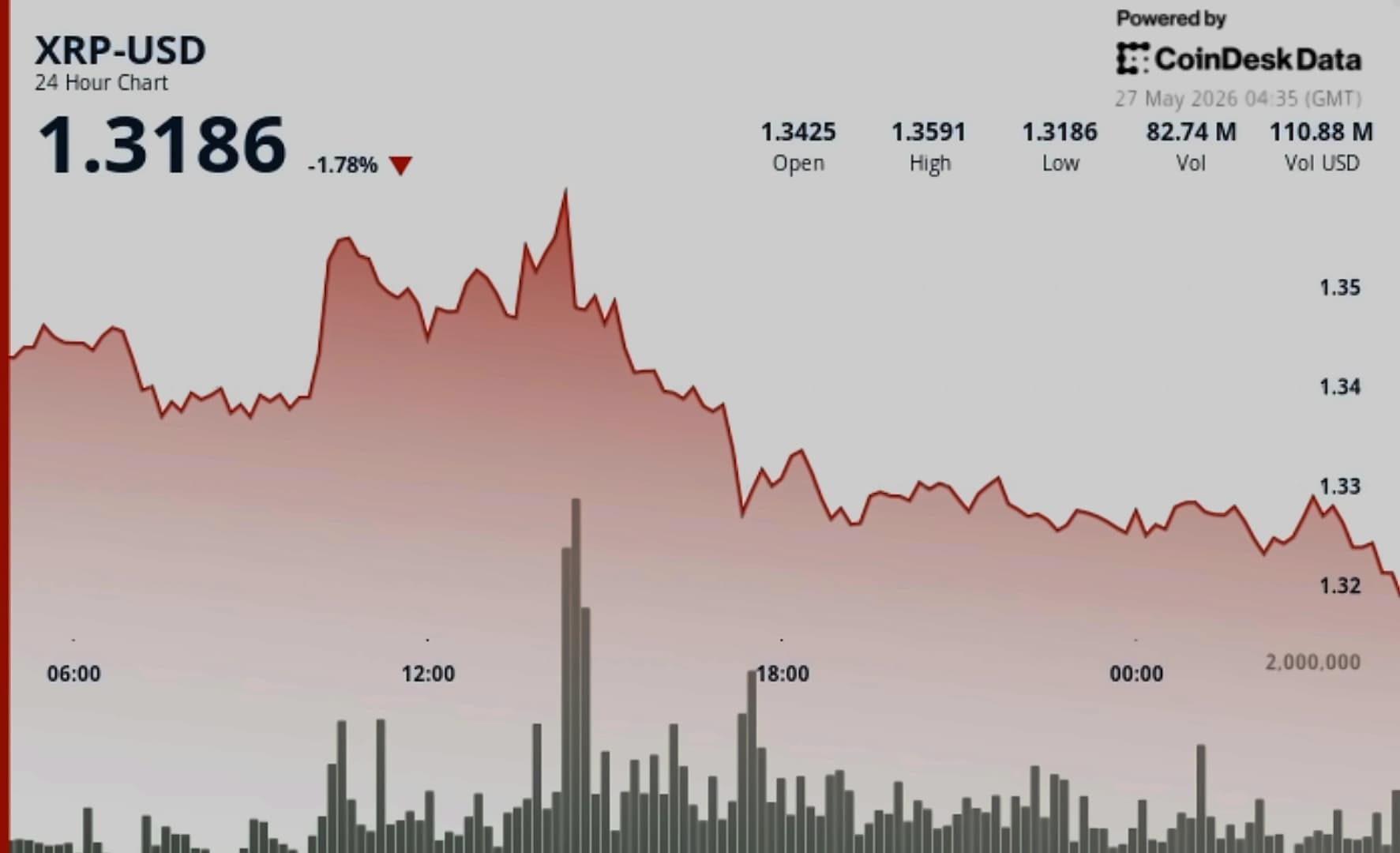
XRP is currently trading at $1.37 in midday Tuesday action, with parallel feeds showing the asset at $1.33-$1.35 on the LiteFinance and Bitget aggregates and $1.42 on the ByDFi reading. The asset sits roughly 26% down year-to-date in 2026, a striking drawdown given that XRP entered the year on the back of an $1.90 close in December 2025 and climbed to $2.34 in January before the broader crypto correction triggered the multi-month consolidation. The chart structure defines clear tactical levels with immediate support at $1.32 (the cluster low that has held through multiple May tests), then $1.30 (round-number), then the structural floor at $1.27-$1.28 (April 2026 low). On the upside, resistance sits at $1.45 (the ceiling of the May consolidation range), then $1.50 (round number), then $1.70 (the cup-and-handle target that ByDFi's pattern-recognition framework has flagged as the proximate upside trigger).
The single most important structural development in XRP's investment thesis over the past 12 months was the launch of spot XRP ETFs in the U.S. market. The first U.S. spot XRP ETF — XRPR — launched on September 18, 2025, and additional XRP ETFs (including XRPI) followed through November 2025. Cumulative net inflows since launch have exceeded $1.44 billion across the spot XRP ETF complex, with Changelly's analysis confirming over $1 billion in net inflows since inception. The structural significance is that XRP is now investable through regulated U.S. brokerage infrastructure for the first time, and the institutional access has translated into a measurable demand pillar that did not exist during the 2017-2021 cycles. Recent flow patterns show "XRP ETFs attract inflows amid wallet surge" while "Bitcoin, ether funds struggle," with the cumulative ETF AUM representing roughly 1.9% of XRP's total market capitalization, meaningfully smaller than the spot Bitcoin ETF complex (6.5% of BTC market cap) but materially larger than most altcoin ETF analogs have achieved.
Sentiment across crypto markets has weakened significantly, with fear-driven positioning rising to the highest levels in roughly three weeks. According to Coinpedia, historically such extreme fear and skepticism have often acted as contrarian signals for XRP. When retail traders become excessively bearish, it usually indicates that a large portion of weak hands may have already exited the market, gradually reducing selling pressure. Previous dips into the "FUD zone" were frequently followed by price stabilization phases or short-term rebounds beyond local resistance. The latest Santiment data reveals XRP traders have turned heavily bearish after the recent rejection from the key resistance zone, with the ratio of positive-to-negative XRP commentary dropping sharply to nearly 1.1 bullish comments for every bearish comment, marking one of the weakest sentiment readings seen in the past three weeks.
The asset is trading below all four key exponential moving averages — 20-day, 50-day, 100-day, and 200-day — which is a structurally bearish signature, but the alignment also creates conditions for a sharp short-cover rally if a single catalyst breaks the trend. RSI at 43 reads neutral-bearish but not deeply oversold, leaving room for a further leg lower if support breaks. The May 2026 range is constrained to $1.32-$1.45 unless broader crypto sentiment improves significantly. The asset rejected the 50-day EMA on the last attempt to break out, and the failure has reinforced the tight consolidation pattern. A clean reclaim of the 50-day EMA (currently in the $1.45-$1.50 zone) would be the first credible breakout signal. If XRP decisively breaks and sustains above the heavy supply zone near $1.50, it could trigger a stronger rally toward $1.62 and potentially $1.80 by the end of the month. The longer the range tightens, the higher the odds of a sharper volatility expansion once price finally breaks out of consolidation.
On-chain and derivatives data reveal a bifurcated story similar to Bitcoin and Ethereum, with whales accumulating while retail and short-term flow remains cautious. XRP whales accumulated 71 million tokens last week alone, even as the broader crypto market dropped more than 5% — the kind of pattern that historically marks accumulation lows. Ledger activity surged sharply, with daily transaction counts and new wallet creation both moving higher even as price action chopped sideways. Options positioning carries an interesting signal: a crypto whale made a $224,000 bet that XRP's price stays perfectly flat through June, collecting approximately $224,500 in premiums on the bet that XRP remains close to $1.40 through expiry. The trade structure reflects the whale's read that the asset is genuinely range-bound and that the implied-volatility surface is too rich for the realized range, capturing the next 30-60 days. The broader options-positioning signal is that institutional and quasi-institutional traders are positioning for continued consolidation rather than directional resolution, which limits the speculation premium that could otherwise drive XRP higher on a clean catalyst.