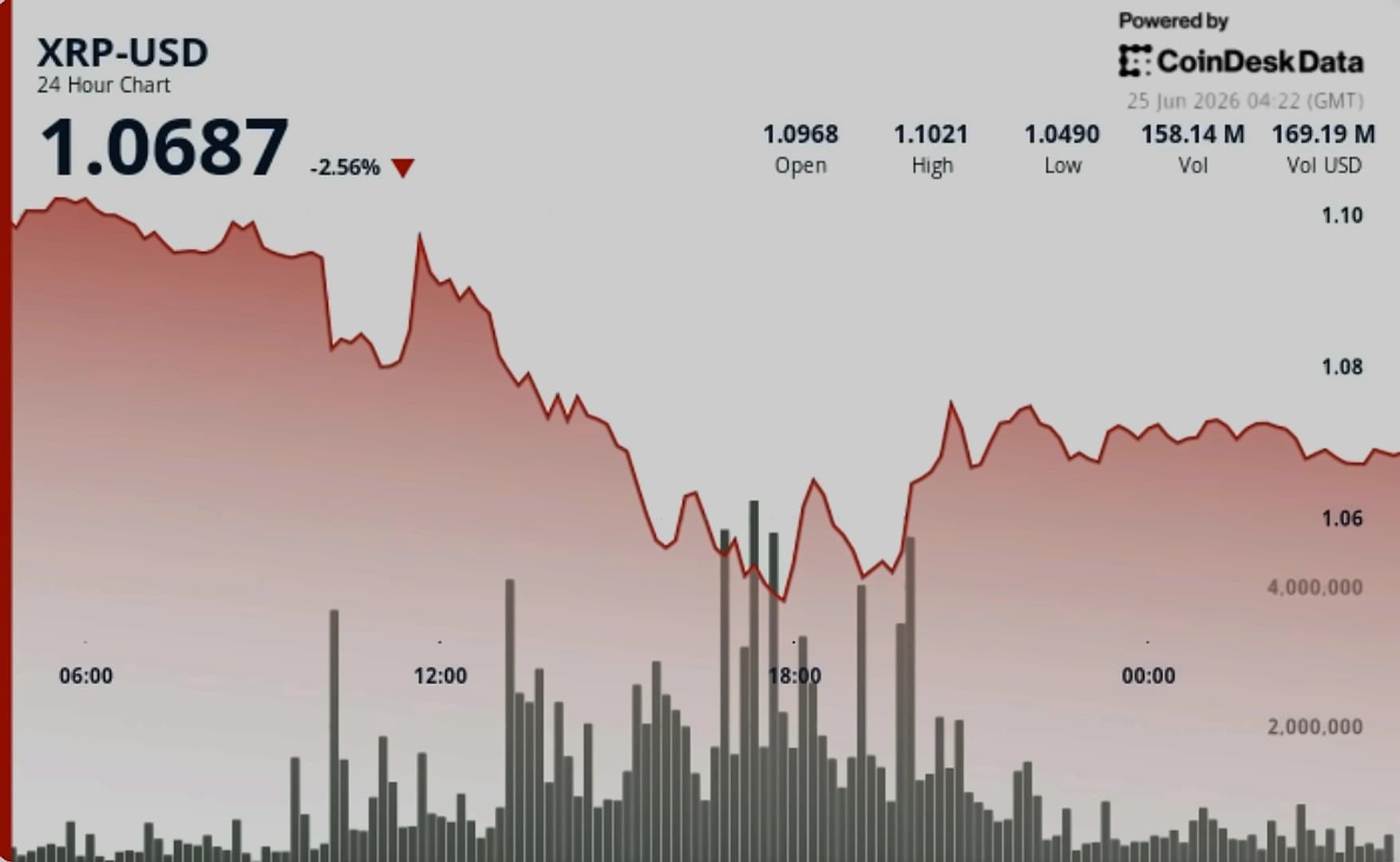
XRP has entered a historically oversold zone near $1.03, well below its 200-day Moving Average, confirming that buyers have not yet regained control of the broader trend despite recent deleveraging efforts. The token has fallen to a 20-month low near $1.02, down more than 70% from its $3.66 July 2025 high, marking a significant breakdown from the $1.04 support level that had previously acted as a key line of defense. According to latest data, XRP is now trading around $1.03, down roughly 40% year-to-date, with the token having spent the better part of a year grinding steadily lower in a clean series of lower highs and lower lows. The token has now broken down from a symmetrical triangle pattern, with the weekly RSI hitting oversold territory near 28 - levels last seen in 2022. The breakdown has left XRP trading near $1.03 with the 14-day RSI sitting around 33, leaving momentum close to oversold territory but without any confirmed bullish divergence. The $1.02 level, which previously absorbed multiple corrections and served as reliable cushion, has now cracked under pressure and flipped from defensive support into fresh overhead resistance, with technical analysts describing the chart as an asset still searching for a bottom rather than building toward a breakout. The latest decline was triggered by nearly $3 million in long liquidations at its peak, with Binance leading at $4.5 million in forced selling, highlighting the concentration of leverage within one exchange.
The derivatives reset has reduced speculative pressure significantly, with Open Interest dropping from approximately $1.18 billion to approximately $1.04 billion, while Funding Rates have turned sharply negative, reflecting strong bearish conviction about XRP's future price action. As forced selling intensified, derivatives traders rapidly reduced exposure instead of adding fresh positions, with the synchronized decline suggesting speculative excess has largely been flushed from the market. Such resets typically take pressure off the downside because they eliminate weakly positioned leveraged sellers. However, the stable Binance reserves show that spot holders are still unwilling to sell aggressively, indicating that while leverage-driven selling pressure is being removed, stronger spot demand remains essential for a sustained recovery. The current setup keeps the bearish bias firmly intact, with XRP having slipped out of its high-volume value area and the broader weekly structure continuing to tilt against any short-term bullish recovery attempts. If Open Interest begins to rebuild along with the improving funding rate, then XRP may begin to trend upward towards a healthier recovery, otherwise bearish momentum will likely continue.
XRP ETF demand is tightening available XRP supply despite the market weakness, with the net inflow reaching 4.82 million XRP during week 26, driving total ETF holdings up by almost 10% to 938.73 million XRP. This represents approximately 1% of the currently circulating XRP, with each new ETF creation requiring the purchase of additional Spot XRP. The total ETF holdings now account for approximately 1% of the currently circulating XRP, creating a gradual reduction in available XRP on the open market that can help limit selling pressure. However, despite the fact that institutional buyers are accumulating significant amounts of XRP via the ETFs, no corresponding increase in participation from the broader spot market has been seen. As such, prices have continued to be pressured downward, with valuations declining from over $1 billion at one time down to $989 million at present. This suggests that institutional buying power has increased more than the valuation of XRP, though the absence of spot market participation limits immediate price recovery potential. The Sharpe Z-Score has dropped deeper into negative territory, mirroring extreme readings before the November 2024 breakout and July 2025 rally, suggesting that downside momentum may be becoming exhausted rather than accelerating further.
The single most important catalyst hanging over XRP is the CLARITY Act, a crypto market-structure bill that would codify the classification of tokens like XRP as commodities under the commodities regulator, providing the legal certainty that has long been the gatekeeper for institutional capital. For XRP specifically, formal codification of commodity status would remove the last major source of regulatory uncertainty and open the floodgates for institutional allocation. One prominent bank has projected that passage and the resulting clarity could drive several billion dollars of additional inflows into XRP exchange-traded funds, a demand shock that would dwarf current flows. However, the passage is truly uncertain with the bill facing a contested floor vote, a tight legislative calendar, and disputes that have nothing to do with XRP, and prediction markets have priced its chances at roughly a coin flip. This makes the CLARITY Act a wild card in the truest sense: if it passes, XRP gains a powerful fundamental catalyst that could combine with the existing accumulation to drive a significant move higher, while if it fails or stalls, a key pillar of the bullish case is removed, the accumulation looks more like a trap, and the downward pressure on the price intensifies. The outcome is close to even, making it the largest two-sided risk in XRP's outlook.
The bear case for XRP points concretely toward the $0.70 level as a real possibility in the bear scenario, with several fundamental forces reinforcing the bearish technical picture. If XRP loses the $1 level, the chart shows little meaningful support until $0.85 and then $0.70, so a breakdown could move quickly through those levels, especially in a weak overall market. Several fundamental forces reinforce the bearish technical picture: XRP's high correlation with Bitcoin means that if Bitcoin continues lower toward or below $50,000, XRP would likely be dragged down regardless of its own developments. Ripple's growing emphasis on its dollar stablecoin, which increasingly handles the cross-border settlement role XRP was meant to play, raises a structural question about the token's core demand source, with the stablecoin arguably cannibalizing XRP's primary use case. The large amount of XRP held in escrow and released on a schedule adds a persistent overhang of new supply, while competition from other networks for the cross-border and tokenization business continues to pressure XRP's long-term thesis. If the CLARITY Act fails, the regulatory catalyst the bulls are counting on evaporates, making the bear case coherent and serious despite the current institutional accumulation. However, XRP remains near $1.03, well below its 200-day Moving Average, suggesting that downside momentum may be becoming exhausted rather than accelerating further, with the token potentially consolidating until stronger buying confirms the historical signal.