A Fireblocks-labeled custody wallet transferred 30 million USD1 to Binance during a 15-hour period, according to an August 31 report from blockchain tracker Onchain Lens. The tokens had a nominal value of $30 million because USD1 is designed to track the U.S. dollar. This transfer extends a series of large Solana-based stablecoin deposits from the same address, though the commercial purpose remains unknown as neither Fireblocks, Binance nor USD1 developer World Liberty Financial has publicly identified the beneficial owner or explained the transfers. The sending address is identified as 9Rycov3U4efJf5HiqZYGjN7qJJHEtMsj4vbmkG4xfCxk, with activity visible through the Solscan account page.
World Liberty Financial (WLFI) has announced that USD1, its U.S. dollar stablecoin issued by BitGo Bank & Trust, National Association, is now available on Canton Network, the only privacy-enabled public blockchain purpose-built for regulated financial markets. According to the latest announcement, USD1 is now natively issued on Canton and can be configured as a settlement option for institutions bringing tokenized real-world assets onto the platform. This development provides a fully reserved stablecoin for the cash leg of onchain transactions, offering instant cross-border payments with 24/7 settlement, onchain asset issuance, funding and redemption, and financing across institutions and markets. Zak Folkman, Co-Founder and Chief Operating Officer of World Liberty Financial, emphasized that "Tokenization has moved faster than the money behind it. Institutions have put trillions in U.S. Treasurys and government debt onchain, but the dollar leg of settlements still runs on outdated infrastructure, creating a gap where the cost and the risk sit."
The Office of the Comptroller of the Currency (OCC) cleared World Liberty Trust Company to issue and redeem USD1 on August 14th, but the ownership structure has raised significant concerns among lawmakers. According to the Wall Street Journal, an entity tied to Sheikh Tahnoon bin Zayed al Nahyan holds 49% of the bank, while a Trump family entity holds 38%. The OCC collected passivity commitments from three entities - DT Marks SC LLC signed by Eric F. Trump, StringZ Holding RSC signed by Hamad Khlfan Ali Matar Alshamsi (a former director of Tahnoon's artificial intelligence firm G42), and AMGUS LLC signed by co-founder Zachary Folkman. Each entity promised no board seats, no influence over dividends, pricing, personnel, or operations, with any voting stake above 9.9% to be handed to management by proxy. Senator Elizabeth Warren has pressed Comptroller Jonathan Gould to delay the charter review until the president divests, stating that "any financial connection between Sheikh Tahnoon bin Zayed Al Nahyan and an applicant for a national bank charter, especially one owned by the President, should be immediately disqualifying given the national security concerns."
On Canton, USD1 is available to support collateralization for derivatives and institutional lending, with more than $9 trillion in tokenized assets issued or processed on Canton every month. The platform handles over $350 billion in onchain U.S. Treasurys moving across the network daily. As reported by AMBCrypto, WLFI received a conditional trust charter license last week from the OCC, joining other major players such as Ripple and Circle. This approval allows the firm to custody its own reserves linked to issued stablecoins, which Witkoff stated would help WLFI "institutionalize its business." USD1 is 100% backed by a reserve containing short-term U.S. Treasurys, U.S. government money market funds, U.S. dollar deposits, and other cash equivalents. Eric Saraniecki, Co-Founder and Head of Network Strategy at Digital Asset, noted that "Deep, efficient markets need choice on both sides of a transaction. As more stablecoins become natively available on Canton, institutions gain greater flexibility in how they fund, settle, and move liquidity across applications and markets."
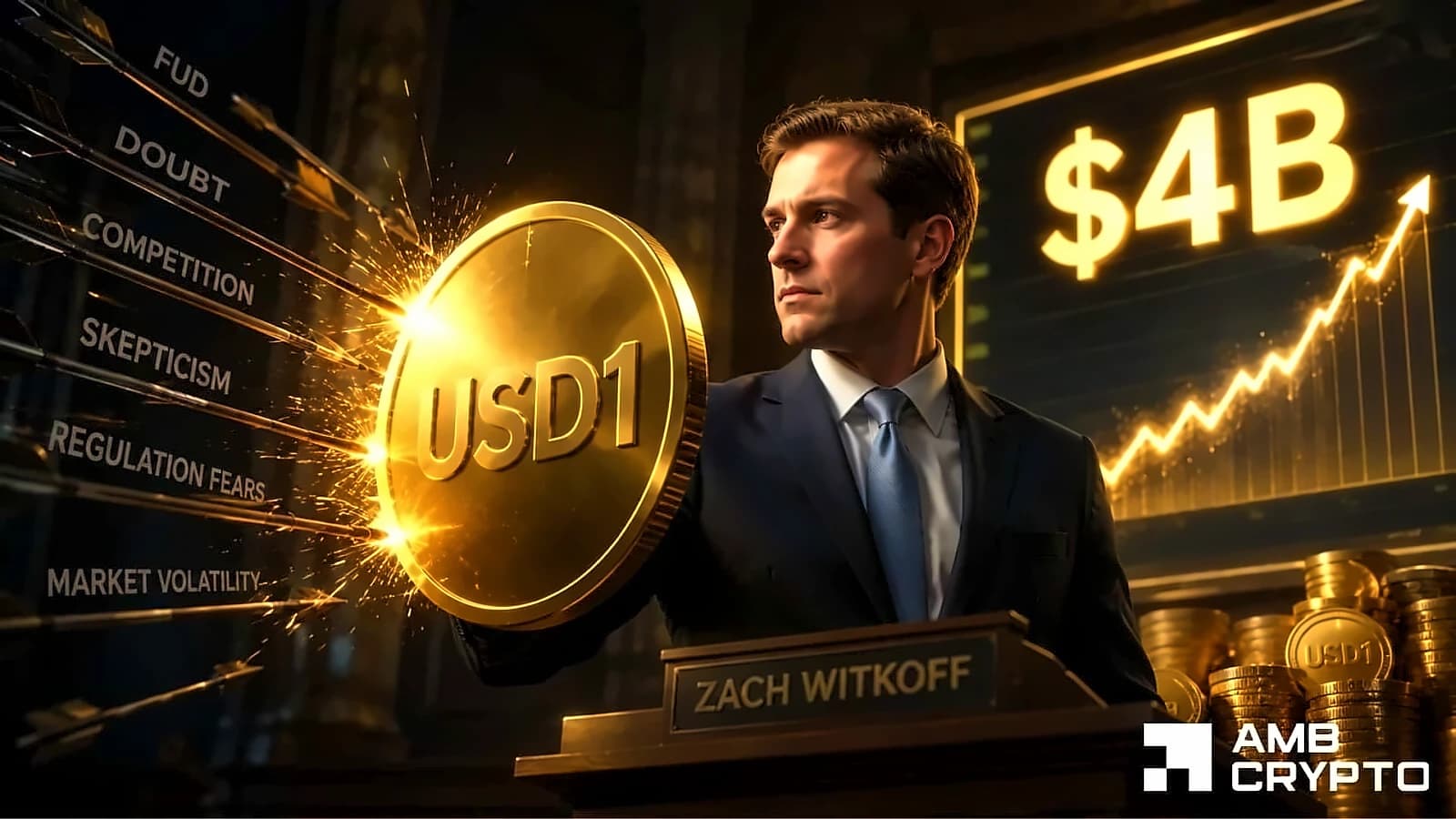
The Canton integration addresses a critical gap in real-world asset (RWA) tokenization where slow settlement cycles tie up capital and force institutions to hold liquidity buffers against timing they can't control. USD1 provides a dollar-equivalent leg that settles atomically alongside the asset, with the same Canton privacy and compliance controls these assets require. Zak Folkman explained that "Canton and native USD1 together allow real-world assets to access a dollar that settles alongside them with speed and privacy." USD1 has surpassed $4 billion in circulation since launching in March 2025, significantly outperforming the stablecoin sector in 2026. Despite growing scrutiny of Trump's crypto empire by Democrats, USD1 has significantly outperformed the stablecoin sector with market supply growing by +20% year-to-date and reaching $4 billion, while Tether's USDT, the largest stablecoin, slipped 2% to $183 billion. USD1 is issued by BitGo Bank & Trust, National Association, a federally regulated trust authorized by the Office of the Comptroller of the Currency, which manages the reserve assets backing the stablecoin and processes all mints and redemptions.