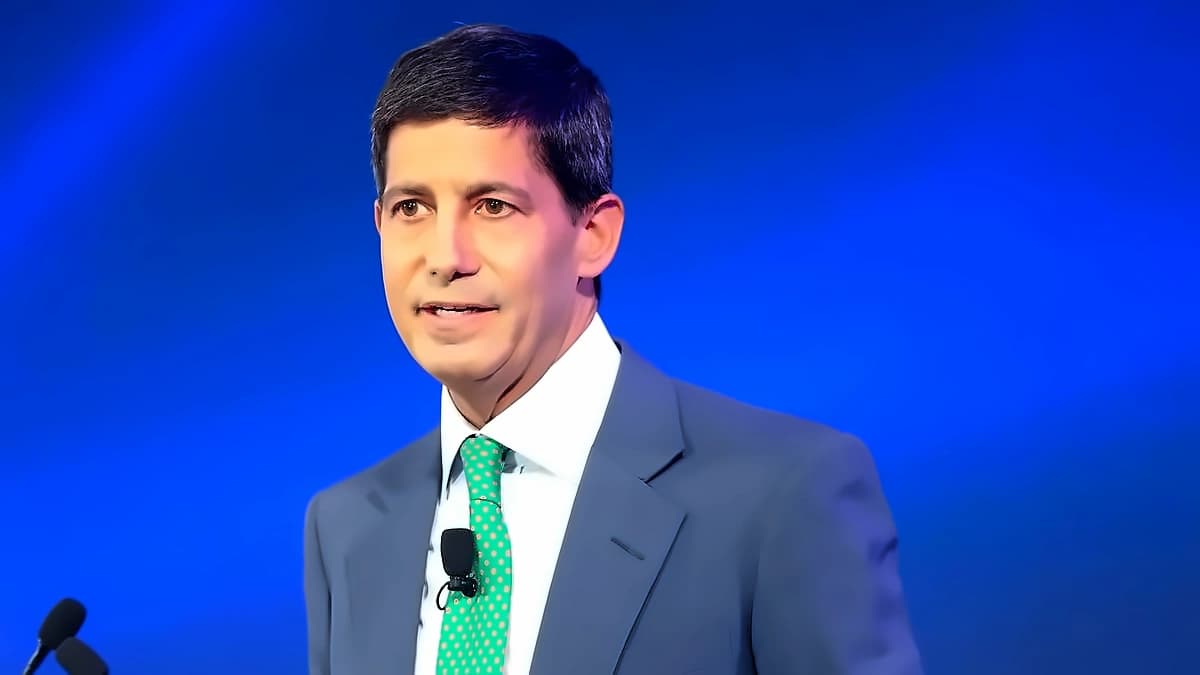
Federal Reserve Chair Kevin Warsh delivered his most definitive statement yet against forward guidance at the ECB Forum on Central Banking in Sintra, Portugal, formally burying one of the Fed's most relied-upon tools of the last 25 years. When the moderator repeatedly pressed for guidance on how the Fed may adjust monetary policy, Warsh was unequivocal: "You're back to forward guidance. I'm going to disabuse you of trying to extract that. No forward guidance, no forward guidance." This represents a fundamental shift from the Fed's previous approach, with Warsh indicating that the Fed would let the financial markets dictate Fed policy, so essentially, if Treasury yields decline, the Fed would follow and cut key interest rates. The more significant development was Warsh's acknowledgment that the Fed would let the financial markets dictate Fed policy, so essentially, if Treasury yields decline, the Fed would follow and cut key interest rates. This represents an acknowledgment that bond vigilantes (large institutional investors) remain in charge of influencing Treasury yields and central bank policy. Interestingly, ECB President Christine Lagarde, Bank of England Governor Andrew Bailey, and Bank of Canada Governor Tiff Macklem all expressed similar reservations about continuing with forward guidance, with Lagarde stating that her "one regret" was feeling "bound and compelled" by forward guidance in the past.
Gold snapped back to around $4,090 per ounce after Federal Reserve Chairman Kevin Warsh told attendees at the ECB Forum in Sintra, Portugal that inflation risks had "come down in recent weeks." This represents a sharp reversal from the selling pressure that had built up on expectations of aggressive rate hikes under the Fed's new leadership. The roughly 2% rebound marks a sharp reversal from the pressure gold had faced following the Fed's June meeting. The rally reflects the market's active search for confirmation that the current rate cycle has peaked, with rates parked at 3.50-3.75% and inflation expectations trending lower. U.S. gold futures for August delivery settled 1.1% higher at $4,082.4, while the yellow metal had hit its lowest level since November in the previous session. According to Reuters, spot gold rose 1.6% after the ADP national employment report showed private employment rose by 98,000 jobs last month, below economists' forecast of 118,000.
The latest employment data revealed only 57,000 payroll jobs were created in June, which was far below economists' consensus estimate of 115,000. A large drop in leisure and hospitality of 61,000 (largest monthly decline since 2020) was largely responsible for the lower-than-expected June payroll report, with the Labor Department noting the drop reflected "weaker than usual seasonal hiring." However, manufacturing and construction employment both increased, which is indicative of the AI data center building boom. Average hourly earnings rose by 13 cents or 0.3% to $37.64 per hour and have risen 3.5% in the past year. Fully 14 of the 17 manufacturing industries that ISM surveyed reported an expansion, with the Institute of Supply Management (ISM) manufacturing index slipping to 53.3 in June, down from 54 in May. The new orders component remained strong at 56 in June, down from 56.8 in May, while the price component plunged to 73 in June, down from 82.1 in May. This was the largest monthly drop in the price component in almost four years (since July 2022) and is signaling that commodity inflation is cooling off.
Bitcoin reclaimed prices above $60,000 following Warsh's comments at the ECB Forum, recovering from declines that had been directly tied to tighter monetary policy signals. When Warsh's hawkish statements during the June 17 FOMC meeting spooked investors, Bitcoin dropped into the $64,000 range. The cryptocurrency market has responded positively to these developments, with bitcoin pushing above $61,000 and gold stabilizing above $4,050 after dipping to $3,942 earlier this week. These budding recovery rallies could accelerate significantly if upcoming U.S. jobs data shows clear labor-market weakness, which would validate Warsh's view and reduce the case for aggressive Fed rate increases.
Looking ahead, traders are currently pricing in about a 65% chance of an interest rate hike for September, according to the CME FedWatch Tool, though the recent dovish sentiment suggests this could shift. Warsh's decision to reduce forward guidance gives the Fed more flexibility to respond to incoming data without being locked into a predetermined path, but it also means markets will have less visibility into future policy moves. The FOMC minutes from the Fed's June 17 meeting will be released on Wednesday, which will give investors their first detailed look at how hawkish the internal debate actually was. Warsh stressed his inflation commitment plainly: "We're going to deliver price stability in the US." Beyond his stern messaging against forward guidance, his discussion on productivity was interesting, with Warsh noting that AI-driven productivity gains over the past four quarters give him reason for optimism. The takeaway from his first speech is clear: Warsh will not telegraph his next move, with investors who relied on speeches, Fed dot plots, and the FOMC press conference for signals on how to position ahead of rate decisions operating in a new regime where the markets will help lead the Fed, not the other way around.