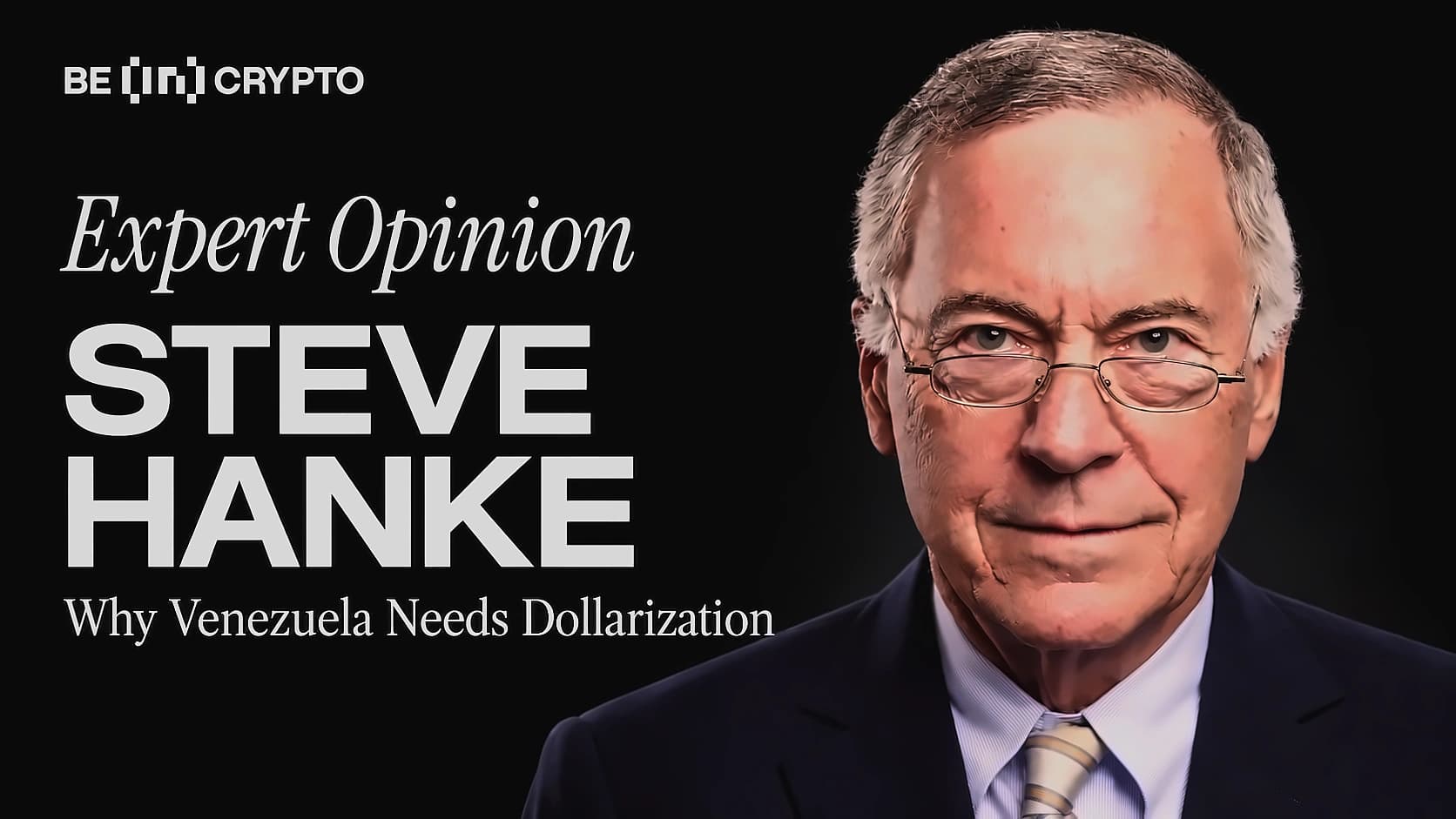
Venezuela is moving closer to formal dollarization as economist Steve Hanke drafts a comprehensive bill to abolish the bolivar. According to reports, the National Assembly appointed him as a special adviser this month to work on the project alongside Assembly member Antonio Ecarri, founder of the centrist 'Lápiz' party. This marks Hanke's second attempt at currency reform in Venezuela, following his unsuccessful 1995-1996 currency board proposal under President Rafael Caldera. The economist estimates 50% to 80% odds of passage for the current legislation.
Hanke argues that conditions have changed significantly since his previous attempt, citing surveys showing most Venezuelans want to abandon the bolivar. Inflation currently runs near 400% annually, making Venezuela the world's most inflation-affected economy. The economist told Fortune that 'Venezuela would be the most competitive economy in the world' under his plan, noting that the bolivar has lost 78% of its value to the U.S. dollar in the past year. Despite inflation easing from the 700% rate recorded before Maduro's capture, it remains six times higher than Iran's, translating into an 8% weekly increase in prices of essential goods.
Oil production sits at the center of Venezuela's economic diagnosis, with the country producing just 1.1 million barrels per day, roughly 1.3% of global output and only one-third of the 3.4 million barrels it pumped before Hugo Chávez took power in 1998. Venezuela's external debt stands at near $250 billion, roughly 150% of GDP, the fourth-highest ratio globally. Hanke argues that dollarization and rising oil production work together, as current instability makes it difficult to renegotiate debt with creditors including Russia, China, ConocoPhillips, and ExxonMobil. ExxonMobil CEO Darren Woods has called Venezuela uninvestable, citing the country's history of expropriations.
USDT adoption is growing significantly across multiple Latin American markets, with Tether CEO Paolo Ardoino confirming that the stablecoin is increasingly used for savings, payments and trade in Venezuela, Argentina, Bolivia and Turkey. According to Chainalysis, Venezuela ranked 18th globally for crypto adoption in 2025, with Argentina at 20th and Turkey at 14th. When adjusted for population, Venezuela ranked ninth worldwide for crypto adoption. Chainalysis measured nearly $1.5 trillion in Latin American crypto activity between July 2022 and June 2025, with Argentina accounting for $93.9 billion, Venezuela $44.6 billion, and Bolivia $14.8 billion. Tether reports that its products served more than 570 million people by March 2026, with USDT supply reaching a record $188 billion during 2026.

In Venezuela, local businesses reportedly use USDT for retail payments and some import and export settlements, operating alongside bolivars, physical dollars and other digital assets within what local observers describe as a hybrid currency economy. Bolivia provides a clearer official signal, with the Central Bank of Bolivia publishing a reference USDT exchange rate based on weighted peer-to-peer activity on Binance. The bank's January financial stability report identified foreign currency restrictions, higher inflation and low international reserves as continuing risks. Bolivia has moved toward recognizing USDT within its national payment system, with local banks providing some USDT services and businesses using crypto for international payments and fuel-related transactions. However, the government has not completed a national framework making USDT equivalent to legal tender.