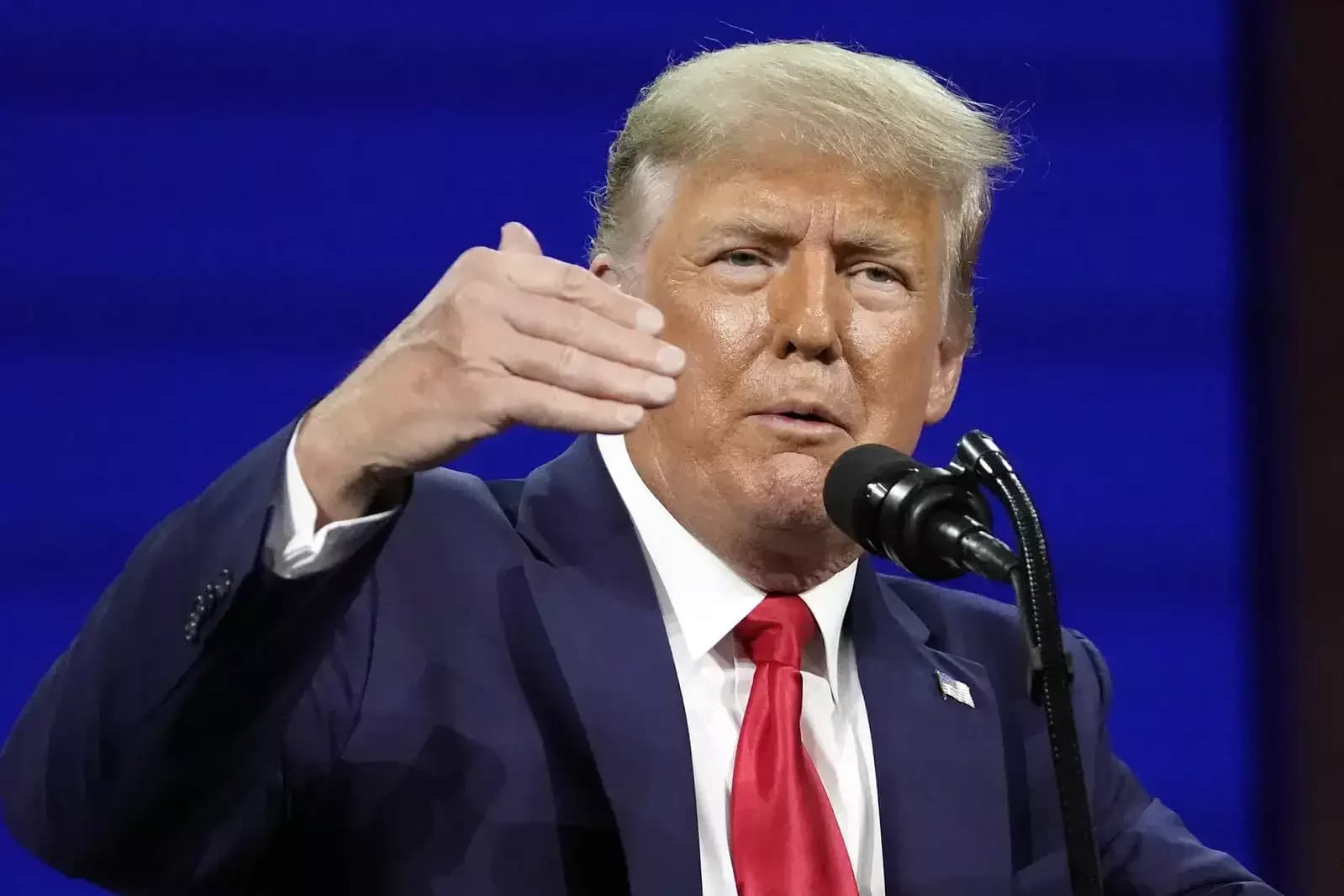
U.S. President Donald Trump has sided with the Commodity Futures Trading Commission (CFTC) in an ongoing legal battle with states over the multi-billion-dollar prediction markets sector. According to reports from Cointelegraph, Decrypt, and the Unchained Daily newsletter, Trump posted on Truth Social on Tuesday stating, 'It's critically important that the CFTC's exclusive authority over prediction markets is maintained and that they thrive. It's a major industry, and we must protect it.' The president's backing for the CFTC and its chair, Mike Selig, could boost the federal regulator's push for authority over the sector. Trump also took aim at several state officials whose states have launched legal action against prediction markets, including Chris Christie, Letitia James, Tim Walz, and JB Pritzker, writing 'Under my leadership, we are setting 'rules of the road' that are the Gold Standard for the States. We cannot have SCUM like Chris Christie, Letitia James, Tim Walz, and JB Pritzker setting the rules!'

Trump backed the sector as 'financial markets' rather than 'gambling' platforms, as critics portray them. As reported by Cointelegraph, this framing aligns with supporters like venture firm a16z, who view prediction markets as crucial risk management tools for hedging against future events. However, ongoing states' push for control over the sector can fragment liquidity and make prediction markets less accurate as forecasting tools. The trading volumes on major platforms Polymarket and Kalshi are dominated by sports and elections markets, which critics argue makes them '100% gambling platforms.' The sector has grown quickly over the past two years and is projected to reach $1 trillion in market volume by 2030, allowing users to wager on outcomes across crypto, traditional markets, sports, weather, politics, and culture.
Several states have moved against prediction markets, with Minnesota recently passing a law that bans prediction markets with criminal charges for operators. According to Cointelegraph, Arizona, Connecticut, Illinois, New York, and Wisconsin have also moved to ban or regulate these markets. Multiple state authorities have argued that prediction markets are violating state laws by offering gambling without a license, and have sued or issued cease-and-desist orders to multiple platforms. Prediction markets including Kalshi have sued various state authorities to fend off legal action, claiming it is regulated solely by the CFTC. The CFTC has filed suits or amicus briefs against six states: Arizona, Connecticut, Illinois, New York, Wisconsin, and Minnesota, with the agency's legal position that prediction market contracts offered by designated contract markets (DCMs) registered with the CFTC fall under exclusive federal jurisdiction. State officials have sought to apply gambling laws to prediction market contracts, including through cases against Kalshi in Arizona and Nevada. The Trump administration has responded with lawsuits asserting that state attempts to ban prediction markets illegally interfere with federal authority.
The Trump family maintains significant involvement in the prediction markets sector, creating potential conflicts of interest. As reported by Cointelegraph, Donald Trump Jr. is an investor and part of the advisory board at Polymarket, and he serves as a strategic advisor to Kalshi. Additionally, Trump's Truth Social has launched its prediction platform, TruthPredict, in partnership with Crypto.com. Despite this family connection, Trump has criticized Chris Christie, an advisor to the American gambling industry lobby opposing prediction markets, and called out governors and judges pushing back against prediction markets as 'scums.' However, a New York Times investigation published over the weekend reported that career CFTC officials who raised concerns about Polymarket, Crypto.com, and other firms with business ties to the Trump family were pushed out of the agency. After that report, Senator Richard Blumenthal (D-CT) wrote on X that the agency has become 'a craven tool of prediction markets and shady crypto firms, ignoring national security risks while bullying state regulators and retaliating against staff attempting to enforce the law.'
The CFTC has established an advisory team to oversee the listing and trading of event contracts and ensures market participants satisfy anti-manipulation, surveillance and market integrity requirements. According to Cointelegraph and Decrypt, federal regulators treat prediction markets as event contracts overseen by the CFTC, placing them under derivatives rules rather than gambling laws set by individual states. The agency claimed that prediction markets fall within the CFTC's existing derivatives framework under the Commodity Exchange Act. Trump emphasized the international competition, stating 'Where we are currently the Crypto (Bitcoin, etc.) Capital of the World, other Countries are trying diligently to replace us in that capacity, but we won't let that happen.' Last month, Trump told reporters he was 'not happy' with prediction markets and was 'never much in favor' of them, responding to questions about well-timed bets on platforms linked to the Iran war that drew Democratic criticism. However, Trump later softened his stance and said the United States would risk being 'left out in the cold' if it failed to support the industry, arguing that prediction markets are a major emerging industry that could play an important role in the future of finance. Trump's statements on Wednesday tied the dispute to the CFTC's current rulemaking work, praising Chairman Mike Selig as 'doing a great job.' Selig has called for a framework that would bring exchanges onshore, warning that failure to create clear U.S. rules could push activity overseas and lead to FTX-style 'implosions,' adding that exchanges should register in the U.S. under rules for fair markets, investor and customer protections, and guardrails.