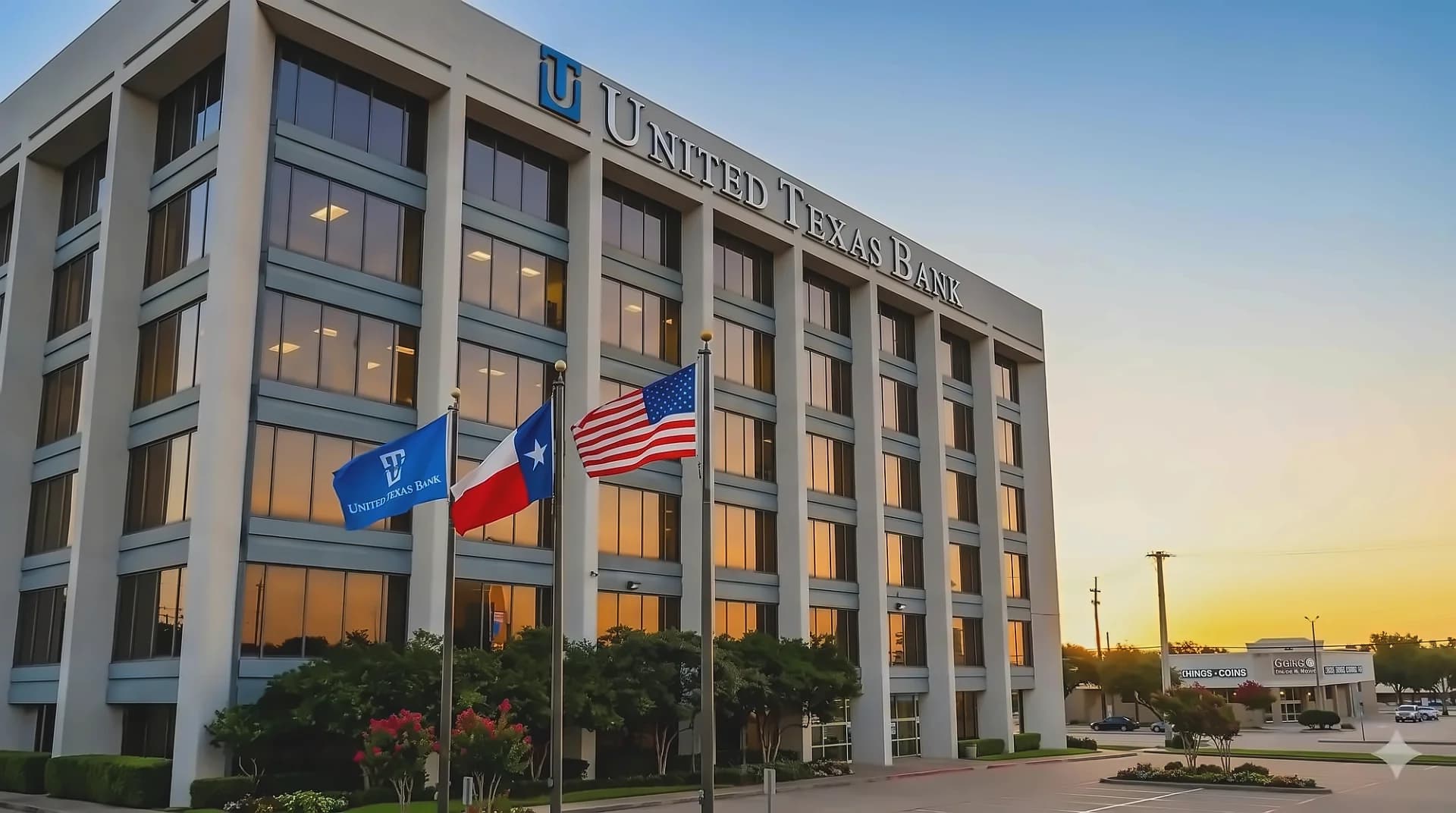
United Texas Bank has successfully completed a significant regulatory transformation, converting from a Texas state charter to a nationally chartered bank approved by the Office of the Comptroller of the Currency (OCC) on May 27, 2025. According to reports from CoinDesk, this conversion makes UTB one of the first banks in the U.S. to successfully complete an OCC conversion since the passage of the Dodd-Frank Act 15 years ago. The conversion was granted with two conditions that were satisfied as of May 27, 2025, following a Consent Order with the Federal Reserve since 2024 related to Bank Secrecy Act and compliance infrastructure.
The strategic conversion positions United Texas Bank on par with money-center giants like Bank of America and JPMorgan Chase, granting it identical federal licensure, full trust powers and direct access to the Federal Reserve's wire and ACH systems. As reported by CoinDesk, the bank retains FDIC insurance while achieving the same regulatory status as major financial institutions. UTB President and CEO Scott Beck emphasized that this conversion uniquely positions the bank as a bridge between crypto firms worldwide into the U.S. banking system, providing access that very few banks are willing to offer. The move is designed to position the 40-year-old bank as a bridge between cryptocurrency firms and traditional financial institutions, at a time when larger Wall Street lenders are still moving cautiously into the sector.
United Texas Bank has been providing services to reputable crypto firms for about five years, handling over $120 billion in transactions yearly for them. According to reports from CoinDesk, the bank currently clears approximately $10 billion a month in U.S. dollar volume for foreign banks, over-the-counter (OTC) desks and major exchanges. The bank's chair noted that crypto startups cannot obtain accounts at traditional institutions like Bank of America or Citibank, making UTB a critical access point for digital asset companies seeking U.S. dollar access. Since 2024, UTB has operated under a Federal Reserve consent order tied to Bank Secrecy Act and compliance infrastructure, responding by building its proprietary BSA and anti-money laundering platform, UTB Prism Sentinel, which Beck described as central to the bank's compliance framework.
To capitalize on its federal upgrade, United Texas Bank is launching UTB Atomic, an artificial intelligence-driven, real-time payment network designed to restore round-the-clock crypto liquidity infrastructure. As reported by CoinDesk, this 24/7 crypto market solution enables instant, off-balance-sheet clearing between institutional clients while a parallel AI network, UTB Prism Sentinel, conducts real-time blockchain surveillance to neutralize compliance risks. The system is purpose-built to navigate upcoming regulatory thresholds like the federal stablecoin frameworks under the GENIUS Act and Clarity Act. The expansion comes as more regional and state-chartered institutions seek a larger role in crypto finance, including in Minnesota, where new legislation recently allows local banks and credit unions to offer crypto custody services.
United Texas Bank is developing a comprehensive digital asset custody and full-service trust department scheduled to launch this summer. According to reports from CoinDesk, this expansion aims to bridge traditional finance and crypto, positioning the bank as the native financial plumbing for the next era of global commerce. The bank's strategic positioning allows it to bypass the regulatory restrictions that have historically limited crypto startups, providing full access to the Federal Reserve for wires and ACH while maintaining its role as a primary bridge between the cryptocurrency industry and traditional financial institutions. The rollout, alongside product expansion and acquisitions, underscores a broader push by regulated U.S. banking players to integrate digital-asset rails while navigating technical and market constraints.