Earlier this week, Tether USDT stablecoin held a higher market cap than Ethereum for the first time in eight years. According to reports from multiple trackers, both assets were placed in the $183-188 billion range during the crossover window, with one snapshot showing USDT at $187 billion against ETH at $186 billion, representing a spread of under $1 billion. The flip lasted for hours before ETH reclaimed second place once prices stabilized, demonstrating the volatile nature of cryptocurrency rankings. Recent market data shows USDT's current market cap at $166 billion, reflecting the continued strength of this stablecoin.
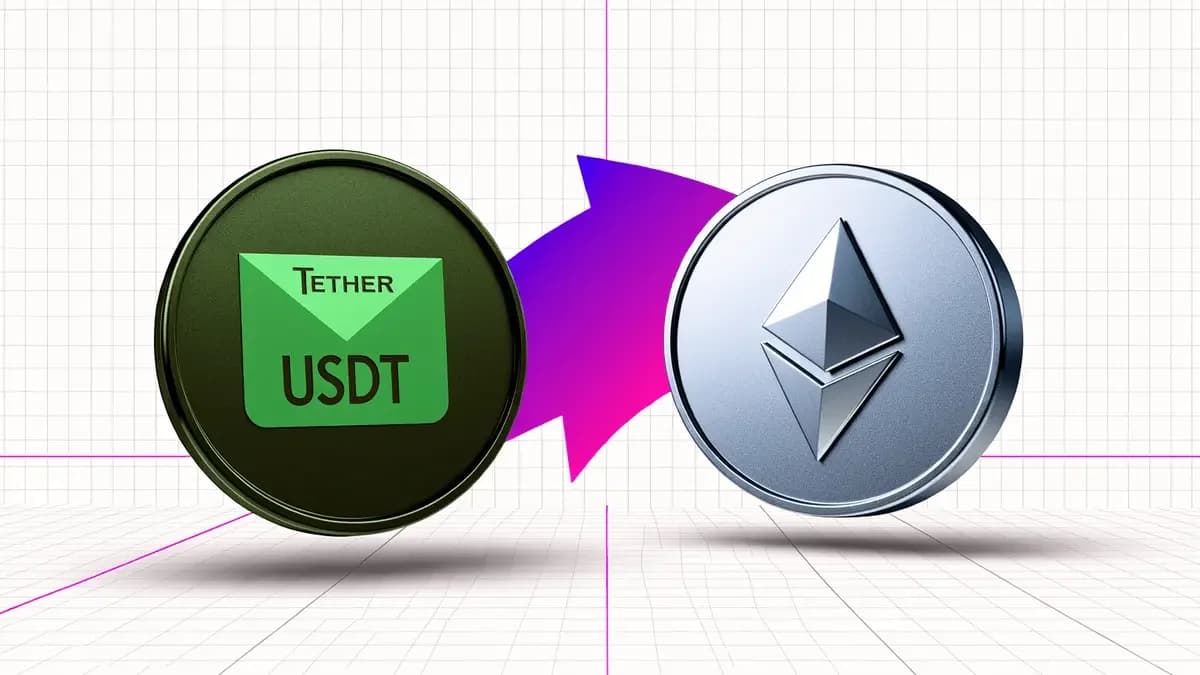
Tether's Q4 2025 attestation revealed USDT at a record $187.3 billion, having added $12.4 billion in a single quarter even as the crypto market declined. As reported by market data, USDT's market cap climbed from $144.2 billion to $184 billion in twelve months, representing 28% growth, while ETH's dollar valuation moved in the opposite direction. In the three weeks leading to the crossover, more than $7 billion exited the stablecoin sector while $400 billion was wiped from the total crypto market cap, with Ethereum's DeFi TVL sliding to around $36 billion.
USDT currently holds 59% share of the total stablecoin sector, with USDT and USDC together accounting for 82%, positioning Tether as a dominant player in this dynamic. According to market analysis, the mechanism that produced the crossover involved steady USDT supply expansion meeting sustained ETH price weakness, with the supply expansion driven by issuance rather than a supply shock on Ethereum's side. At $1 peg, market cap and circulating supply are essentially the same number, meaning every new USDT minted represents a direct market cap increment without price volatility that governs ETH's ranking.
Bloomberg Intelligence senior commodity strategist Mike McGlone has been tracking this trajectory since October 2020, when he noted USDT was 'on pace to match the market capitalization of Ethereum in a bit less than a year.' As reported by McGlone, he expects the flippening to continue, with Tether's market cap potentially topping Ethereum in 2026 and eventually Bitcoin. The extreme scenario he outlines involves USDT growing 7x from current levels if Bitcoin falls toward $10,000, though he acknowledges this represents a speculative rather than mainstream prediction.
As of today, Ethereum has reclaimed the second position in market cap rankings, though the margin remains uncomfortable. According to market data, ETH would need to sustain meaningful price recovery or Tether USDT issuance would need to plateau for second place to feel secure again. While structural improvements in Ethereum's tech stack, including ZK-proof scaling developments, offer longer-term bullish counterpoints, these catalysts operate on a different timeframe than the near-term price weakness that enabled the June flip. Recent market data shows USDT maintaining its strong position with a current market cap of $166 billion.