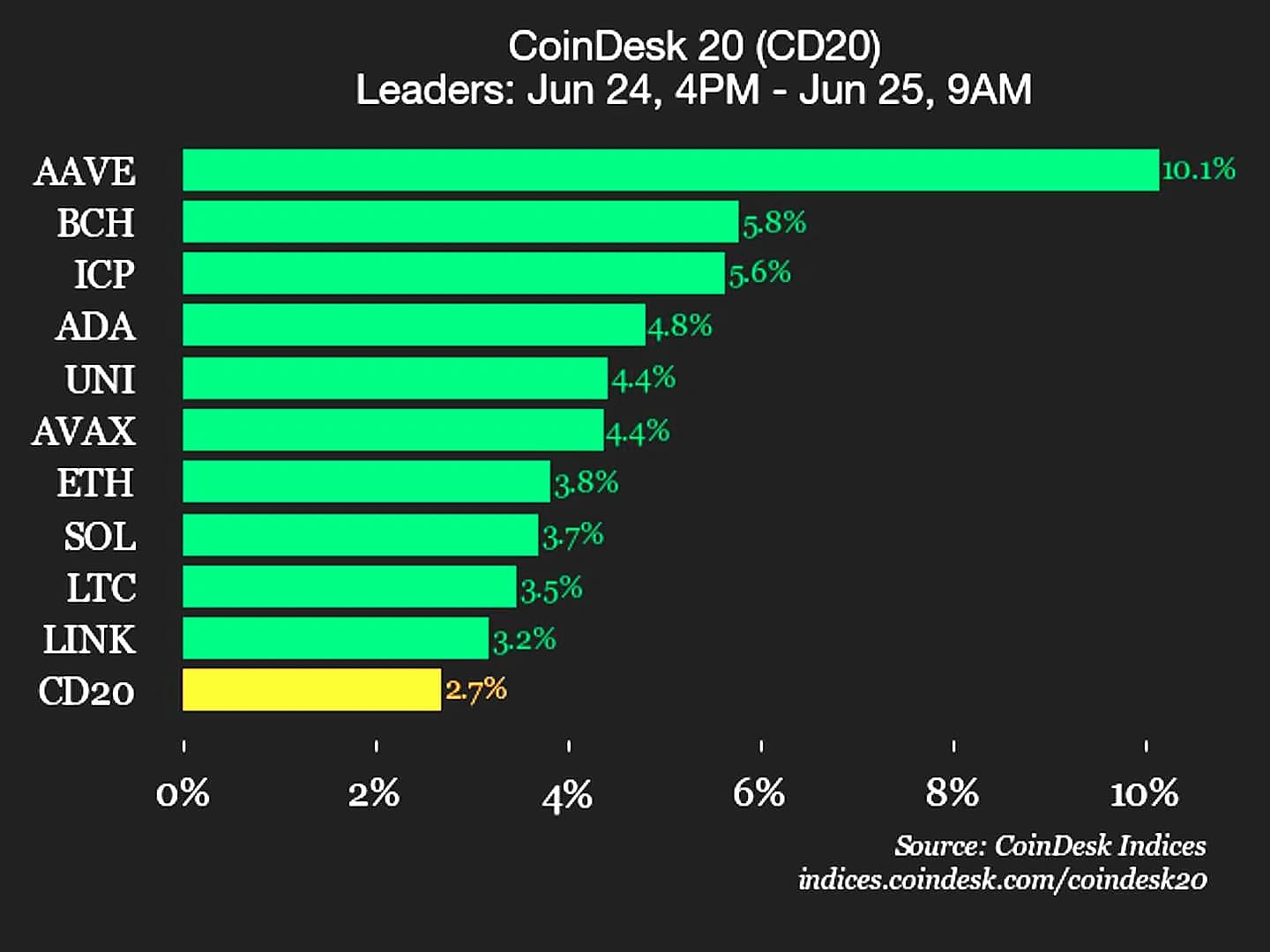
According to the latest CoinDesk performance update, Stellar (XLM) fell 8.4% on Tuesday, leading the CoinDesk 20 Index lower with the index currently trading at 1941.81, down 2.6% since 4 p.m. ET on Monday. The cryptocurrency currently maintains a market capitalization around $5.3 billion and ranks #19 to #21 among major crypto assets. The latest decline represents a significant reversal from the 14.1% weekend rally that had demonstrated strong momentum, with XLM having traded between $0.15 and $0.17 in late May 2026. Only two assets in the 20-member index managed to post gains - NEAR (+3.2%) and ICP (+0.7%) - while Aave (AAVE) also underperformed with a 3.9% decline from Monday levels.
As reported in the analysis, Stellar has secured partnerships with major financial institutions including PayPal's PYUSD with billions in circulation, USDC with approximately $500 million monthly volume, and Franklin Templeton's $270 million tokenized fund. The network also partners with MoneyGram for remittances, IBM World Wire for settlement, Visa for payment infrastructure, Mastercard for Crypto Credential, Paxos for tokenization, and Ondo Finance for tokenized treasuries. The Soroban smart contract platform has expanded capabilities beyond payments, supporting DeFi applications, advanced stablecoins, and tokenized treasury products, with Protocol 26 Yardstick launching on testnet April 16, 2026. The partnership density and depth suggest traditional finance views Stellar as a legitimate infrastructure partner for cross-border payments and tokenization, with operational deployments rather than just announcements. The regulatory positioning is clean with the SEC/CFTC March 2026 joint guidance classifying XLM as a digital commodity, removing regulatory uncertainty for U.S. institutions.
According to the analysis, Stellar received significant regulatory clarity with the SEC/CFTC March 2026 joint guidance classifying XLM as a digital commodity, removing regulatory uncertainty for U.S. institutions. The network achieves consensus in under 6 seconds via Federated Byzantine Agreement with transaction fees of 0.00001 XLM (approximately $0.0000015 at current prices). ISO 20022 compliance positions Stellar as one of the few crypto assets natively compatible with the global messaging standard being adopted by SWIFT and major central banks. The CME XLM Futures launched in February 2026 provides regulated derivatives access, with the fixed total supply of approximately 50 billion XLM following the 2019 community vote that ended 1% annual inflation. The Stellar Development Foundation (SDF) holds approximately 30 billion XLM (60% of circulating supply) for ecosystem grants and development, creating both potential supply pressure if distributed aggressively and potential structural support if SDF shows discipline in releases.

The analysis presents three distinct scenarios for Stellar's price trajectory through 2030. The bull case targets $1.20-$3.50 by 2030, requiring tokenized RWA volume scaling to $20-50 billion, significant stablecoin growth, and institutional partnerships translating to proportional XLM demand. The base case projects $0.40-$0.90 by 2030, assuming moderate growth in tokenized assets and stablecoin volumes. The bear case forecasts $0.10-$0.25 by 2030, requiring adverse outcomes including stalled tokenization growth and competition from XRP and direct stablecoin payment rails. The analysis identifies five key variables - tokenized RWA volume, stablecoin adoption, bridge currency usage, Soroban DeFi ecosystem development, and SDF token distribution discipline - that will determine which scenario materializes. The wide range reflects how much depends on whether platform success eventually translates to token value capture, with the bull case requiring substantial conversion of platform success to token demand.
The current Stellar price reflects what may be the largest fundamentals-to-price disconnect among major crypto assets in 2026, with XLM trading approximately 82% below its 2018 all-time high of $0.9381 despite substantial institutional adoption. The latest decline demonstrates how quickly market sentiment can shift for compliance-focused crypto assets, with the weekend rally's momentum now reversed. The price has fallen to levels approaching multi-year support, creating what analysts describe as one of the most interesting risk-reward setups in compliance-focused crypto. For current holders, the asset has the strongest fundamentals-to-price gap among major crypto assets, with institutional adoption concrete and substantial at current levels. The risk-reward depends on assessment of tokenized RWA growth probability, stablecoin volume scaling, bridge currency usage materialization, and SDF distribution discipline. The conversion question is what makes the asset analytically interesting, requiring monitoring of specific transaction patterns rather than headline metrics.