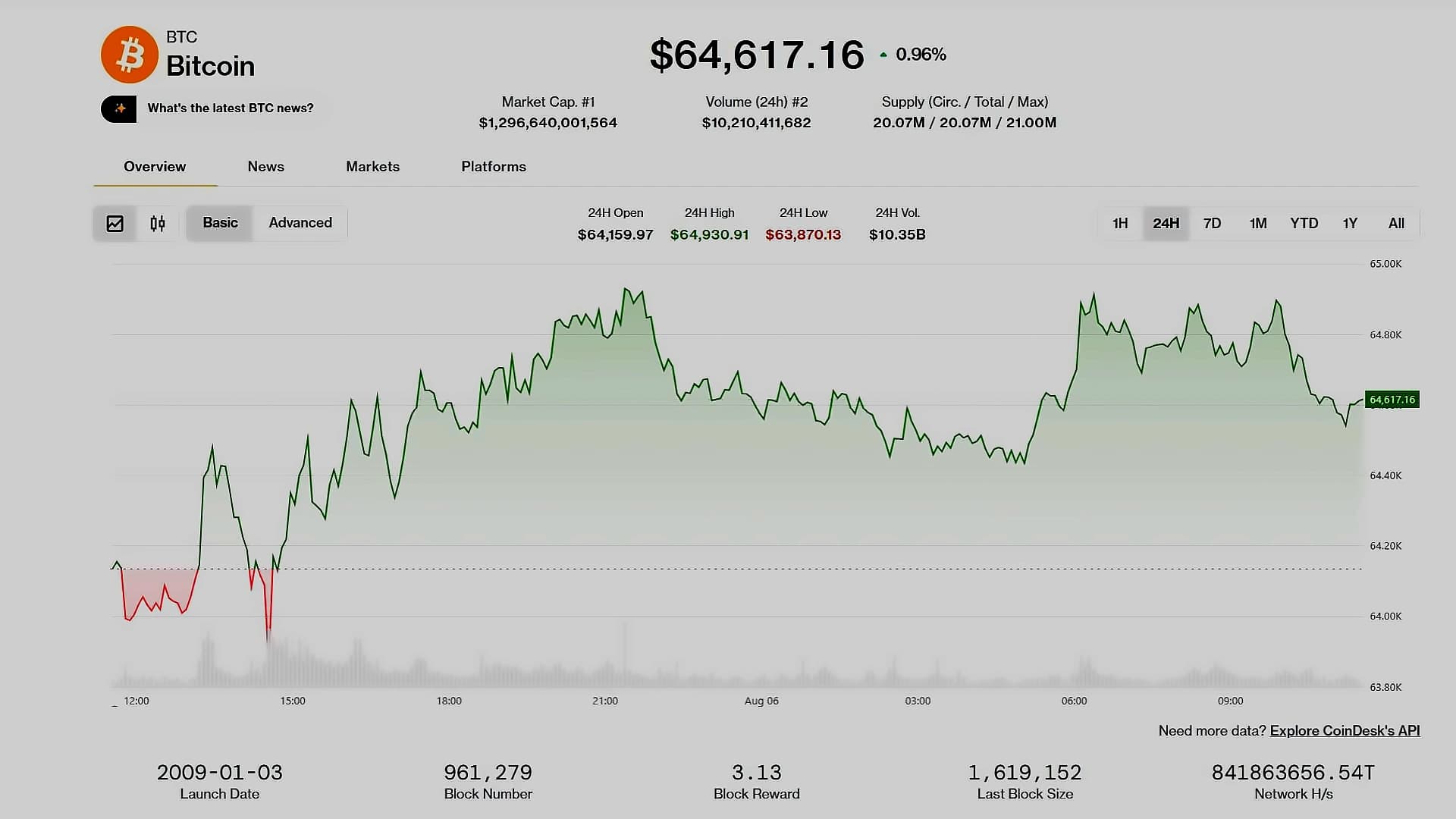
Bitcoin faces a weekly close below $68,300 that could trigger further downside based on historical bear cycle patterns. The cryptocurrency traded around $67,000-$68,000 on Thursday, hovering just below the 200-week EMA after last week's plunge to $60,000. Analyst Rekt Capital noted that in prior cycles - 2018 and 2022 - a weekly close below the 200-week EMA followed by a failed retest of the level from below triggered what he termed 'bearish acceleration,' meaning steeper and more sustained price declines. Bitcoin must close the week above $68,300 to avoid repeating that pattern, as the 200-week EMA had been expected to act as a long-term price floor. Last week's drop below $60,000 broke through both the 200-week EMA and the 200-week simple moving average intraday, though the weekly candle recovered from those lows.
Despite the bearish technical setup, Bitcoin's Mayer Multiple has dropped to approximately 0.6, according to CryptoQuant data. Readings below 0.8 have historically coincided with strong long-term buying opportunities, with only about 5.3% of Bitcoin's trading days seeing a lower Mayer Multiple. Previous instances at this level include the December 2018 bear market bottom, the March 2020 COVID crash, and the November 2022 FTX collapse. Charles Edwards, founder of quantitative fund Capriole Investments, called the 0.6x reading 'historically one of the best buy signals in Bitcoin history,' while acknowledging further downside is possible. The technical debate plays out against a deteriorating macro backdrop, with the outcome of this week's close potentially determining whether the sell-off deepens or stabilizes.
Strategy Inc. (MSTR) announced significant debt reduction through convertible note buybacks, with the company repurchasing $1.5 billion of 2029 convertible notes at an 8% discount, reducing total convertible note obligations from $8.2 billion to $6.7 billion - an 18.3% reduction. The company used $1.38 billion in cash and posted a $333 million gain on Bitcoin, demonstrating its continued strategic accumulation. MSTR issued $2 billion notional of its Variable Rate Series A Perpetual Stretch Preferred Stock and $84 million in Class A common stock during the quarter to support ongoing accumulation, and used the proceeds to purchase an additional 24,869 Bitcoin. The company, the largest corporate holder of Bitcoin, now owns 843,738 BTC, or almost 220,900 Bitcoin Per Share. MSTR's stock was up over 4% in early morning trade, though retail sentiment on Stocktwits remained in the 'bearish' zone.
Bitmine Immersion Technologies (BMNR) revealed it has $12.3 billion in total crypto, cash, and strategic holdings, making it the largest institutional owner of Ethereum. The company's holdings include 5.39 million Ether (ETH) or 4.47% of the total Ethereum supply, worth nearly $11.5 billion at current prices, plus 203 Bitcoin, $444 million in cash, and equity stakes in Beast Industries and Eightco Holdings. CEO Tom Lee announced that as of Monday, Bitmine has staked 4.71 million ETH, or roughly $10.1 billion, making it the biggest ETH stake in the world with the position consisting of more than 87% of total ETH holdings. At scale, the company projects $276 million in annualized staking revenues, based on a 2.75% seven-day yield that's already being generated on the Made in America Validator Network (MAVAN) platform. Bitmine also owns $95 million of Eightco (ORBS), which offers indirect exposure to OpenAI. The stock was up almost 4% during early morning trade, though retail sentiment on Stocktwits remained in the 'bearish' zone.

The technical debate plays out against deteriorating macro conditions and weakening institutional demand. U.S. spot Bitcoin ETFs have shed roughly $6 billion in net outflows since November 2025, according to CoinShares data. CryptoQuant noted that institutional demand has 'reversed materially,' with ETFs becoming net sellers in 2026 after purchasing 46,000 BTC during the same period last year. This contrasts with the recovery in ETF flows that Standard Chartered's Geoff Kendrick noted as a key component of Bitcoin's July advance, when spot Bitcoin ETF inflows ended a 10-day negative streak after recording $221.7 million in net inflows on July 2. Whether this pessimism is warranted or a contrary indicator depends largely on what happens when the weekly candle closes on Sunday.