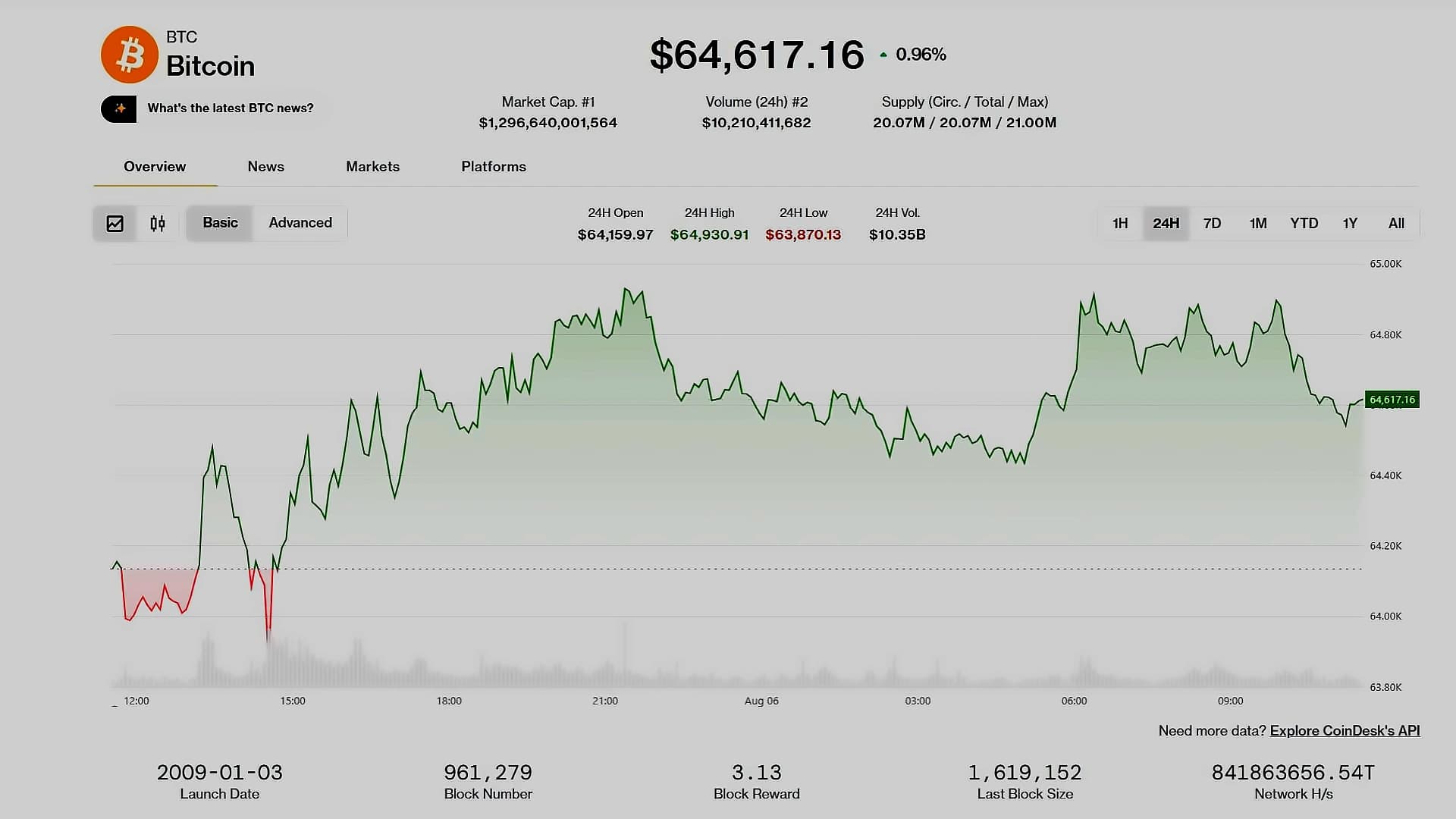
Bitcoin is currently holding around $65,200 per digital asset as of latest trading, maintaining its position as the dominant force in the cryptocurrency market. Bitcoin's market dominance is estimated at approximately 60-70%, representing a slight decline from previous levels but still significantly above the 50% threshold that typically signals altcoin season. The cryptocurrency market's total capitalization has exceeded $3.2 trillion, establishing this as one of the primary benchmarks for the digital asset sector alongside liquidity and daily turnover metrics. Technical momentum has improved with the Moving Average Convergence Divergence (MACD) forming a bullish crossover between Thursday and Friday, with the blue line moving above the orange signal line. Buying Volume recently reached its highest level since May 26th, indicating strengthening accumulation patterns.
Bitcoin's recovery now faces unprecedented pressure from record long exposure, with traders holding a record 361,000 BTC worth $23.4 billion in long positions. According to AMBCrypto data, at the current trading price of $65,200, approximately 57.62% of all positions are net-long, with bulls holding the majority of longs. The amount of short exposure was less than 264,000 BTC at press time, creating a highly concentrated long position structure. Short-term holders are nearing breakeven, with the 30-day STH SOPR rising to 0.997, just below the neutral 1.0 threshold, suggesting they may be less likely to sell now than when the price was near 0.98 back in March. Historically, similar imbalances have been vulnerable to price weakness, which would prompt forced liquidation of traders' positions as prices fell.
Bitcoin is currently testing a key resistance structure that has capped rallies for more than ten months since the October 2025 peak. Chart analysis from Alphractal's Joao Wedson mapped this descending path where Bitcoin tested the upper resistance boundary three times across more than ten months. The formation usually turns bullish after a breakout gains sustained momentum, but Bitcoin has yet to deliver such a decisive move. The Accumulation/Distribution Line shows buyers dominating the market, with the short-term holder realized-profit signal adding to the case for a potential Bitcoin surge. However, CoinMarketCap's 24-hour sentiment reading stands at +2.06, offering limited confirmation as sentiment remains broadly flat despite the technical improvements. Bitcoin has rallied more than 10% so far in Q3, but a real breakout still looks far-fetched unless Bitcoin clears the $73k resistance.
Bitcoin's recovery increasingly depends on whether spot demand can support leverage, as the Spot CVD fell from roughly 3,800 BTC to 2,500 BTC since 5th August. According to AMBCrypto analysis, without spot recovery, Futures demand may test $67,000, while the divergence will keep $62,000 firmly exposed. Open interest also recovered to 108,000 contracts, confirming renewed derivatives activity, but this comes alongside weakening spot demand. Long-short ratios have been declining too, adding to the overall bearish sentiment. The concern comes from concentration, with 361K BTC worth $23.4 billion now positioned long, weaker momentum could trigger faster deleveraging and make Bitcoin's recovery more volatile.
Bitcoin ETFs recorded more than $870 million in net inflows last week, marking their strongest weekly inflow since April according to AMBCrypto data. Spot Bitcoin ETFs holding approximately $65 billion in assets under management according to Bloomberg data. Exchange balances dropped to 2.1M BTC (lowest since 2018) per Glassnode, indicating increased institutional holdings. Long-term holders (>155 days) now control 76.3% of circulating supply, while the Bitcoin MVRV ratio sits at 1.8—historically a "buy zone" before major rallies. According to LedgerMind analysis, Bitcoin's strongest returns historically occur 12-18 months post-halving, with the current post-halving timeline (April 2026 is ~24 months post-halving) aligning with this pattern.