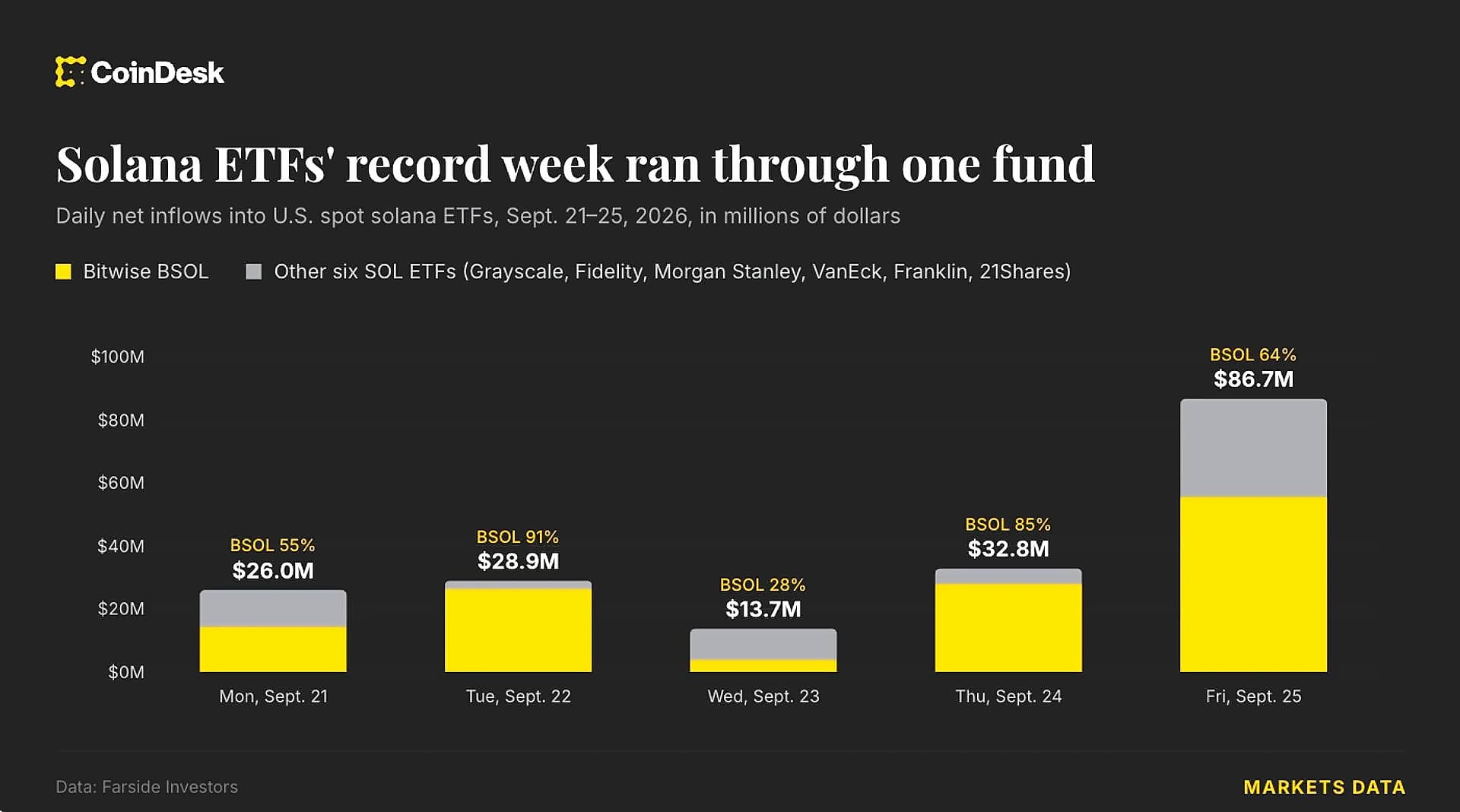
Solana has successfully broken above the $122 resistance level for the first time since January, driven by six consecutive trading sessions of Spot ETF inflows totaling over $235.8 million since September 18. According to AMBCrypto, Daily Net Inflows reached roughly $86 million on September 25, with Bitwise leading at over $55 million and Grayscale contributing $18 million. None of the nine Solana ETFs recorded net outflows that day, marking a significant shift in institutional sentiment. The sustained ETF demand has provided crucial support for SOL's breakthrough, with Solana's Delta staying positive for two consecutive days, rising from 560,000 to 4.8 million on September 26. Exchange Netflow also turned negative, reaching approximately -$9.07 million after two days of positive readings, indicating that more SOL left exchanges than entered them. However, the immediate hurdle remains at $120, with SOL needing to hold above this level to maintain the current rally momentum.
Solana's Alpenglow upgrade has successfully reached both public test networks, marking a significant milestone in the blockchain's consensus improvement journey. According to Anza, the company building Solana's core software, Alpenglow is now active on both the developer network (devnet) and testnet, giving application teams a place to test their software before the live blockchain switch. The upgrade targets a dramatic reduction in transaction finality from approximately 12.8 seconds to around 150 milliseconds, representing a 10,000x improvement in irreversibility processing. Anza announced the developer-network switch on September 25, a day after the separate testnet completed its transition, with the Solana Foundation's upgrade page now listing Alpenglow as active on both networks. However, mainnet activation remains inactive as the system continues to use the existing TowerBFT consensus. The Solana Foundation has advised data providers to reset their comparisons as the upgrade changes how validators reach agreement and will remove validator votes from blocks, making some Solana activity charts fall even if user activity remains unchanged.
Solana has achieved a historic milestone with weekly spot DEX trades surpassing the New York Stock Exchange for the first time in history. According to DeFiLlama data, in the week ending September 13, Solana recorded approximately 208 million spot DEX trades compared with roughly 190 million on the NYSE. This represents a fundamental shift in where liquidity is flowing, with cumulative DEX volume crossing $600 billion in Q3, already surpassing Q2's $572 billion. The gap with Nasdaq has also narrowed to about 47 million trades, the smallest on record. Jupiter, Solana's largest trading platform, drove much of that growth, processing more than 80 million trades so far this month, up 38% from last month. Overall, weekly spot DEX trades on Solana have climbed about 185% from their July lows, demonstrating how much real trading activity is moving onchain and why Alpenglow's faster finality matters for transaction processing.
The surge in DEX activity is being driven by tokenized equity adoption reaching a record 973,000 holders in September, up almost 60% since August. According to Blockworks data, this represents Solana seeing "liquidity" growth outside crypto, with more users gaining exposure to traditional assets through DEXs. The supply of stablecoins on Solana hit a record $16.5 billion on September 22, jumping more than 6% over the past week and adding nearly $1 billion in new liquidity for the network. The latest development comes as the Federal Reserve recently requested public comments on two proposals tied to the GENIUS Act, which could significantly impact Solana's stablecoin ecosystem. One proposal requires that any stablecoin under Fed supervision be 100% held against certain approved assets, with options including short-term US treasury bills, while another would establish guidelines for eligible banks and firms to issue stablecoins. These regulations, while not directly affecting Solana itself, could attract regulated issuers and users to stablecoins on public blockchains, potentially catalyzing further DEX activity growth.
Alpenglow replaces Solana's existing TowerBFT consensus system with a new voting protocol called Votor. As reported by CoinDesk and GitHub, validators now send votes directly to one another and can settle on a block after one or two rounds, removing the long chain of onchain votes that previously required 32 slots for finality. The upgrade allows validators to finalize blocks after one or two rounds of direct voting without changing how users send funds or how applications execute transactions. Under the new design, validators can reach agreement after one or two voting rounds, with Votor designed to reach finality through one of two voting paths depending on validator participation. The expected result is a sharp reduction from Solana's existing finality time, with Anza estimating median finality at around 150 milliseconds, while earlier simulations put it as low as 100 milliseconds under favorable conditions. However, the speed figure remains a target derived from simulations, rather than a demonstrated result under live-market conditions, with wallet processing and exchanges' own deposit checks adding further waiting time. Anza's software schedule tentatively allows mainnet feature activations to resume on September 28, though the Foundation's status page still lists the upgrade as inactive on mainnet.