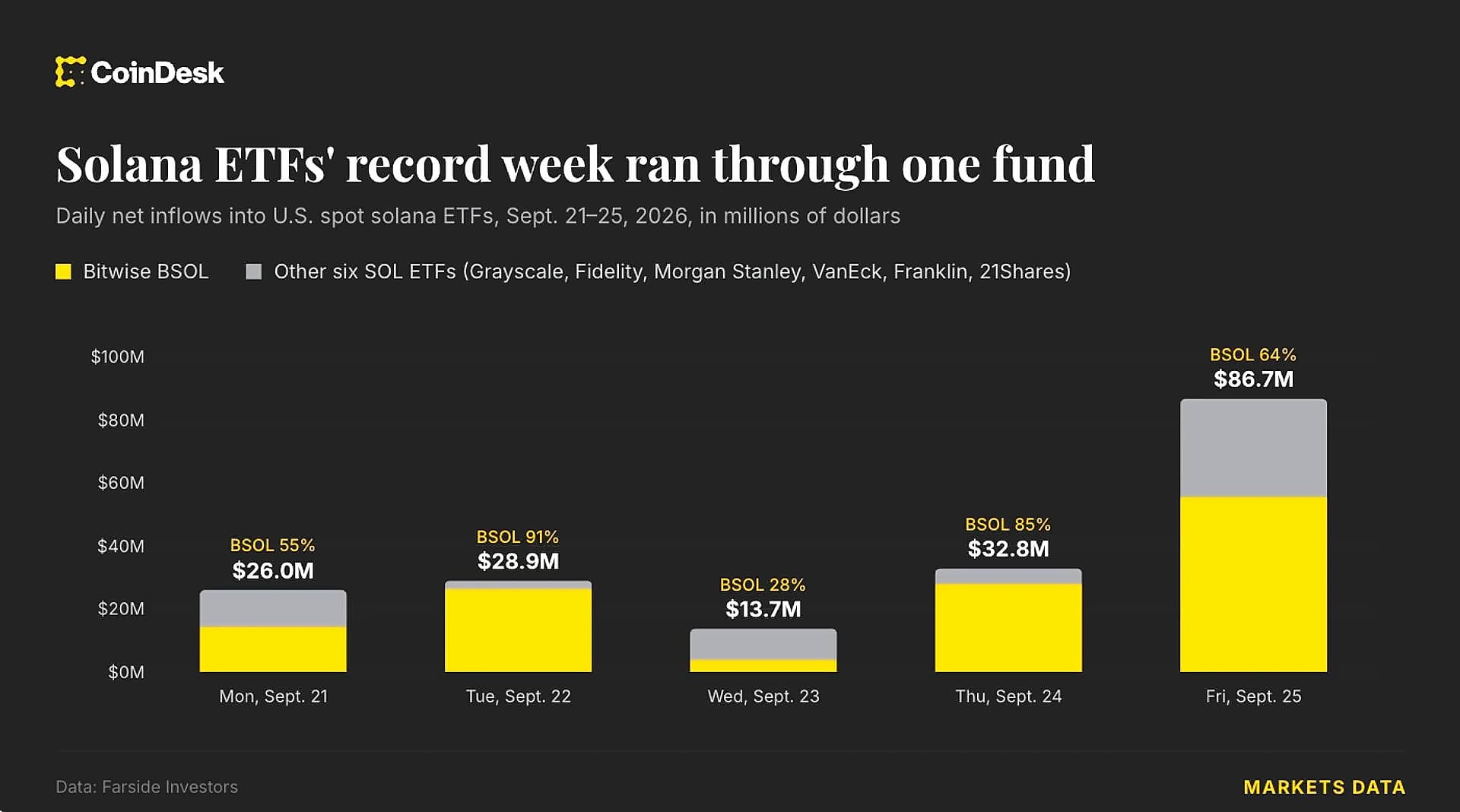
U.S. spot Solana exchange-traded funds attracted a record $188.21 million in net inflows during the week of September 21-25, 2026, marking their strongest week since launching late last year. However, the record flows coincided with clarification from Solana developers that the Alpenglow mainnet launch is not imminent, with co-founder Anatoly Yakovenko using the crypto slang term "decel" to signal a slowdown in the upgrade timeline. The funds added approximately $87 million on Friday alone — the largest single-day intake since going live, including $56 million for Bitwise and $19 million for Grayscale. The delayed launch comes as Solana developers prepare validators for the consensus overhaul since July, with the upgrade currently remaining on testnet. As reported by CoinDesk, the record flows coincide with Solana developers testing Alpenglow, an upgrade that reached the network's second public testing environment on Friday, with the proposed switch changing how validators agree that a block is final.
Bitwise's BSOL product led with approximately $128.46 million in weekly inflows, capturing about 68% of the total and bringing its cumulative net inflows to roughly $1.2 billion of the group's $1.6 billion since inception. As reported by CoinDesk, this represents approximately 76% of the group's total cumulative inflows. Grayscale's GSOL followed with $28 million, while Fidelity's FSOL contributed $18 million, with Morgan Stanley, VanEck, Franklin Templeton and 21Shares accounting for the remaining $14 million. The strong inflows across all seven Solana ETFs highlight renewed investor confidence in Solana's growth potential despite the delayed upgrade timeline.
The buying extended across crypto funds, with U.S. bitcoin ETFs attracting approximately $2.4 billion during the week and ether products adding roughly $690 million, according to CoinDesk calculations using Farside's daily figures. SOL traded around $119.85 at press time, down 0.36% over 24 hours, according to BeInCrypto Markets data. The muted price movement suggests few traders had priced in a September 28 Alpenglow mainnet launch, reflecting the cautious tone among developers who want to avoid rushing consensus changes after recent network stability concerns. Spot ETFs allow investors to hold SOL exposure through brokerage accounts without managing a crypto wallet, with net inflows measuring money entering funds after withdrawals rather than share trading value.
The record flows coincide with Solana developers testing Alpenglow, an upgrade that reached the network's second public testing environment on Friday. As reported by CoinDesk, the speed remains a target, and a launch date for the live blockchain has not been announced. The upgrade aims to significantly reduce payment finality time from about 12.8 seconds to roughly 150 milliseconds. However, recent network stability concerns have influenced developer caution, with a routing fault in August pushing Solana close to a network halt. The Alpenglow mainnet launch date was initially traced to Anza's Agave v4.3 release schedule, which lists September 28 as the day mainnet resumes feature activation, though the entry never mentions Alpenglow specifically. The follow-up v4.4 timeline sets the next mainnet activation window for November 9, which Anza calls tentative and does not name Alpenglow. According to latest reports, September 28 was a calendar trap as it was a feature activation window for resuming a queue of feature gates, not a scheduled protocol cutover. The correct news hook is that the testing and activation process is still open after the widely circulated date.
The testing phase reveals important distinctions between protocol performance and user experience. The 150 millisecond finality target is best understood as a performance claim under favorable network conditions, not a promise that every user payment clears in that time. As reported by CoinDesk, the protocol defines fast finalization when validators representing 80% of stake notarize a block in one round, while slower routes rely on two rounds involving 60% of stake. The Votor consensus mechanism is the primary change in the initial proposal, explicitly leaving Rotor's data dissemination replacement for a separate change and keeping the existing Turbine propagation initially. The proposal describes a 20% adversarial plus 20% unresponsive stake model that accepts different security tradeoffs compared to two-round designs. A validator migration requires a shared starting block with 82% genesis certificate evidence, followed by a 5,000-slot boundary to avoid epoch start complications. The migration process includes validator rollback behavior and recovery scenarios for nodes returning after the transition. The strongest case for Alpenglow's value lies in settlement improvements, where exchanges can credit deposits sooner and payment providers can settle with less waiting, though the protocol's strongest assurance comes after RPC visibility, not just block finality.