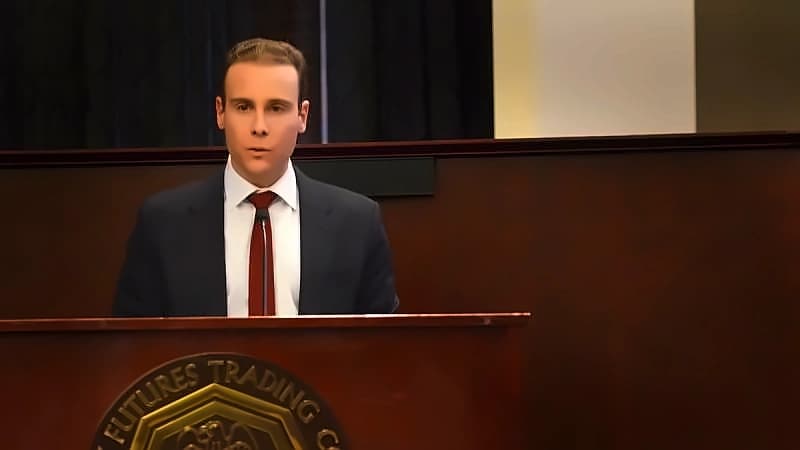
A heated debate has emerged between derivatives veterans over how U.S. regulators should classify crypto perpetual contracts, with the recent launch of CFTC-regulated crypto perpetuals on Kalshi reigniting long-standing discussions about financial market definitions. John Lothian, publisher of John Lothian News, argued that perpetual contracts resemble swaps because they involve recurring bilateral cash-flow payments through funding-rate mechanisms, while Udesh Jha, Kalshi's head of exchange analytics, countered that perpetuals function like futures because they are exchange-traded, centrally cleared and designed to track underlying spot markets. According to The Policy Protocol, both sides view the same product through different regulatory lenses, with Lothian noting that labeling perpetuals as swaps could require different regulatory treatment and potentially limit retail participation unless Congress or regulators create new frameworks. The classification could determine who can access the products and under what rules, with Jha emphasizing that bringing perpetual trading onshore gives U.S. customers access to a product that already generates trillions of dollars in offshore volume.
Kalshi has introduced new measures requiring users to disclose their employers for higher-risk markets as part of an aggressive crackdown on insider trading and market manipulation. The federally regulated exchange announced Tuesday that the new policy will apply to markets it considers at higher risk for insider activity or abuse, with traders potentially screened before being allowed to participate. According to CoinDesk, for markets with heightened insider or manipulation risk, Kalshi now collects employment information before traders can participate, designed to identify people who may have access to material nonpublic information. The company stated that the process is designed to identify people who may have access to material nonpublic information tied to an event or outcome. These measures take effect immediately and follow recommendations from an independent Surveillance Audit Committee that reviewed Kalshi's enforcement systems, monitoring tools, and trading controls.
Kalshi's perpetual futures crossed $1 billion in trading volume within just one week of launch, marking a dramatic acceleration from the company's original prediction market business. According to CNBC, CEO Tarek Mansour reported that the Bitcoin perpetual futures (BTCPERP) went live on June 3rd, generating more than $100 million in volume during the first 24 hours alone. This performance significantly outpaces Kalshi's original prediction market business, which took 40 months to reach the same $1 billion milestone. The company now offers 13 CFTC-approved contracts with Solana, XRP, and Dogecoin contracts pending regulatory sign-off, while the waitlist reached more than 1 million users before launch. As noted by AMBCrypto, John Wang, Head of Crypto at Kalshi, emphasized that "Took 1 week for Kalshi Perps to get to $1B, and we haven't even launched publicly yet. Prediction markets took 3.5 years to get to $1B."
Kalshi has demonstrated significant enforcement capabilities, blocking more than 100 potential insider trades in the first quarter using new screening tools, according to the company's latest announcement. The platform also opened more than 150 investigations, referred more than 20 cases to law enforcement, and issued five disciplinary actions. However, Lothian warned that funding-rate calculation windows could create incentives for traders to influence prices around settlement periods, potentially affecting large positions, while Jha responded that Kalshi calculates funding rates continuously throughout funding cycles rather than relying on a single closing period, which he said reduces manipulation risks. These figures come as prediction markets face increasing scrutiny, with a recent Yale and London Business School paper analyzing Polymarket trades from 2023 to 2025 finding that only 3% of traders accounted for most price moves. The company has implemented a new risk-scoring system that evaluates markets based on factors including insider-trading risk, market importance, regulatory concerns, and national-security implications.
The filing places Kalshi in direct competition with Hyperliquid, Binance, and Coinbase in the perpetual futures market, with both companies now serving as the first US-regulated platforms to offer CFTC-approved perpetual futures. Kalshi and Hyperliquid have already worked together on infrastructure development through Hyperliquid's HIP-4 upgrade, which integrated Kalshi's regulated financial and prediction markets with Hyperliquid's decentralized execution layer. As reported by Coingape, Kalshi filed with CFTC to list several perpetual contracts tied to altcoins such as ETH, XRP, SOL, DOGE, XLM, LINK, BCH, LTC, SUI, SHIB, DOT, and HBAR, but notably left out Hyperliquid (HYPE) until this recent filing. However, Hyperliquid covers more crypto pairs and commodities than Kalshi, and only BTC and LINK perps have been approved with 12 others on the pipeline for Kalshi. The $90 trillion annual global volume in perpetual futures represents a significant market opportunity that US traders were previously locked out of due to regulatory barriers.

Tim Meggs, CEO and co-founder of LO:TECH, a transparent market data infrastructure firm, told CoinDesk that prediction markets have grown so rapidly that questions about their integrity need to be addressed as they are no longer theoretical. "Kalshi's move to require employment verification, risk-scored markets, and whistleblower tools highlights how the sector is starting to build the surveillance infrastructure to match its ambitions," Meggs stated. "That maturation matters as much as the volume numbers." The platform has also added new whistleblower reporting tools that allow users to flag suspicious trading activity directly from individual markets, enhancing transparency and accountability. These developments reflect the growing sophistication of prediction market platforms as they navigate increasing regulatory scrutiny and the need to maintain market integrity in an expanding user base. The ongoing debate over perpetual contracts' classification will likely continue as U.S. crypto derivatives markets expand, with regulators and industry participants testing whether traditional legal definitions fit new products.