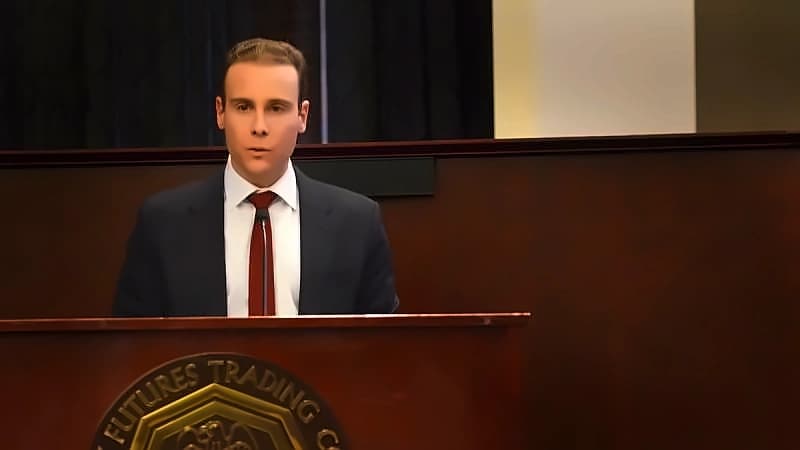
Kalshi CEO Tarek Mansour has defended prediction markets against growing insider trading concerns, arguing at DC Fintech Week on Wednesday that publicly visible trades make suspicious activity easier to detect and report. According to reports from CoinDesk, Mansour described the large number of transactions and public trading information as a 'blessing and a curse for prediction markets'. He said the transparency of platforms such as Kalshi can help identify potentially improper trades, citing the company's handling of former U.S. Representative George Santos. 'You're committing crime in broad daylight, and that makes it so much easier to kind of police that sort of activity,' Mansour explained, emphasizing how the transparency makes misconduct more visible.
The George Santos case provides a documented example of trading misconduct involving a prediction market. As reported by CoinDesk, the Commodity Futures Trading Commission (CFTC) announced on July 31 that it had settled charges against Santos for manipulating contracts related to whether he would attend the State of the Union. The CFTC found that Santos traded the contracts between February 12 and February 25, 2026, making public statements about his attendance plans while holding positions that could benefit from changes in market prices. The order required Santos to return $17,569.98 in trading profits and pay a $17,500 civil penalty, with the company separately permanently barring him from its platform. According to Mansour, 'within a few minutes, we had 100 whistleblowers complaining, being like, 'something is weird here.' You know, we caught it.'**
Beyond Kalshi, enforcement cases have involved other prediction market platforms and government employees. According to CoinDesk, the CFTC confirmed in August that Gabriel Perez, a former White House teleprompter operator, used advance knowledge of presidential speeches to trade contracts predicting words or phrases President Trump would use. Perez earned more than $107,500 from the trades and agreed to return $107,539.02 in profits plus a $65,000 civil penalty, bringing the total to $172,539.02. Another case involved Army Special Forces Master Sergeant Gannon Ken Van Dyke, who allegedly used classified information to profit from contracts linked to a military operation in Venezuela, with trades reportedly generating more than $400,000 in proceeds. In April, an active-duty U.S. Army soldier was charged for using confidential information to place bets on the prediction market Polymarket ahead of former Venezuelan President Nicolás Maduro's capture.

Federal regulators and state authorities remain divided over who can legally oversee sports prediction markets. As reported by CoinDesk, the CFTC maintains that federally registered exchanges fall under its authority when they offer derivatives covered by the Commodity Exchange Act. In April, the CFTC filed a lawsuit against New York, seeking to prevent the state from applying its gambling laws to federally registered prediction market exchanges. New Jersey has taken the jurisdictional question to the U.S. Supreme Court, filing a petition in September seeking review of a federal appeals court decision favoring Kalshi's position on federal regulatory authority. The Commodity Futures Trading Commission has argued that most contracts on prediction markets are swaps and so far under its 'exclusive jurisdiction', while states have argued that prediction market firms are operating illegally, violating their gaming laws and avoiding paying taxes.
The debate over prediction market misconduct has extended to other platforms, with authorities pursuing cases involving government employees and military personnel. According to CoinDesk, over the past year, lawmakers on both sides of the aisle have introduced bills to restrict trades by people who have access to non-public information. Some states, including New York, have banned state officials from using nonpublic information to profit from prediction markets. At DC Fintech Week, Mansour defended the federal approach and warned against rules that could force prediction market operators outside the United States, stating 'I think it's a choice of whether prediction markets exist in the U.S. or they go offshore.' Prediction markets have ballooned in the past few years following the 2024 election and are now worth tens of billions of dollars each.