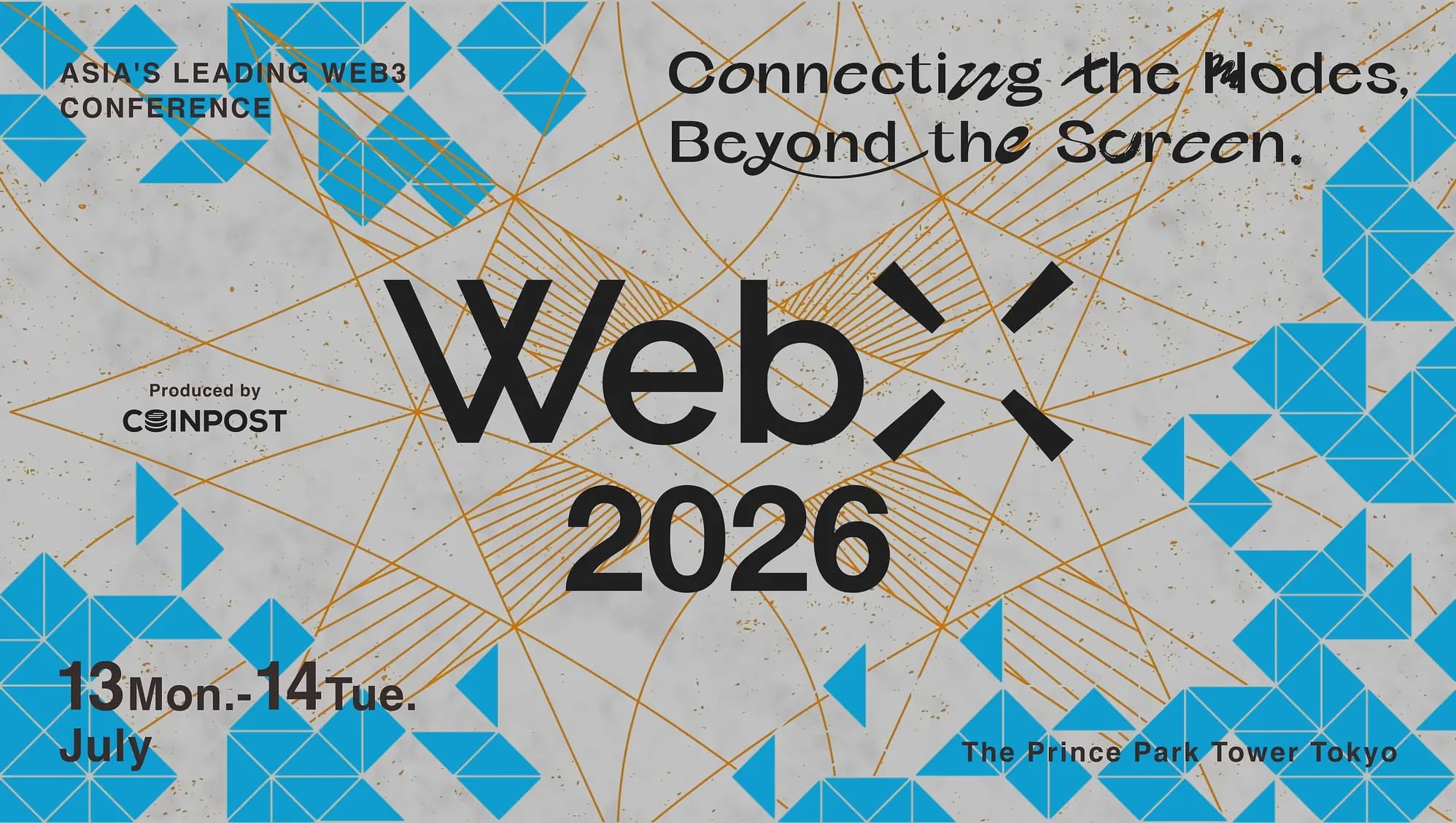
WebX 2026, Asia's premier Web3 and blockchain conference, returns to Tokyo from July 13-14, 2026, hosted by CoinPost, Japan's largest crypto media outlet. The conference has secured title sponsors including Bitbank, bitFlyer, BitLending, eole Inc., SBI Holdings, Simplex, and UPCX, demonstrating strong industry support. WebX CEO Ryo Sakai emphasized that Japan is entering a phase of increasingly clear regulations, which is expected to unlock greater institutional participation and broaden access to growth capital. The 2025 conference attracted over 14,000 attendees from more than 90 countries and regions, with past speakers including Japanese Prime Minister Fumio Kishida, Binance CEO Richard Teng, and TRON founder Justin Sun.

According to reports from BeInCrypto, Istanbul Blockchain Week 2026 demonstrated a marked shift toward institutional-grade discussions, with retail speculation and meme coins notably absent from the agenda. Türkiye operates the largest crypto market in the Middle East and North Africa, with close to $200 billion in annual on-chain activity by Chainalysis' count, around four times the UAE. The inaugural Istanbul Institutional Markets Summit (IISM) served as the central event, establishing themes around custody, compliance, stablecoin utility, and tokenization throughout the two-day conference at the Hilton Bomonti. WebX 2026 will feature keynote speeches from leading organizations in the global finance, technology and government sectors, with the theme "Beyond the Screen, Connecting the Nodes" reflecting the core mission to build real-world connections and create an expanding ecosystem of collaboration.
As reported by BeInCrypto, IISM opened with clear conditions for traditional finance entering crypto markets, with speakers identifying three non-negotiables: strict custodian regulation, full custodial insurance, and Big Four audits. BitGo MENA Managing Director Nick Coombs advocated for integrated platforms combining trading, storage, and security rather than leaving clients to assemble services separately. The legal foundation builds on 2024 amendments to Capital Markets Law No. 6362, with Turkish rules mandating separation between trading platforms and custody institutions, contrasting with the EU's MiCA allowing combined models. Panelists expect the Turkish market to fragment into specialized entities, similar to traditional banking structure. WebX 2026 comes at a pivotal time for Japan's technology and finance landscape, with recent regulatory developments including the explicit classification of crypto assets as financial instruments, signifying a maturing market environment.
According to the fundraising panel moderated by Marc Johnson with participants from Sigma Capital, Bankless Ventures, Arbitrum, and TBV, the consensus emphasized that tokens should launch only when ecosystems actually need them. The panel stressed that issuing tokens quickly to raise money damages industry credibility, recommending that founders hold long-term plans over short-term strategies and that both founders and investors exercise greater patience than current market conditions allow. Investors were advised against chasing projects on hype immediately after launch, while founders should maintain selectivity in accepting capital and implement strict lock-up and vesting terms to align incentives. WebX 2026 will feature carefully curated networking opportunities, aiming to foster meaningful partnerships and support the industry's long-term development.
As reported by BeInCrypto, stablecoins emerged as more valuable to institutions than volatile assets at IISM, with use cases including central counterparty settlement, capital mobilization, and lower-cost cross-border payments. The preference leaned toward integrated infrastructure over fragmented platforms, with the existence of competing stablecoins treated as normal, comparable to holding different fiat currencies. Panelists emphasized that speed and reduced friction through blockchain technology beat traditional payment rails in these applications. WebX 2026 will provide a timely dialogue platform for stakeholders to engage in practical discussions on infrastructure development, governance enhancement, and sustainable market growth.
According to BeInCrypto, Buğra Ayan from the Presidency's Directorate of Communications highlighted the Turkish state's role as a blockchain builder rather than merely a regulator. Ayan described implementing customized in-house language models within CİMER, the state communication center, which processes 15,000 daily applications and surfaces urgent ones within seven minutes. The directorate also operates AI agents directly on-chain through OpenCLI and became the first state institution to acquire a blockchain domain with post-quantum encryption on its roadmap. Officials identified tokenizing yield-bearing assets and agricultural supply chains as near-term opportunities, while warning against fraud cases disguised as agri-tech projects. WebX 2026 will welcome a diverse group of attendees from Japan and around the world, including executives, entrepreneurs, investors, policymakers and technology leaders.