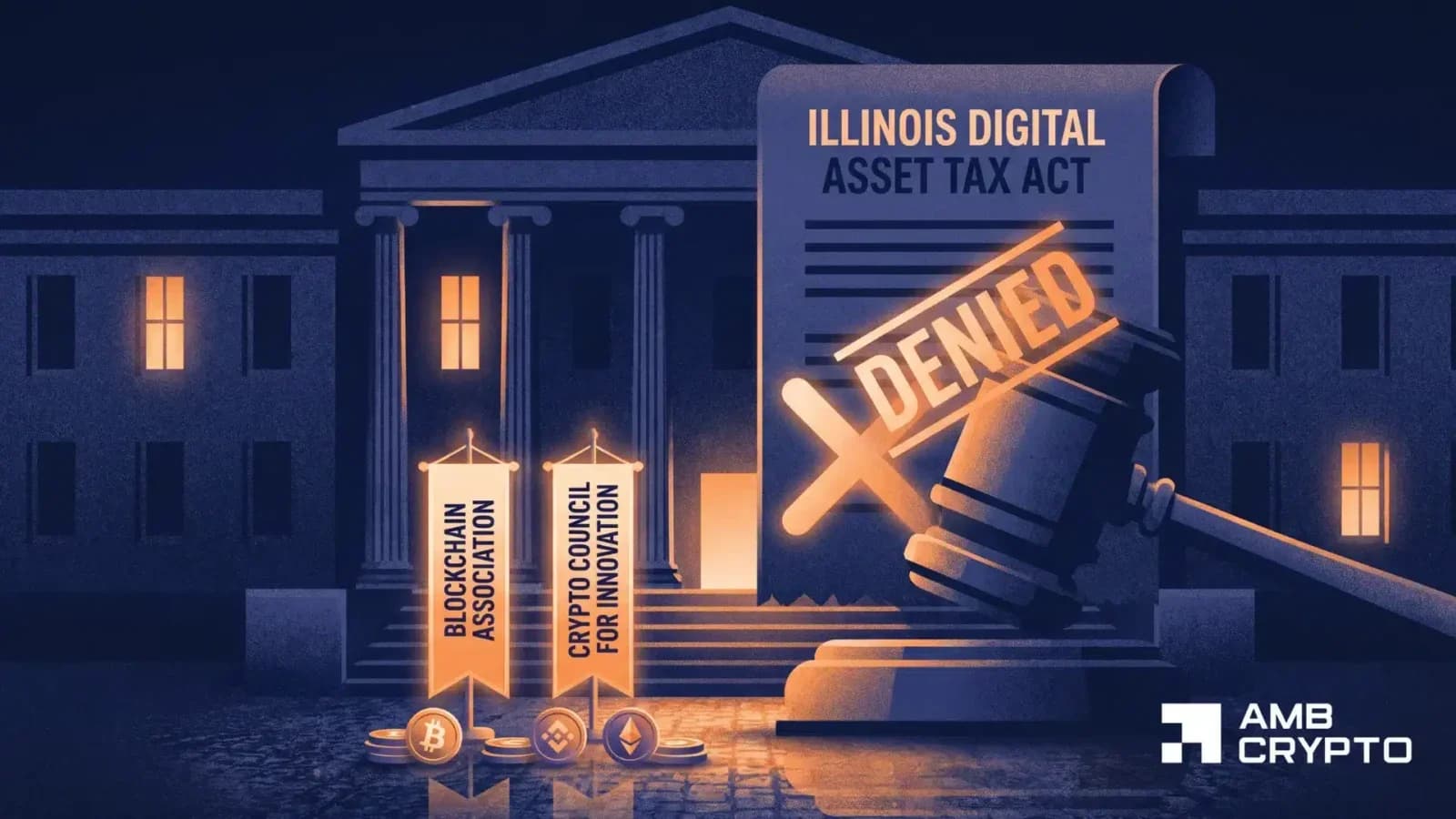
Illinois has agreed to postpone its 0.2% digital asset transaction tax until July 1, 2027, providing significant relief to the crypto industry. According to reports from AMBCrypto, the Digital Chamber and Illinois Blockchain Association filed a joint lawsuit against the Illinois Department of Revenue and Attorney General Kwame Raoul, challenging the Digital Asset Tax Act. On October 1, both sides submitted an agreed motion asking the Sangamon County Circuit Court to pause implementation for six months. The agreement allows both sides to focus on legal disputes without the tax looming closely, as crypto interests continue efforts to permanently repeal the legislation. Digital Chamber CEO Cody Carbone stated that the delay provides relief from costly compliance obligations while they seek permanent repeal through courts.
Illinois' 0.2% digital asset transaction tax is now scheduled to take effect July 1, 2027, following the six-month delay agreement. According to reports from the Illinois Department of Revenue, the proposal remains in draft form and was originally approved by Governor JB Pritzker on June 16 as part of Public Act 104-468. The tax applies to digital asset transactions involving firms that exceed $100,000 in receipts, including all transaction activities and accepting assets for storage. Under the tax structure, customers would pay 0.2% of the value of crypto involved in qualifying transactions, with the broker providing the service collecting the tax. For example, a $2 state tax will be applied to a transaction involving $1,000 in crypto that is seen as taxable, in addition to any trading, withdrawal, or platform fees.

The crypto industry groups argue that Illinois has singled out digital assets for treatment that does not apply equally to other similar financial transactions. According to AMBCrypto, they claim the law could affect businesses and users outside Illinois, potentially interfering with trade between states. The plaintiffs also raised concerns about due process, penalties, and Illinois's restriction on taxing personal property according to its value. They argued that the tax was in conflict with federal rules that were intended to prevent discriminatory taxation of online commerce. Illinois disputes these allegations, but the temporary pause was agreed upon as the court considers the constitutional arguments. Illinois officials must respond to the amended complaint by November 13, providing additional time for the court to evaluate the legal challenges.
The draft rules treat stablecoins as taxable digital assets while excluding nonfungible tokens (NFTs) from coverage entirely. As reported by the Illinois Department of Revenue, stablecoins are classified as digital assets even when designed to maintain fixed value against fiat currencies, commodities or other financial instruments. NFT transactions fall outside the tax because the underlying state definition excludes digital representations with value or utility beyond existing as digital assets. Tokenized securities and commodities also receive exclusion treatment, listed among digital equivalents of tangible or intangible goods with separate value or utility. The tax applies when assets are moved from an exchange into a self-custody wallet, but direct transfers between personal wallets without brokers do not fall under it and will not be taxed. According to tax advisory firm BDO, covered brokers would have to register with the Illinois Department of Revenue, collect the levy separately and submit monthly reports.
Decentralized exchange transactions generally avoid the Illinois crypto tax when users do not provide valuable consideration to digital asset brokers. According to the draft rules, network fees paid to miners or validators do not qualify, while swap fees directed solely to liquidity providers are excluded. However, when a DeFi platform collects protocol fees for operating or maintaining services, the associated exchange activity becomes potentially taxable. Cross-chain bridges are explicitly included in the definition of exchange activity, with Illinois describing bridging as exchanging digital assets between blockchain networks for consideration. These rules remain preliminary and have not been filed with the Secretary of State or submitted to the Joint Committee on Administrative Rules.
At the federal level, the House Ways and Means Committee approved the Digital Asset Tax Certainty Act, H.R. 10357, on September 16 in a 38–5 vote. According to committee-approved text, taxpayers would not recognize gains or losses when using eligible digital assets to pay qualifying network or transaction fees of up to $10. The provision would cover certain validation, brokerage, trading, and liquidity fees, subject to restrictions. The complete bill would raise a net $500 million in federal revenue over fiscal 2027–2036, according to the Joint Committee on Taxation estimate. Committee approval did not enact the measure, as both congressional chambers would need to approve identical legislation before sending it to the president.