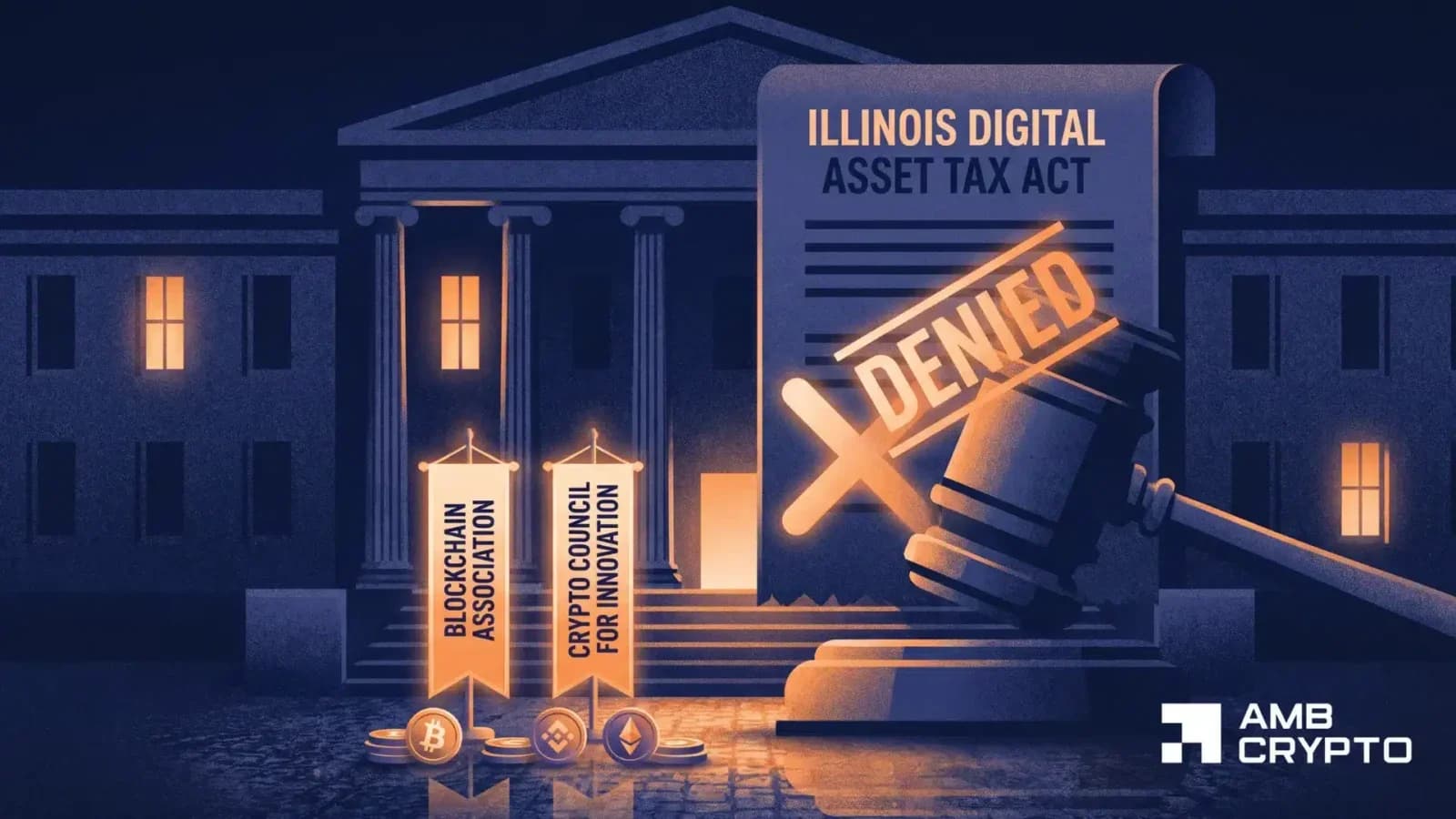
The Blockchain Association and the Crypto Council for Innovation (CCI) have filed a second lawsuit in Sangamon County Court, marking an escalation in their challenge against Illinois's new Digital Asset Tax Act. This follows a similar lawsuit filed by the Digital Chamber on July 21, representing a coordinated effort by the crypto industry to push back against state-level tax policies they view as discriminatory and potentially unconstitutional. The latest lawsuit argues that Illinois exceeded its constitutional authority by creating a tax specifically targeting digital-asset activity, seeking to declare the Digital Asset Tax Act unlawful and enter preliminary and permanent injunctive relief barring the state from enforcing it. As reported by Crypto.news, the complaint was filed on August 21 and names Illinois Revenue Director David Harris, Attorney General Kwame Raoul and Sangamon County State's Attorney John Milhiser as defendants in their official capacities. The Sangamon County venue decision is particularly noteworthy as Springfield sits in Sangamon County, meaning the case goes before a state court in the capital rather than a federal judge, despite one of the three claims resting on federal law. The Digital Chamber's original lawsuit, filed on July 21, also argues the tax unlawfully targets blockchain transactions while leaving comparable traditional financial activity untaxed.
Illinois Public Act 104-468 imposes a 0.2% tax on the value of digital assets involved in covered activity, with the tax taking effect on January 1, 2027. The statute defines covered activity as specified exchanges, transfers or storage provided to customers in Illinois, with the tax based on an asset's value rather than a customer's profit or the fee earned by a broker. As reported by Crypto.news, brokers must register and begin collecting the tax by January 1, 2027, with initial remittances due in February 2027. One provision treats a broker with at least $100,000 in qualifying Illinois receipts during the previous 12 months as maintaining a place of business in the state. However, the plaintiffs argue that other collection and registration provisions lack that threshold, creating uncertainty about which companies must comply. The state has estimated the tax could generate approximately $60 million annually, though this remains a budget estimate rather than guaranteed revenue while enforcement faces litigation and possible legislative repeal. According to tax advisory firm BDO USA, certain out-of-state brokers can fall under the law when they receive at least $100,000 from Illinois customers during a 12-month period, with location tests drawing on billing details, customer records, mailing addresses, and IP information.
The lawsuit alleges that Illinois's new Digital Asset Tax Act violates both the U.S. Constitution and the Illinois Constitution through six comprehensive counts under federal and state law. According to the 39-page complaint filed in Sangamon County Circuit Court, the plaintiffs allege violations of the federal Internet Tax Freedom Act by treating online digital asset activity differently from comparable transactions involving stocks, cash or gold. The lawsuit also alleges violations of the dormant Commerce Clause and federal and Illinois due process protections. At the state level, the groups claim the tax violates Illinois' Uniformity Clause, unlawfully delegates tax policy to an administrative agency, and fails to meet a state constitutional rule requiring bills to be read by title on three separate days in each legislative chamber. The complaint argues that brokers and Illinois customers cannot determine with enough certainty which activities fall under the law or who must collect and remit the tax, with statutory violations potentially exposing brokers to Class 3 felony charges. The groups also challenge the process used to enact the 1,624-page budget package, citing that House and Senate committees gave the public about an hour or less of notice before hearings and both chambers passed the rewritten bill within 24 hours.
Illinois lawmakers have another route available to address the tax controversy through legislative action. Republican state Representative John Cabello introduced House Bill 5798 on June 22 to repeal the Digital Asset Tax Act immediately. However, as reported by Crypto.news, official records show that HB 5798 has not advanced beyond its filing stage, having received no committee vote or floor vote. The filing itself does not suspend the law, meaning unless a court grants an injunction or legislators repeal it, companies must continue preparing for the January 2027 effective date. The immediate legal question is whether the plaintiffs can obtain preliminary relief before January 1, as they must persuade the court that they meet Illinois requirements for an injunction, including showing likely legal success and irreparable harm without early intervention. The latest complaint reveals that some association members are already spending money on outside legal and tax advice and changing their systems to calculate, collect, and record the levy, with the plaintiffs arguing that withholding court review would leave affected firms with a choice between limiting service to Illinois customers and risking criminal liability.
The lawsuit raises significant concerns about interstate tax discrimination and double taxation under the Commerce Clause. According to the complaint, Illinois has not fairly limited the tax to economic activity within the state, allowing officials to treat a transaction as occurring in Illinois by relying on details such as a customer's address, account records, or IP address. The groups argue that another state could use its own location test for the same transaction, raising the possibility that two jurisdictions would tax one transfer, creating competing tax claims for customers with Illinois addresses who complete online transactions while visiting other states. The complaint notes that Illinois lacks a credit for comparable tax paid to another state, potentially placing interstate digital asset activity at a disadvantage compared with transactions conducted entirely within one state. Summer Mersinger, CEO of the Blockchain Association, invoked the 50-state problem, warning that should Illinois succeed with a 0.2% receipts tax on crypto activity, there's nothing to stop the next statehouse from drafting its own flavor at a different rate with a different threshold. The Internet Tax Freedom Act claim focuses on the tax treatment of online commerce, pointing out that Illinois does not impose the same levy on the exchange, transfer, or storage of cash, stocks, bonds, or precious metals, creating an unfair distinction between traditional and digital assets.