According to Binance's latest strategic announcement, the company is positioning itself as a 'financial super app' rather than just a cryptocurrency exchange, targeting 3 billion users globally. Co-CEO Yi He outlined this vision at the Hong Kong Web3 Festival in April, emphasizing Binance's ambition to serve as global financial infrastructure beyond traditional crypto trading. The company's strategy centers on integrating direct stocks, tokenised securities, perpetual futures, and payments into a single digital ecosystem, leveraging its existing ₹117 billion in reserve assets and 30% share of global centralised crypto spot trading volume to build this comprehensive financial platform. As per Binance's latest article, the company describes this concept through its 'one account, no closing bell' approach, with users from emerging markets playing a particularly noticeable role in adoption.
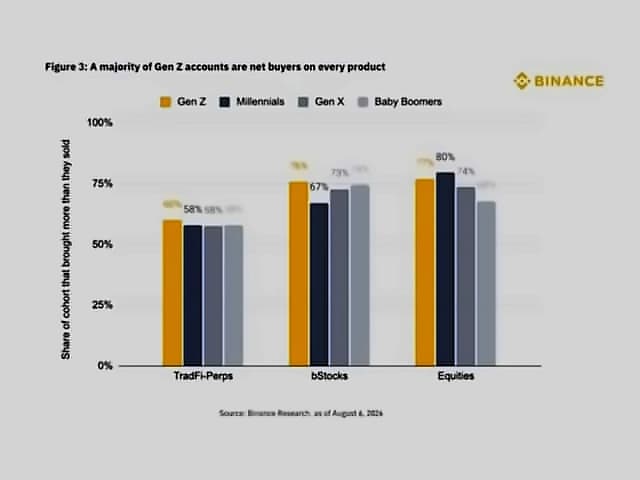
According to Binance Research's latest weekly market commentary titled 'Onboarding the Next Generation', 30% of Gen Z investors began investing during university or early adulthood, significantly higher than the 15% rate for Millennials and well above the 9% for Gen X. This earlier entry is paired with stronger preparation, as 77% of Gen Z investors report having received formal financial education, the highest of any generation, compared with 69% of Millennials and 58% of Gen X. The report finds that Gen Z is the largest single cohort across Binance's TradFi suite, accounting for 44% of Direct Stocks and bStocks users and roughly 45% of TradFi-Perps users. As highlighted in Binance's latest article, these figures suggest that Binance's traditional finance products are gaining traction even in markets where access to conventional brokerage services might be comparatively limited.
According to the latest Binance Research analysis, Gen Z's behavior contradicts assumptions of speculative trading, with leveraged ETFs accounting for just 5.9% of Gen Z trading volume, the lowest share of any generation. The cohort trades less frequently at 2.6 trades per day compared to other cohorts at 3.0 trades per day. NVIDIA emerges as the dominant first investment, with 20% of Gen Z's youngest equity users making it their first trade, followed by Micron Technology at 8%. Across the wider equity base, users allocate roughly 60% of equity holdings to Information Technology and Communication Services, with around 26% concentrated in semiconductors, reflecting a thematically coherent tilt toward the artificial-intelligence complex rather than scattered speculation. Despite holding the lowest investment capital per user, Gen Z has contributed approximately US$80B of TradFi volume year-to-date, compounding at 24% month-over-month.
As reported by Binance Research, Gen Z's share of newly onboarded TradFi users has risen steadily from 41% in January to 47% in July, suggesting momentum rather than saturation. Among users who have adopted all three products, 48% are Gen Z. The research identifies that more than 90% of TradFi users in every generation are based in emerging markets, with Gen Z at 90%. Within that base, 13% of Binance Direct Stocks users are Gen Z investors from emerging markets holding less than US$2,000 in equity assets, a segment the report identifies as 'Next Gen Users'. This penetration is particularly significant given that 700 million people worldwide hold brokerage accounts, meaning 89% of the global population lacks meaningful access to U.S. equities. As noted in Binance's latest article, this gap is a major reason for the company's expansion into tokenised securities and direct stock products.
Binance's bStocks product has achieved remarkable growth, surpassing ₹500 million in assets under management (AUM) in less than seven weeks after launching on June 11. By the end of July, outstanding supply exceeded ₹565.9 million, representing an approximately 5,000% increase. The product's 24/7 trading model allows users to trade tokenised securities outside traditional market hours, with Binance Research analysis showing that bStocks priced in a median of 92% of stock-price gaps observed on Mondays during the seven weekends following launch. In 41 observed instances involving gaps larger than 3%, bStocks correctly predicted the direction of price movement. Meanwhile, TradFi perpetuals now account for approximately 74% of the global ETF perpetuals market, rising from 18% when the category launched in March. The company's ETF perpetuals lineup has expanded to 146 pairs, demonstrating successful integration of traditional financial markets with crypto-style trading infrastructure.