According to the latest Binance Research data, Gen Z traders have increased ETF share of their equity trading volume to 25% by early August, up from 21.9% in July and 18.5% in June. This represents a significant shift in Gen Z's investment approach, with individual stocks receiving 74.2% of July inflows, down from 77% one month earlier. The research shows that while Gen Z increased their ETF allocation, their overall trading activity remains limited compared to older generations. As per the report, Gen Z averaged fewer monthly trades than Millennials and Gen X across all products studied, with the youngest cohort demonstrating the most disciplined approach to market participation.
According to Binance Research's latest weekly market commentary titled 'Gen Z Perspective Rewrite', Gen Z users demonstrate significantly different trading patterns compared to older generations. The report reveals that 22% of Gen Z direct-equity accounts have never placed a sell order, compared to 19% for Gen X and 9% for Baby Boomers. These buy-only accounts maintain minimal trading activity, averaging 1.63 trades per month in bStocks against 3.45 for typical users, with high-frequency trading effectively absent at 0.1%. The analysis shows that Gen Z demonstrates the lowest turnover rates among working-age cohorts across all products, with the average Gen Z account trading 13 times per month in TradFi-Perps against 17 for Millennials, 16.5 for Gen X, and 19 for Baby Boomers.
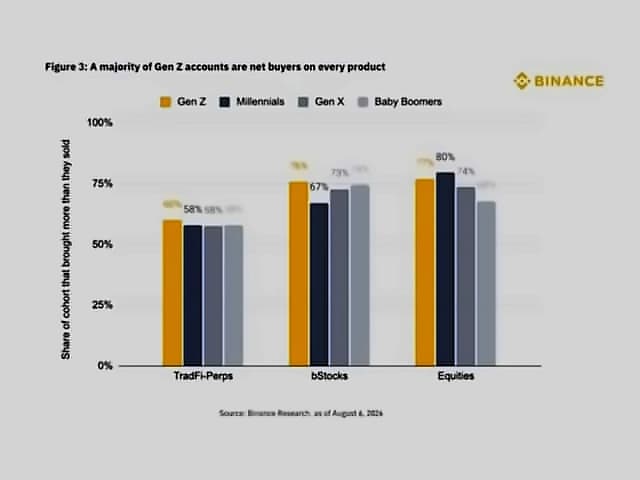
Binance Research finds that Gen Z leads net accumulation across all three TradFi products examined. In bStocks, 76% of Gen Z accounts were net accumulators, the highest share of any generation and nine points above Millennials at 67%. For direct equities, 77% of Gen Z accounts accumulated compared to 74% for Gen X and 68% for Baby Boomers. In TradFi-Perps, 60% accumulated, once again the highest of any cohort. The direct-equity figures carry the most economic weight, with Gen Z showing a net flow ratio of 26.5% and average net inflow of US$1,898 per account. As per the report, these accumulation patterns run counter to a pure speculation thesis, with the data suggesting a more disciplined and allocation-oriented approach to wealth accumulation.
The report highlights that Gen Z avoids leveraged and inverse ETFs more than any other working-age cohort on two of three products, with 88.2% of TradFi-Perps accounts and 98.9% of bStocks accounts recording no such activity. More notably, leveraged instruments made up 9.25% of Gen Z's July turnover in direct equities but only 3.93% of net monthly inflow, indicating these instruments are round-tripped within the month rather than funded. This gap has widened from 4.55% in June to 2.65% in early August, demonstrating an increasing trend toward avoiding leveraged products. Gen Z is also rotating into unleveraged ETFs, with the ETF share of equity volume rising from 14.6% in June to 25.0% in early August, compared with 9.5% for Millennials. Within the Gen Z buy-only group, Broadcom, Tesla, and the Schwab U.S. Dividend Equity ETF ranked among the leading assets by cumulative purchases.
Binance Research notes that despite Gen Z's preference for ETFs over single stocks, the early pattern runs counter to a pure speculation thesis. The report emphasizes that Gen Z's behavior is more disciplined and allocation-oriented than common assumptions suggest, with the data suggesting a more sophisticated investment strategy than commonly perceived. However, the research cautions that Binance's direct-equities product only reached meaningful scale in June, leaving too little data to determine whether the allocation and trading patterns represent lasting generational behavior. The short operating history limits conclusions about Gen Z's long-term investment approach, though the data suggests a more strategic and disciplined approach to wealth accumulation across TradFi products.