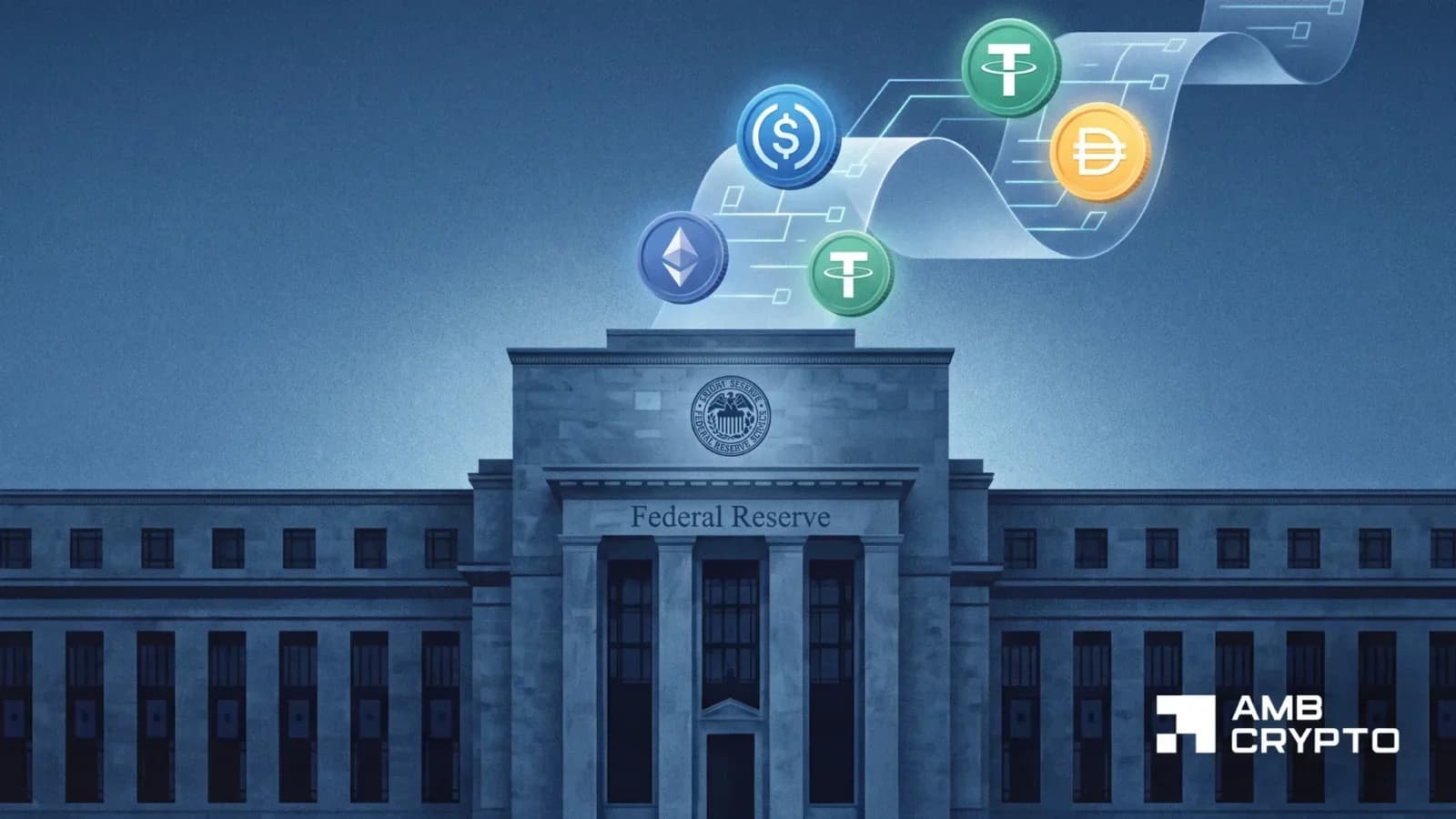
Federal Reserve researchers have proposed a framework for determining how stablecoins and other blockchain-based financial products could fit within U.S. money supply statistics. According to the study published on September 4, payment stablecoins could eventually qualify for inclusion within M1 or M2, depending on their primary use by households and businesses. The researchers, Kristen Payne and Mary-Frances Styczynski, examined payment stablecoins, tokenized bank deposits and tokenized money market funds, considering both their economic function and whether reliable data could be collected without counting the same money twice.

Under the researchers' framework, an asset used mainly as a medium of exchange would normally belong in M1, while an asset used primarily for short-term savings would be more consistent with the non-M1 portion of M2. As reported by the Federal Reserve study, payment stablecoins could fall into either category. Tokens used for household purchases, business payments or instant transfers would share transactional features with M1, while stablecoins used primarily to trade cryptocurrencies or store value temporarily would resemble M2 assets. The researchers used USDC as the closest existing comparison, noting that few payment stablecoins currently operate under the GENIUS Act framework.
Adding stablecoins to M1 or M2 would not be as simple as counting every token in circulation, as stablecoin reserves create double-counting risks. According to the study, issuers hold reserve assets supporting tokens, which may already appear elsewhere in monetary aggregates. A stablecoin reserve can contain bank deposits, Treasury bills and other permitted liquid instruments, with bank deposits already appearing in M1 or M2. The researchers noted that Treasury bills do not form part of M1 or M2, making the size of adjustments dependent on each issuer's reserve composition rather than total stablecoin circulation.
Tokenized deposits require different treatment because they remain liabilities of regulated banks, as reported by the Federal Reserve study. A tokenized checking deposit remains immediately accessible and functions as a medium of exchange, placing it in M1 alongside conventional checking deposits. However, banks already report these balances through the same regulatory forms used for traditional deposits, with the Federal Reserve not currently separating tokenized balances from conventional banking systems. The researchers found no additional double-counting problem for tokenized deposits, as their underlying bank assets are generally outside the monetary aggregates.
The research does not establish a timetable for adding stablecoins to M1 or M2, instead identifying tests that would need to be satisfied before the Federal Reserve could publish reliable figures. According to the study, officials would require standardized circulation data, consistent reporting channels, and methods for deducting reserve assets already captured elsewhere. The researchers emphasized that the paper reflects their personal views and does not represent a Federal Reserve policy decision or active deliberation over changing monetary aggregates. Until these questions are resolved and the Federal Reserve formally changes its methodology, payment stablecoins remain outside the published U.S. monetary aggregates.