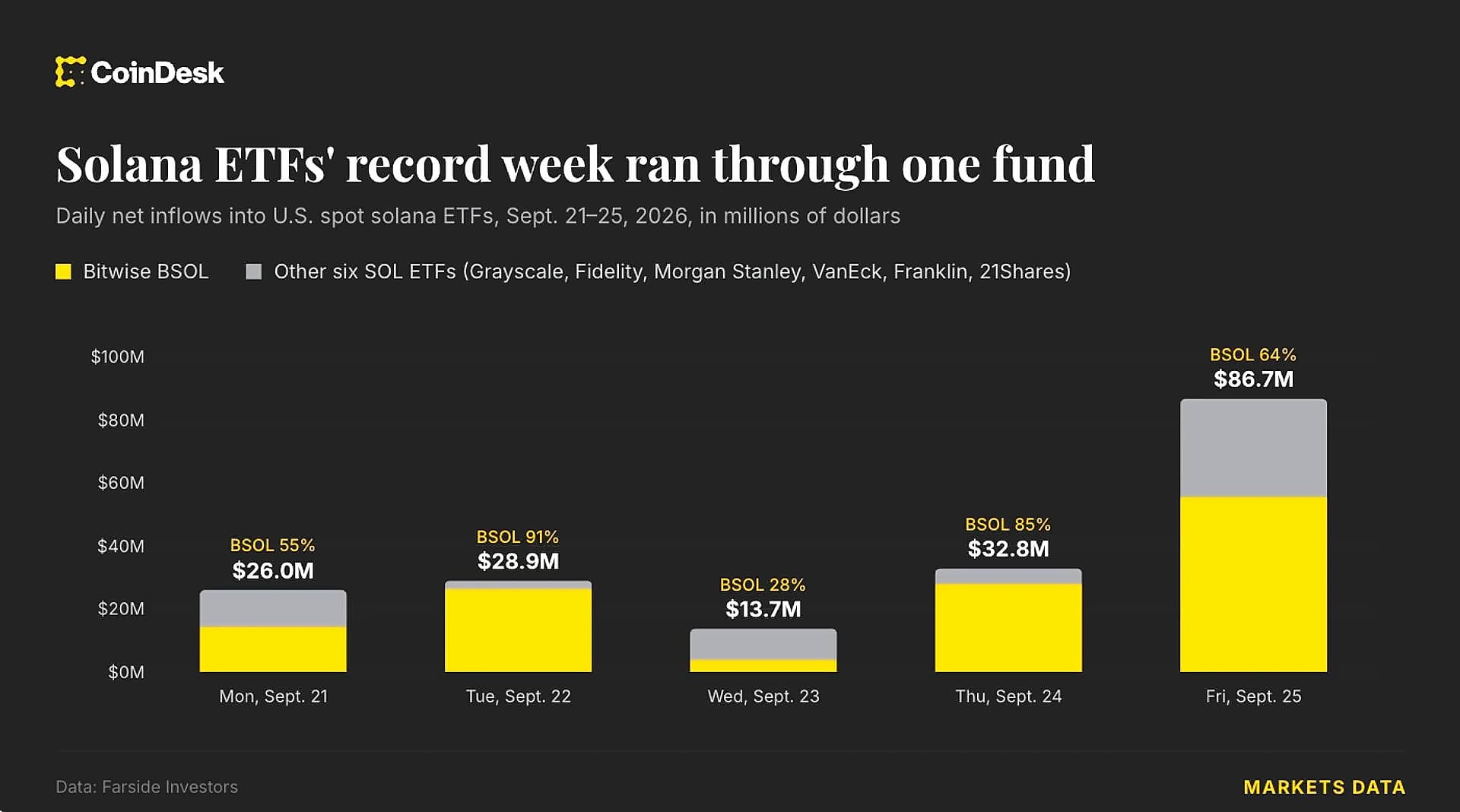
Solana has achieved a record $1.7 billion in cumulative ETF inflows after nine consecutive days of record inflows, with the latest session attracting $153.87 million on August 27, according to Glassnode data. This represents the fastest one-day increase of 2026 with a 4.83% cumulative net inflows growth. The SOL/ETH ratio has climbed over 1.6% this week, with a break above the critical 0.04 resistance level potentially signaling stronger institutional demand and serving as a key Q3 trigger. However, SOL is trading around $101.59 after shedding roughly 3% in the previous session, putting the $100 psychological support level under direct scrutiny. The institutional positioning comes as ETF flows have picked up significantly, with more than $3 billion flowing into Bitcoin ETFs during August, representing their strongest monthly inflow since the October crash.
Bitwise's Solana Staking ETF (BSOL) emerged as the largest beneficiary of recent inflows, crossing $1 billion in Assets Under Management and becoming the first Solana ETF to reach that milestone. According to Bitwise's official fund data, BSOL held 9,332,360.79 SOL worth approximately $1.018 billion as of August 26, reaching this milestone in roughly 10 months since its October 2025 launch. The ETF category avoided prolonged net outflows despite difficult market conditions during the first half of 2026, with Bitcoin ETFs and other altcoin ETFs also exhibiting inflow streaks during the same period. However, the ETF inflows should not be interpreted as a guaranteed bullish signal for SOL's price, as recent market action shows mixed signals with some profit-taking after the recent rally.
Solana's first round of on-chain governance voting has concluded with the community approving two proposals - SGP-0001, "The Solana Constitution," and SGP-0002, "Double Disinflation." The community rejected SGP-0003, the "Resource and Inclusion Fee" proposal, which proposed splitting transaction fees into fixed inclusion and resource fees with full burning. SGP-0002 doubles Solana's annual disinflation rate from 15% to 30%, allowing SOL to reach its 1.5% terminal inflation rate in about 2.8 years instead of 5.7 years. This governance approval comes alongside the network's record 4.2 billion onchain transactions in July, representing a 13.5% increase from June and the highest monthly total on record. The network has also recorded a record 402 transactions per day, surpassing Base for the first time in six months, suggesting growing use beyond just trading.
Despite strong ETF inflows, SOL's technical indicators are showing cooling momentum with the daily RSI easing to 67 from overbought levels, suggesting buying pressure is cooling even as ETF inflows remain positive. The MACD is edging lower toward its signal line, reinforcing that the pace of upside is slowing rather than accelerating. SOL remains above its 50-day EMA at $85.05, its 100-day EMA at $82.77, and its 200-day EMA at $89.71, with all three averages below the market, maintaining a constructive technical structure. Immediate downside support sits at the February 1 low of $98.02, with a break below that level shifting attention to the 200-day EMA at $89.71, then to the 50-day EMA at $85.05. On the upside, the next notable hurdle is $116.88, the December 18 low, representing a significant structural barrier to an extended rally.
Market analysts suggest Solana's bullish structure remains intact despite recent pullbacks and mixed price signals. The DMI Modified indicator held positive for three consecutive days with the DMI Modified sitting around 34, indicating strong upside momentum. If demand continues, Solana will reclaim $110, flip it, and target $125 next, according to AMBCrypto analysis. However, if rising sell pressure on derivatives persists, SOL will retrace to $102. The network's fundamentals continue to support growth with record 4.2 billion onchain transactions in July and tokenized assets reaching $4.167 billion. DeFi Development maintains its ₹1,600 crore equity program and SOL Per Share (SPS) target of 1.0 by December 2028, providing institutional backing for the network's long-term growth strategy. Recent governance approvals for faster disinflation and rejection of new fee structures suggest continued community confidence in the network's direction.