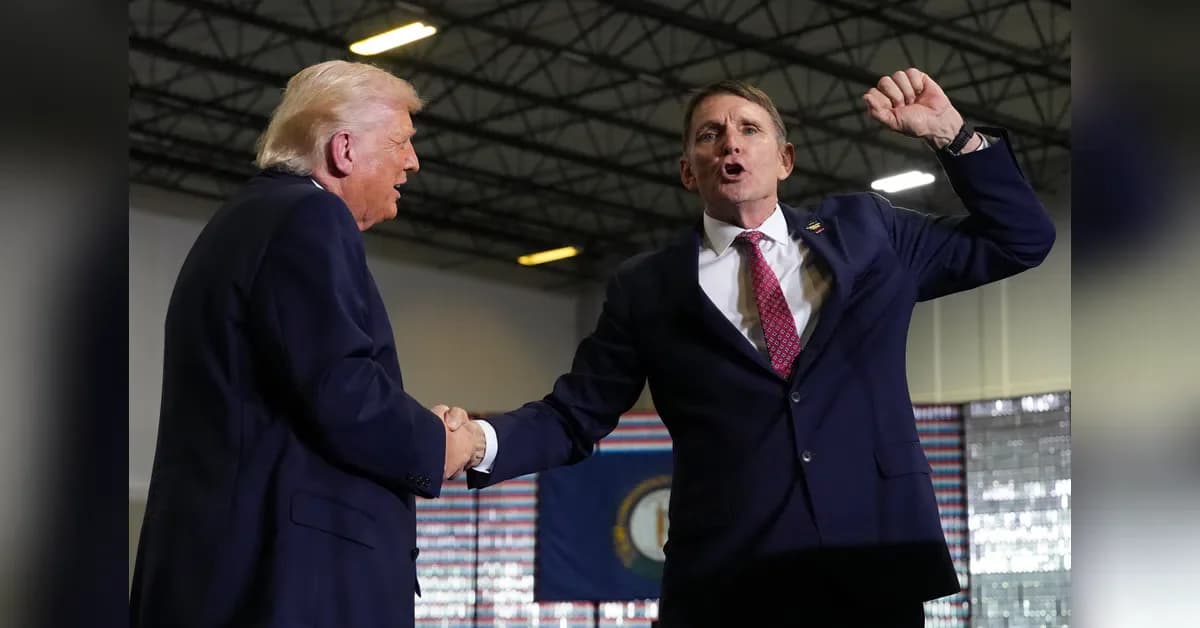
Rep. Barry Moore secured a decisive victory in Alabama's Republican Senate primary runoff on Tuesday, defeating opponent Jared Hudson with 60% of the vote compared to Hudson's 40%. According to unofficial results from the Alabama Secretary of State, all 67 counties had reported results as of late Tuesday, with Moore, who received President Donald Trump's endorsement, expressing gratitude for the conservative support he received throughout the state. The primary victory positions Moore as the Republican nominee for the November general election, where he will face Democrat Everett Wess and independent candidate Craig Jelks. Moore, who was first elected to Congress in 2020 and previously served as a state lawmaker and small business owner, will seek the Senate seat being vacated by Republican Sen. Tommy Tuberville, who is running for governor. Moore was an early backer of Trump's first presidential campaign and has maintained strong ties with the administration.
The victory was significantly bolstered by nearly $7 million in support from cryptocurrency-aligned super PACs, a figure that exceeds the combined spending behind all of Moore's primary opponents. The bulk of that money comes from Defend American Jobs, an affiliate of Fairshake, the crypto industry's most prominent political spending vehicle. As reported by The New York Times, Fairshake, backed by heavyweights like Coinbase, Andreessen Horowitz (a16z) and Ripple, has been aggressive in raising funds for candidates this election cycle. However, the campaign became particularly contentious in its final weeks when Hudson, a nonprofit CEO and former Navy SEAL, attacked Moore over his Washington ties and funding by cryptocurrency PACs. Hudson pushed questions about Moore's military service record, with both men receiving honorable discharges - Moore served in the Alabama National Guard while Hudson was a SEAL. Moore threatened to sue journalists who asked questions about his service record, though both candidates provided documentation to AL.com about their military time.

Moore's candidacy has attracted significant personal and institutional crypto industry support beyond the PAC backing. Moore's 2024 financial disclosures reveal personal Bitcoin holdings valued between $1,001 and $15,000, which has earned him additional backing from the industry. Senator Cynthia Lummis has endorsed Moore's candidacy, specifically pointing to his Bitcoin holdings and pro-innovation stance as reasons for the endorsement. Moore has also taken positions that align with the industry's broader ideological framework, including public opposition to central bank digital currencies, framing them as a vehicle for government overreach in financial matters. Stand With Crypto, the advocacy organization that tracks lawmakers' positions on digital asset policy, gives Moore an 'A' rating and classifies him as 'strongly supportive' of crypto-friendly legislation. Moore's 2024 financial disclosures reveal personal Bitcoin holdings valued between $1,001 and $15,000, which has earned him additional backing from the industry.
According to Federal Election Commission filings, entities affiliated with Fairshake spent over $12 million in areas such as advertising during the primary campaign. The PAC reportedly amassed $193 million at the beginning of the year ahead of the November midterms. At the time of their most recent filings with the Federal Election Commission, the collection of related PACs had approximately $164 million on hand at the end of April, though they were spending at a rapid clip. Currently, Fairshake maintains nearly $150 million cash on hand and plans to continue driving the construction of what they describe as the largest pro-crypto caucus in history. The Digital Asset Market CLARITY Act passed the House in July 2025 but has stalled in the Senate, caught between disputes over stablecoin yields, DeFi oversight, and ethics provisions. Moore will face Democrat Everett Wess in November, with Alabama remaining a strongly Republican state which gives Moore a favorable path after winning the GOP nomination.
On the Democratic side, attorney Everett Wess was named the winner of the runoff Tuesday evening, gathering supporters in a low-key affair at a Alpha Kappa Psi hall in Birmingham. Wess, who received a majority of votes in the primary, is a Birmingham attorney who has previously served as a municipal judge and has been active in local political circles. Democrats are a long shot to win the Senate seat in November, but the party is pushing dissatisfaction with the cost of living, power bills and other issues. Unlike other cycles, they also have a popular person, former Sen. Doug Jones, on the top of the ticket in the governor's race. Moore's win gives the crypto industry a friendly nominee in a Senate race it expects Republicans to hold, with the broader test being whether PAC spending can keep enough pro-crypto lawmakers in Congress before the next round of market structure votes. If Moore wins the Republican primary and eventually the Senate seat, he would join a growing caucus of lawmakers who actively champion crypto-friendly policy.