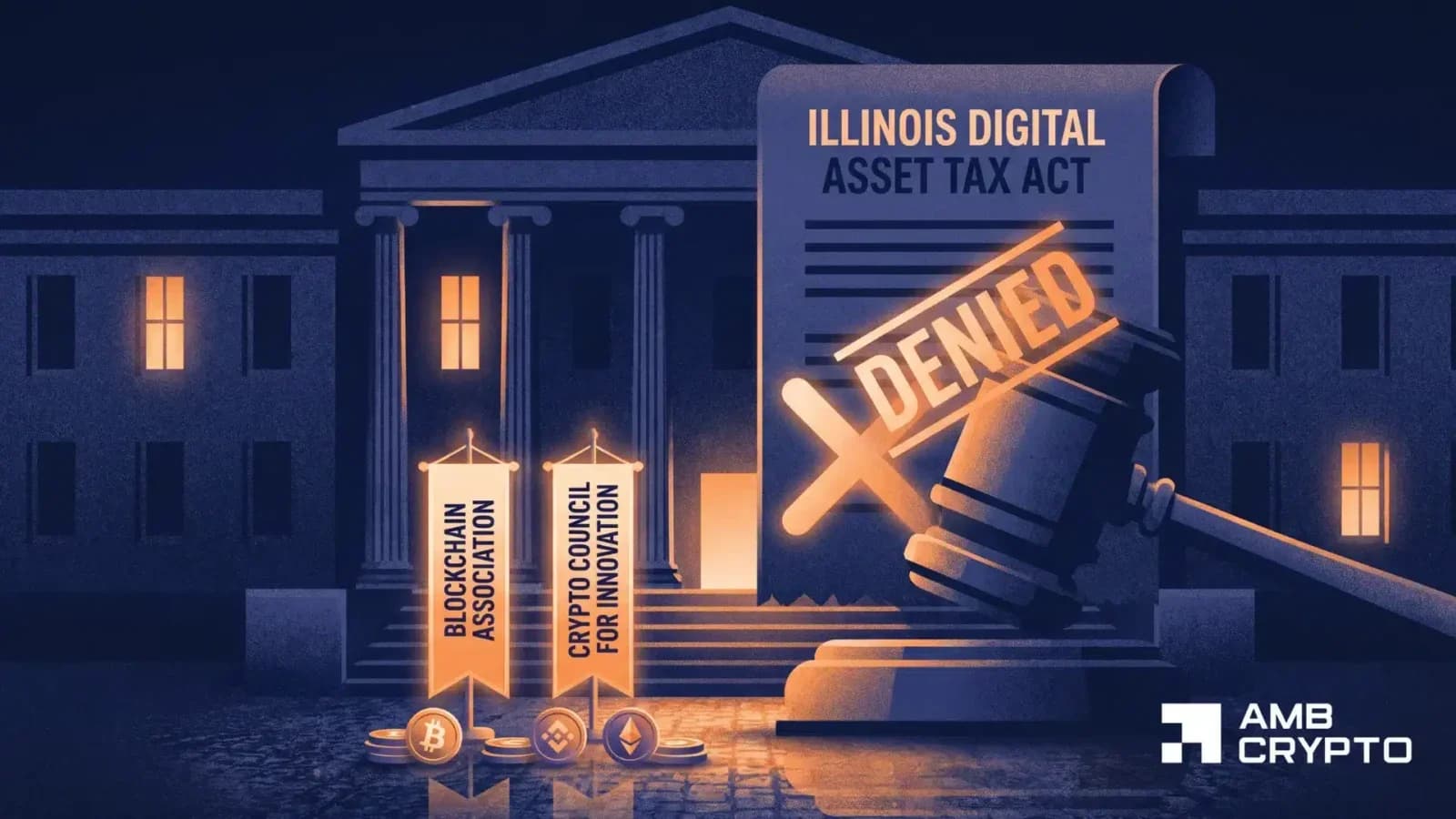
A crypto lobbying organization has launched a legal challenge against Illinois over a recently enacted digital asset tax provision. TDC (The Digital Chamber) filed a lawsuit in Sangamon County, Illinois, seeking to block Illinois' Digital Asset Tax Act from taking effect, according to reports from AMBCrypto. The lawsuit alleges that the tax violates both the U.S. and state constitutions and is preempted by federal tax law. The organization is seeking a federal judge to block the Illinois state government from enforcing the tax. In a statement accompanying the filing, TDC CEO Cody Carbone said the organization is not asking for favorable treatment but for equal treatment under the law, emphasizing that taxes should be designed with fairness in mind alongside revenue generation. Carbone specifically criticized the provision's inclusion in legislation the night before final consideration, stating that "Taxes should be carefully considered, not only for the revenue they produce but for the fairness of those being taxed."
The Digital Asset Tax Act imposes a 0.2% tax on all crypto transactions and takes effect January 1, 2027, as reported by AMBCrypto. The tax applies to any entities that are based in Illinois or provide services with gross receipts of over $100,000. The legislation was passed and approved on short notice last month, right before the Illinois state government wrapped up its session for the year. The tax specifically targets digital asset services provided within the state, including exchange, transfer, custody, and wallet services. Unlike traditional capital gains taxes, several industry groups have argued that the Illinois measure applies to the transaction itself rather than to income or profits generated from digital assets. The tax does not take into account whether you made a loss or profit or moved funds between your wallets, making it one of the most punitive crypto tax regimes in the U.S.
TDC's lawsuit alleges multiple constitutional violations in the tax structure. According to the filing reported by AMBCrypto, the tax violates the Illinois state constitution's uniformity and due process clauses, the Commerce Clause of the U.S. Constitution, and the Internet Tax Freedom Act by specifying digital asset transactions. The lawsuit argues that Illinois has singled out digital assets by imposing a transaction tax based on the technology used to record and transfer ownership rather than on the underlying economic activity. The 32-page complaint contends that economically identical transactions should not receive different tax treatment simply because ownership is recorded or transferred through blockchain technology, creating an unequal legal framework. The group specifically argues that the tax treats identical property differently based only on how ownership is recorded. The lawsuit seeks a declaration that the Act is invalid and an injunction against its enforcement, arguing that the provision burdens interstate commerce and is preempted by the Internet Tax Freedom Act.
The lawsuit follows months of industry criticism after Illinois lawmakers approved the Digital Asset Tax Act as part of the state's $55.9 billion fiscal 2027 budget, which Governor JB Pritzker signed into law in June. State budget documents previously estimated the measure could generate roughly $60 million in annual revenue. Before the budget became law, The Digital Chamber and the Illinois Blockchain Association jointly urged state officials to remove the proposal, saying lawmakers introduced the provision without advance notice during the budget process instead of advancing it through standalone legislation. The Crypto Council for Innovation separately requested that Governor Pritzker use a line-item veto to remove the crypto tax provision. State representative John Cabello has introduced a measure to repeal the tax law, citing a lack of public committee hearing before its passage. TDC's membership includes more than 250 companies and organizations worldwide, including Anchorage Digital, Chainlink Labs, and Intercontinental Exchange (ICE). The organization warns that allowing Illinois to proceed could encourage similar policies elsewhere, potentially extending treatment to transactions settled using artificial intelligence systems or cloud-based payment networks.
While the lawsuit focuses on the legality of the tax, implementation questions have continued to draw attention across the industry. According to tax advisory firm BDO, the law requires digital asset brokers to register with the Illinois Department of Revenue before conducting covered activity once the rules take effect on January 1, 2027. Brokers must collect the tax as a separate line item, maintain transaction records, and submit monthly reports covering the previous month's activity. BDO has said the law may apply to companies located outside Illinois if they generate at least $100,000 in annual receipts from customers in the state. Legal uncertainty has emerged around routine blockchain activity, with litigator Joe Carlasare questioning how ordinary wallet transfers would be treated, asking whether moving Bitcoin from self-custody to an exchange before selling it could create one taxable event or multiple taxable transactions. The tax structure creates additional complexity as it does not take into account whether you made a loss or profit or moved funds between your wallets, requiring users to pay the typical capital gains tax on top of this fee.
The court challenge comes amid ongoing discussions about federal crypto tax policy, with a possible push for a federal crypto tax regime potentially happening after the November midterm elections. The U.S. currently has no single federal crypto tax regime, leaving states to chart their own path for digital asset taxation. However, there is a congressional push for crypto tax clarity, including treatment of mining and staking activities. Recent proposals in the House were supported by the industry, with the sector wanting the bills to be passed as they are. As of writing, the proposals have not even cleared the committee vote, with the tight window ahead of the November elections potentially delaying the tax bills until next year. Commodity Futures Trading Commission Chair Michael Selig publicly criticized the Illinois tax in a July statement, saying Illinois lawmakers had "slammed the brakes on technological progress" by approving the measure. Selig argued that blockchain networks could transform the movement of financial assets in much the same way the internet transformed the movement of information, warning that taxing crypto transfers differently from other financial activity could leave businesses and residents at a disadvantage.