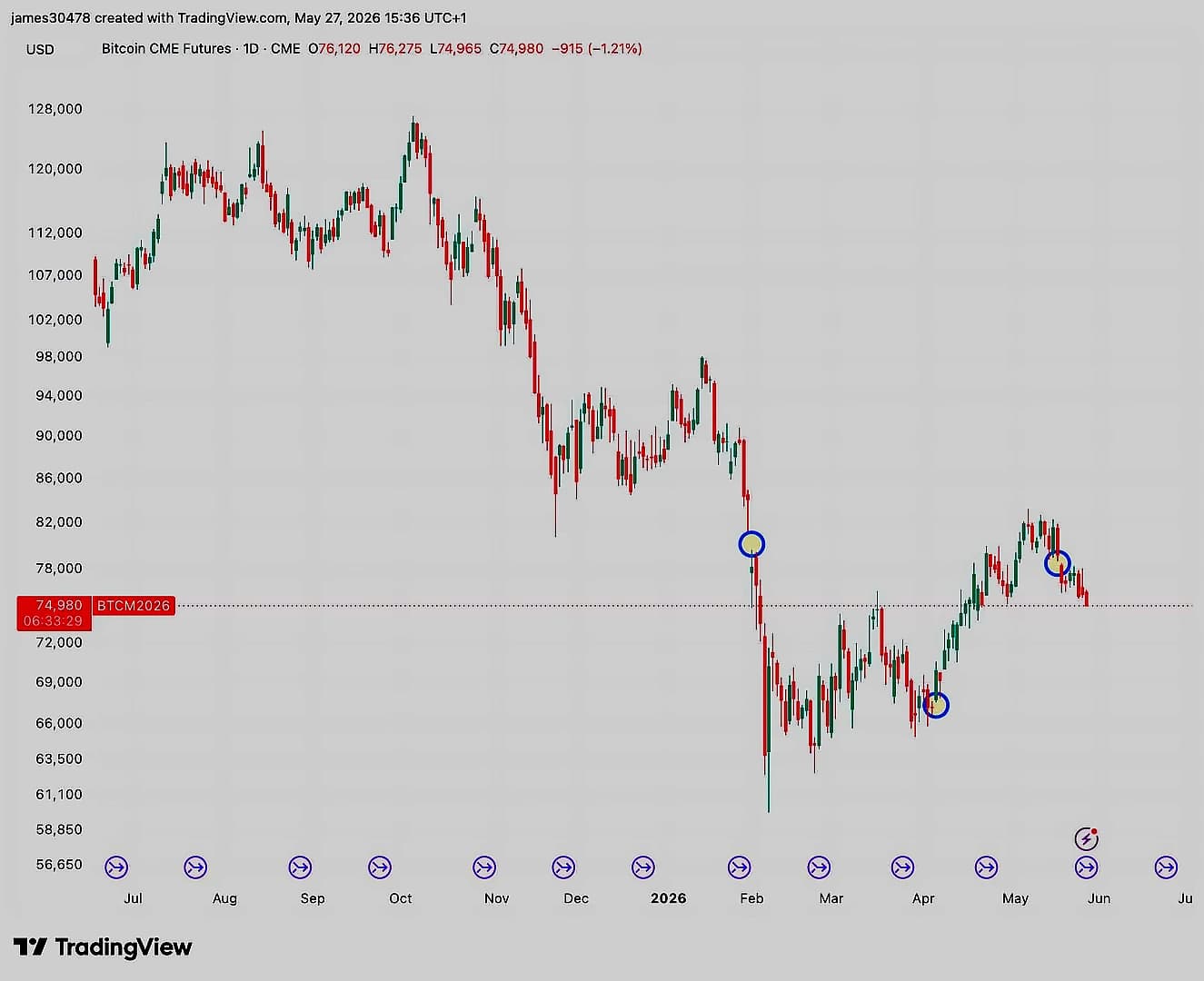
Bitcoin has entered its first full trading week with no new CME futures gap on the chart, marking the end of an eight-year market quirk that traders relied on to forecast short-term price targets. According to CoinDesk, the Chicago Mercantile Exchange moved its regulated cryptocurrency futures and options to around-the-clock trading on May 29, removing the weekend closure that had produced visible price gaps since Bitcoin futures launched in December 2017. Historical fill rates ranged from 70% to more than 90%, making the gap pattern one of the most watched short-term signals in crypto. The structure also frustrated institutions, which could not adjust hedges over weekends on a regulated venue. As analyst Daan Crypto Trades noted, "BTC Closed last weekend's CME gap and is now trading in the big area between the other few remaining gaps. This weekend, 24/7 trading starts for the Bitcoin CME futures so there won't be any new gaps created anymore going forward."
The new 24/7 structure maintains only daily maintenance windows of two minutes on weekdays and two hours on Saturdays, with weekend trades still clearing on the next business day. According to CME Group, client demand for risk management in the digital asset market is at an all-time high, driving a record $3 trillion in notional volume across our Cryptocurrency futures and options in 2025. The exchange now runs Bitcoin, Ether (ETH), Solana (SOL), and six other contracts continuously, giving portfolio managers, ETF issuers, and corporate treasuries a regulated channel to hedge weekend exposure in real time. Since introducing XRP futures in May 2025, the exchange has traded more than 1.3 million contracts with a combined notional value of roughly $62.87 billion, as reported by boerse-global.de. Bitcoin Volatility futures, a new contract tracking 30-day implied volatility, are scheduled to debut on June 1.
XRP ETFs recorded net inflows of $60.5 million in the week ending May 15, marking the highest weekly figure so far this year and pushing cumulative ETF inflows since launch in November 2025 to $1.41 billion. Despite this institutional demand, XRP's spot price remains under pressure, trading around $1.29 and oscillating in a tight band between $1.30 and $1.35. The token is down 31% year-to-date and about 63% below its 52-week high of $3.56 set in July 2025. The 30-day MVRV ratio has dropped to minus 47% - its lowest reading since December 2020, a level that historically has coincided with deeply bearish sentiment. Derivatives data present a split picture with cumulative volume delta for Binance perpetual futures at minus $641.9 million, indicating aggressive short selling, while spot CVD across all centralised exchanges is positive at $397.3 million, suggesting spot buyers are absorbing selling pressure.
Despite the 24/7 launch, three open CME gaps remain, all created this year. As reported by CoinDesk, two gaps sit above Bitcoin's current spot price of roughly $73,000, one formed in late January near $80,000 and another around $78,500. The third gap remains open below the market, just under $70,000. Bitcoin traded near $73,441 on Sunday, down 3.7% on the week, after the quietest weekend in recent memory. Whether those gaps still pull price action under continuous trading represents the first real test of the post-gap era. Early CME volume and open interest on Monday will signal how quickly institutions adapt their playbooks to the new trading environment. The Digital Asset Market Clarity Act (CLARITY Act) awaits a Senate vote that could act as a catalyst for further integration of XRP into traditional finance.
The XRP Ledger is undergoing significant technical improvements parallel to the CME developments. On May 27, validators unanimously approved version 3.1.3, which includes the fixCleanup3_1.3 amendment that fixes bugs in the NFT ecosystem, stabilises the lending mechanism, tightens security for vaults and optimises domain permissions. The upgrade clears the path for the proposed AMM v2 standard published on May 26, which extends the existing automated market maker (XLS-30) with specialized curve types such as StableSwap and concentrated liquidity designed to improve capital efficiency and reduce slippage for large transactions. More than $3 billion in tokenised real-world assets are already recorded on the XRP Ledger, with a cross-border redemption pilot on May 6 demonstrating near-real-time settlement of tokenised US Treasury securities involving Ripple, JPMorgan, Mastercard and Ondo Finance.