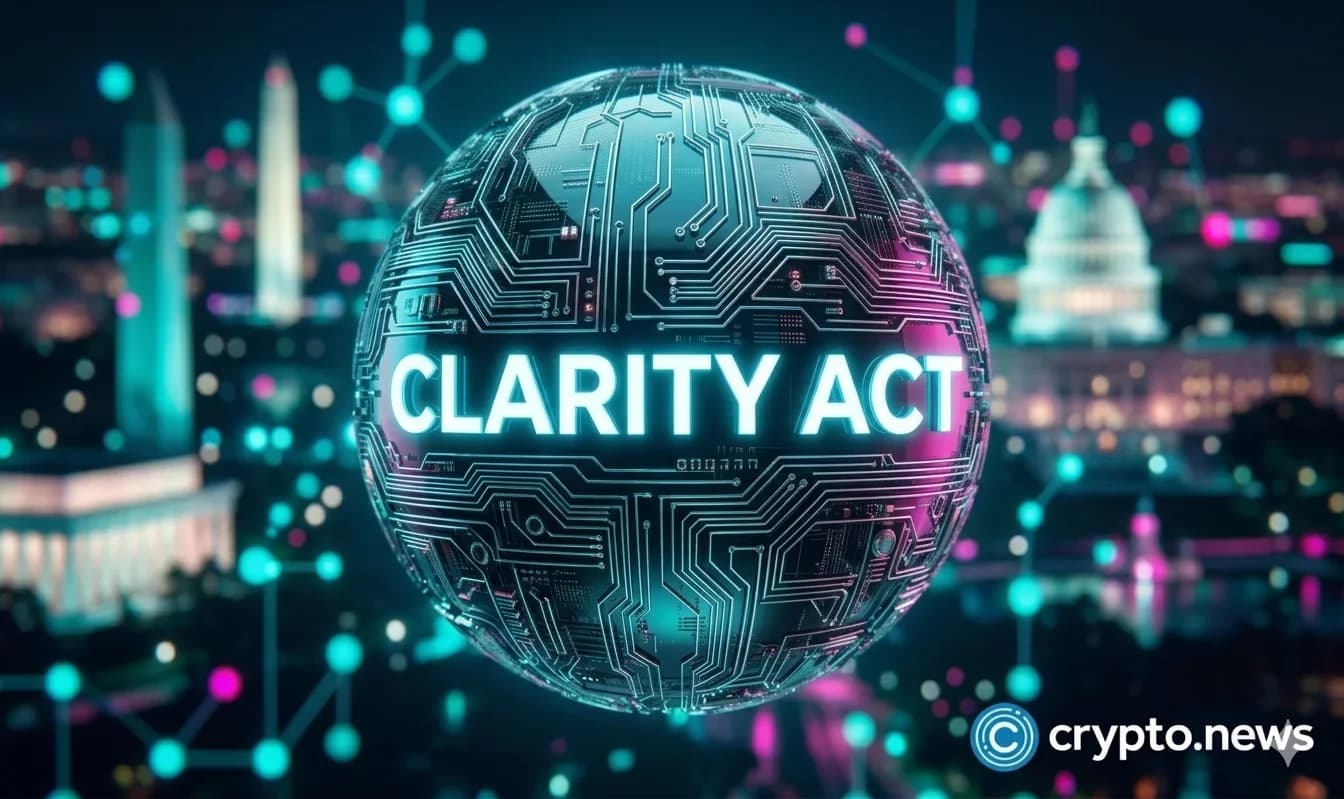
The CLARITY Act has missed its July 4 target despite earlier hopes from White House crypto adviser Patrick Witt, with attention now shifting to August 7, the Senate's final session day before summer break and campaign season. According to Crypto.news, Senate staff are still working to reconcile the Agriculture and Banking Committee versions, as both committees have jurisdiction over parts of digital asset policy and a single Senate text must be ready before floor action can move cleanly. Senator Bill Hagerty has revived hopes after outlining a new Senate roadmap, with the Senate potentially releasing final text before lawmakers return from recess, while Bloomberg Intelligence places the bill's chance of passing this month near 60%. TD Cowen warns the bill's timeline remains uncertain before the November midterm election, pointing to ethics rules, anti-money laundering concerns, and questions over political support as potential issues that could slow a vote. The bill is not dead, but the calendar math is unforgiving, with the ethics standoff that has blocked Democratic votes remaining unresolved. Senator Cynthia Lummis has remained optimistic, stating 'Two hundred and fifty years of American innovation, American freedom, and American grit. The Clarity Act is this generation's contribution to that legacy. Let's finish the job!'
The stablecoin yield debate has become the biggest obstacle to advancing the CLARITY Act, with Bank of America CEO Brian Moynihan warning that yield-bearing stablecoins could drain $6.6 trillion from the banking system. According to The Information, Moynihan carried the message personally, telling audiences that 30 to 35 percent of transactional deposits could leave banks if digital dollars are allowed to pass their reserve earnings to holders. The American Bankers Association's analysis warned that permitting interest-bearing stablecoins could trigger as much as $6.6 trillion in deposit flight, while the White House Council of Economic Advisers looked at the same question and produced a number three orders of magnitude smaller, putting plausible deposit displacement in the low billions, around $2.1 billion. The mechanism behind the $6.6 trillion number is credit contraction, as deposits fund loans and a dollar that leaves a checking account for a stablecoin stops funding a mortgage or small business line. JPMorgan CEO Jamie Dimon dismissed Coinbase CEO Brian Armstrong's framing at Davos, telling him he was 'full of s---' during a public exchange over the consumer-surplus case for stablecoin yield.
The National Organization of Black Law Enforcement Executives (NOBLE) has endorsed the CLARITY Act on July 1, marking the first major law enforcement organization to publicly support the legislation. According to Crypto.news, NOBLE's July 1 letter to Senate Majority Leader John Thune and Minority Leader Chuck Schumer was addressed to the two officials who control Senate floor timing, a deliberate signal that the endorsement was meant to move the legislative calendar. NOBLE represents more than 3,000 members across nearly 60 chapters worldwide, including chief executives and command-level officials, and cited four specific provisions driving its support: expanded regulatory obligations on digital asset businesses, enhanced forfeiture authorities, new transparency requirements, and oversight rules for digital asset kiosks. Critically, NOBLE addressed the enforcement-gap argument head-on, stating explicitly that the legislation does not alter the federal criminal authorities investigators and prosecutors rely on daily, including money laundering, unlicensed money transmitting, conspiracy, aiding and abetting, and sanctions enforcement statutes all remain intact under the bill's current text. Stand With Crypto, representing more than 2.6 million U.S. supporters, called NOBLE the first major law enforcement organization to publicly endorse the CLARITY Act, providing political cover that no industry lobbying group can supply for Senate Democrats who have been most vocal about enforcement preservation.
The Major County Sheriffs of America (MCSA) has shifted to a neutral stance on the CLARITY Act after recent discussions with the administration regarding Section 604, marking a significant shift in law enforcement sentiment as Senate negotiations advance. According to Crypto.news, MCSA sent its own letter on July 3, addressed to Senate Banking Committee Chairman Tim Scott and ranking member Elizabeth Warren, with the organization's position shift from opposition to neutral turning on Section 604, the provision incorporating the Blockchain Regulatory Certainty Act. MCSA's members collectively serve more than 130 million citizens through offices employing at least 700 personnel each, and the organization stopped short of endorsement but explicitly noted room to further strengthen the legislation to support both responsible innovation and state and local law enforcement needs. Removing an active opponent from the ledger is not the same as gaining a supporter, but in a Senate that requires 60 votes for floor passage, eliminating organized resistance from an association representing major population centers carries real procedural weight. The Blockchain Regulatory Certainty Act section would protect software developers and infrastructure providers from legal responsibility for crimes committed by users of decentralized platforms, provided they do not control customer funds.
President Trump's annual financial disclosure revealed roughly $1.4 billion in crypto-linked income for 2025, spread across memecoin royalties, World Liberty Financial token sales, and other streams, plus disclosed crypto holdings exceeding $100 million. Senator Elizabeth Warren, the ranking Democrat on Banking, responded that any bill reaching the floor must stop officials and their families from 'profiting off the crypto industry.' Gallego said he would do 'everything I can' to crack down on what he called corrupt dealings, a reminder that his committee vote was never a floor guarantee. The disclosure doesn't change the underlying negotiation, as Democrats already wanted the ethics language before the number was public; the number gives them a sharper headline, not additional deal leverage. The White House position, as Witt has framed it, is acceptance of rules applying 'across the board' but rejection of anything singling out one officeholder, and that standoff predates the disclosure and will have to be resolved on the same terms regardless. Compounding the Democratic asks, a recent Supreme Court ruling that the president can fire independent-agency commissioners at will has undercut one Democratic demand in the SEC and CFTC negotiations, a bipartisan commissioner slate, as the negotiated value of a bipartisan slate erodes before it's even written into statute. Trump recently stated he would 'not sign other bills' until Republicans in Congress passed the SAVE America Act, adding another layer of complexity to the legislative timeline.
If the CLARITY Act fails to pass before the August recess, the market's most likely reaction would not be a crash, but a 'slow bleed' through premium products,' as noted by crypto analysts. Throughout June, U.S. spot Bitcoin ETFs saw cumulative net outflows of approximately $4.5 billion, equivalent to about 77,000 BTC redeemed - the largest monthly net outflow since products launched in January 2024. XRP might be the asset most directly and significantly impacted, as it would permanently classify it as a commodity, eliminating the risk of reversible agency interpretation. Geoffrey Kendrick, Global Head of Digital Assets Research at Standard Chartered, forecasts an XRP price target of $8 contingent on Senate passage, while J.P. Morgan predicts XRP ETFs could see inflows of $4.3 billion to $8.4 billion in their first year if the bill passes. However, the ethics concerns around Trump's crypto windfall could derail the bill's progress, as noted by market analysts who warn of potential backlash against the industry. The bill still faces debate over stablecoin yield products, ethics rules and decentralized finance oversight, with these issues mattering because Senate leaders need enough support to move the bill through a divided chamber. Despite political obstacles, market sentiment regarding the CLARITY Act remains cautiously optimistic, with 41.6% of participants expressing a bullish outlook over the last 24 hours. The next critical date is August 7, 2026, the last day of the Senate term before everyone leaves for summer and campaign season, with Congress in session for only a few weeks in September due to other priorities including the National Defense Authorization Act.