Bitcoin fell below the $80,000 level on Wednesday, May 13, dropping to $79,046.95 as stronger-than-expected U.S. inflation data weighed on risk assets. The decline came after the U.S. Core Producer Price Index (PPI) rose 5.2% year-over-year in April, significantly exceeding analyst estimates of 4.3% and marking the biggest monthly rise since March 2022. According to the Department of Labor data, the core PPI measure was up 1% month-on-month in April, excluding food and energy prices, which also surpassed expectations of 0.3%. The hotter inflation data was seen as raising the risk of the Federal Reserve keeping interest rates high, with Bitcoin among the biggest losers as traders reviewed expectations for monetary policy. The cryptocurrency's market cap dropped to $1.58 trillion as the broader crypto market weakened amid the macro developments.
According to Bitget's User Asset Allocation Report 2026, retail investors are significantly expanding their portfolio diversification beyond cryptocurrency. 52% of users globally now hold equities alongside crypto, while 35% hold gold or other precious metals, making commodities the most widely adopted non-crypto asset category among surveyed participants. The report combines trading activity on Bitget with responses from more than 6,000 users globally, revealing a fundamental shift in retail investment behavior as portfolio construction becomes more diversified across global asset classes. As Bitget CEO Gracy Chen noted, the data reflects a shift toward more macro-driven retail trading behavior, with users increasingly reallocating capital across asset classes based on liquidity, volatility, and market access, and increasingly expecting a single platform to support these operations efficiently. Stablecoin settlement is becoming a practical entry point for broader market participation as users build portfolios based on global signals rather than around a single asset class.
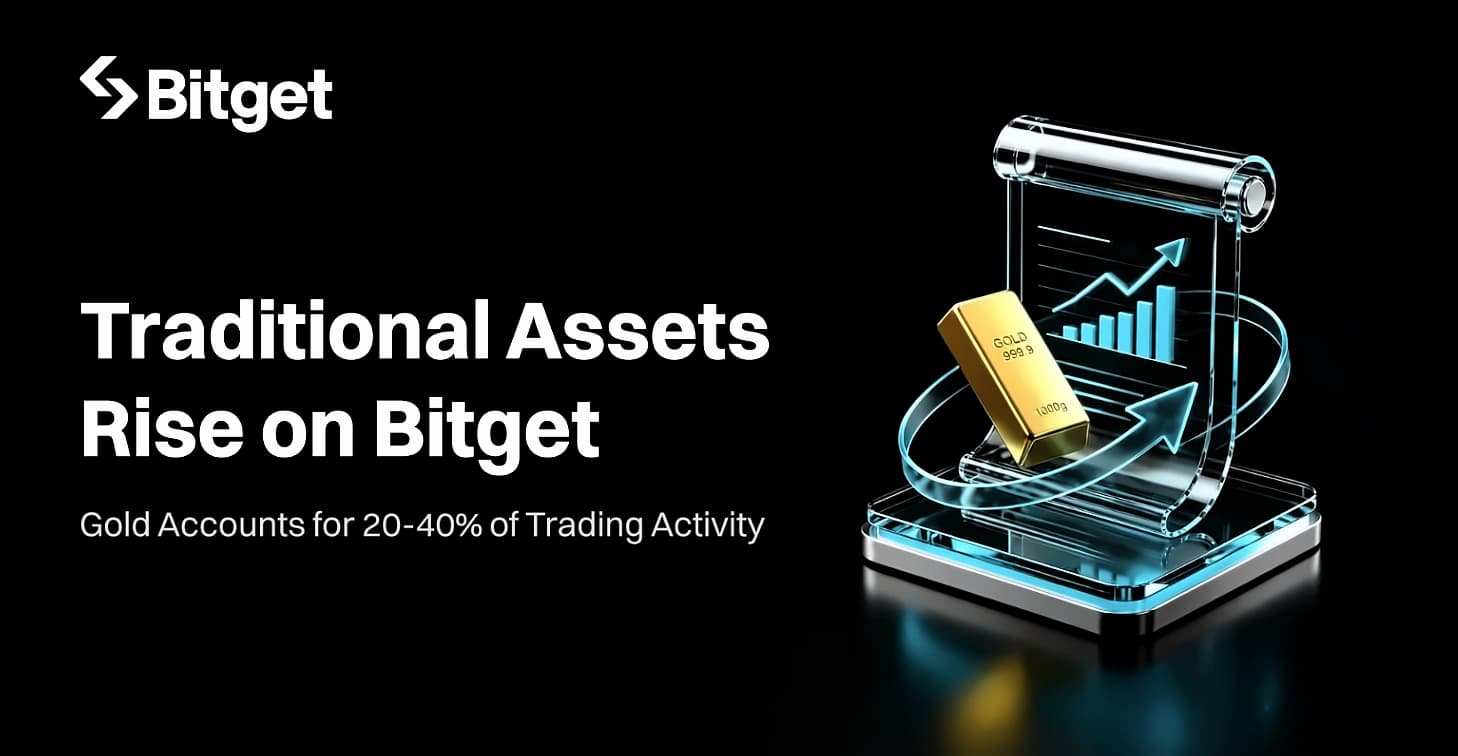
Crypto remained the main source of trading activity in Q1 2026, with 86% of surveyed users holding crypto assets. However, trading in traditional assets led by gold rose dramatically from near zero to between 20% and 40% of total activity, marking the strongest quarterly increase recorded for non-crypto assets on Bitget. As reported by Bitget, crypto accounted for nearly all trading volume in early January before stabilizing in a 60% to 80% range by March as participation broadened into other markets. According to the latest report, this shift represents a broader trend where crypto still dominates portfolios but its share of overall trading activity is gradually declining as users explore new opportunities across multiple asset classes. The company noted that rising demand for commodities, stocks, and AI tools shows users are building portfolios based on global signals rather than around a single asset class. The Bitget team highlighted that AI and precious metals or crude oil emerged as the two themes users most closely associate with investment opportunities in 2026.
Among high-net-worth participants, diversification is accelerating with significant performance results. Bitget users recorded an average annual return of 13% in 2025, while around 6% of VIP users achieved annual returns between 51% and 100%. According to the survey, 74% of high-value users said they plan to expand across crypto, equities, and commodities in 2026 to manage risk more actively, demonstrating the growing sophistication of institutional-level trading strategies. The data points to a maturation of retail investing where crypto remains central but is no longer the only game in town, with users increasingly spreading capital across multiple asset classes. Among surveyed high-net-worth clients, 74% said they plan to increase investments in crypto assets, stocks, and commodities in 2026 to manage risk more actively, with diversification accelerating even faster.
Regional trading preferences continue to reflect local macro conditions across different markets. In East Asia, 60% of users ranked avoiding currency conversion as a key reason for using USDT settlement, while 48% prioritized avoiding traditional account-opening requirements. In Southeast Asia, 46% of users identified leverage access as a major reason for trading traditional assets. In Latin America, 78% said diversification and protection against inflation or currency depreciation are their main reasons for holding both crypto and traditional assets, as reported by Bitget. The regional variations highlight how local market conditions and regulatory frameworks shape user preferences for different trading approaches, with users consistently describing the ideal trading platform as a system that combines access to global assets, stablecoin settlement, and centralized liquidity.
AI adoption is becoming integral to core trading behavior, with 51% of surveyed users already using AI tools to support investment decisions. Bitget's AI products, including GetAgent, GetClaw, and Agent Hub, are increasingly used to interpret earnings releases, commodity price moves, macroeconomic developments, and onchain signals across asset classes. The survey results show strong demand for the Universal Exchange model, with 71% of users identifying USDT settlement as the most important feature and 65% ranking fast switching across crypto, equities, forex, and commodities within one account as a top priority. This growing demand for all-in-one trading platforms reflects the maturation of retail investing where users require integrated solutions for managing diversified portfolios across multiple asset classes, with clients wanting transparent proof of reserves and AI-powered decision-making tools as part of their platform expectations. Users consistently described the ideal trading platform as one that combines global asset access, stablecoin settlement, centralized liquidity, transparent reserve verification, and AI-assisted decision-making tools within a single system.