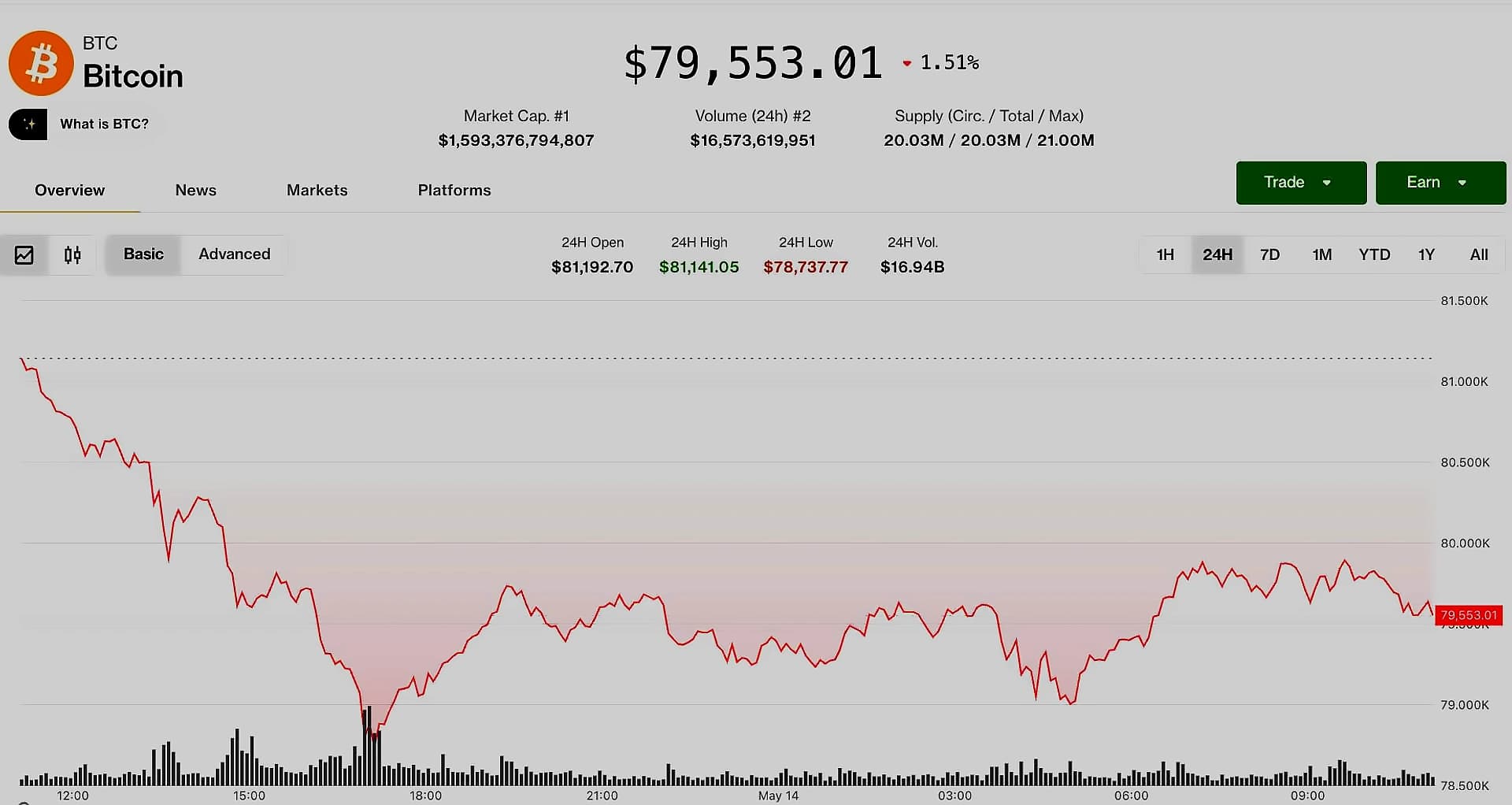
Bitcoin demonstrated remarkable resilience, holding above the $81,000 mark following April's core inflation reading that came in hotter than expected, with the cryptocurrency edging just 0.1% lower over the last 24 hours. According to The Wall Street Journal, the cryptocurrency's ability to remain above key support despite the inflation data could point to underlying market strength. The broader cryptocurrency market also held relatively firm, slipping just 0.5% in the last 24 hours, while U.S. equities declined following the inflation release. The SPDR S&P 500 ETF (SPY) dropped 0.61%, the SPDR Dow Jones Industrial Average ETF (DIA) slipped 0.48%, and the Nasdaq-100 tracking Invesco QQQ Trust (QQQ) tumbled over 1%. Retail sentiment on Stocktwits around Bitcoin remained in 'neutral' territory over the past day, as reported by The Wall Street Journal.
Bitcoin's recovery from February's $63,000 low has been supported by seven consecutive weeks of ETF inflows totaling $3.43 billion, providing a structural floor that did not exist during the Q1 drawdown. According to CoinDesk, Bitcoin ETFs recorded inflows of $272 million while spot XRP ETFs saw their largest inflows since January, with UBS disclosing a holding of 6.31 million MicroStrategy shares worth $1.12 billion, an indirect bet on MSTR's 818,334 BTC treasury. Strong U.S. jobs data showing 115,000 payrolls added and a single-day ETF inflow of $630 million on May 1 are keeping spot demand elevated heading into the vote. The crypto market is navigating a compressed macro calendar this week, with Bitcoin holding above $81,000 through a week of dense macro events supported by strong ETF inflows and steady on-chain activity including a 116% rise in daily transactions so far in May.
The CLARITY Act markup is scheduled for May 14 at 10:30 a.m. ET, with prediction markets now putting passage odds at 60%, representing a major catalyst for institutional adoption and price clarity across the digital asset sector. The Digital Asset Market CLARITY Act (H.R. 3633) passed the House on July 17, 2025, by a bipartisan vote of 294–134, granting the CFTC exclusive authority over spot markets for decentralized digital commodities while keeping SEC oversight over investment contracts. A May 11 compromise between Senators Thom Tillis (R-NC) and Angela Alsobrooks (D-MD) resolved key industry concerns, permitting activity-based rewards like staking while banning bank-style yields – earning Coinbase's public support. Senate Banking Chairman Tim Scott confirmed the committee is "in the red zone," with the legislative backdrop having shifted materially since Q1. According to CoinDesk, if the vote proceeds but faces amendments or delay, price chops between $79,500 and $82,800 with ETF inflows holding the floor, while Democrats' blocking of ethics provisions stalls the vote entirely, testing $80,000.
Bitcoin's technical structure shows constructive but not clean consolidation above $80,000, now acting as immediate support, with resistance sitting at $82,800, a level that rejected price earlier this week. As reported by CoinDesk, a clean close above $82,800 opens the path toward $85,000, the next meaningful ceiling flagged by on-chain analysts. Momentum leans bullish as miners offloaded roughly 3,400 BTC, and the sell pressure failed to dent the uptrend, with demand absorption remaining healthy. The near-term $78,000 to $79,000 range continues to function as a significant support zone where buyers have historically stepped in, while the $82,500 to $83,000 resistance band remains the key technical level for Bitcoin's next move. For altcoins, the rotation story is selective, with broader altcoin recovery likely to trail Bitcoin until a decisive regulatory catalyst arrives.

Fresh on-chain data from Santiment suggests Bitcoin's resilience above $81,000 is largely being supported by aggressive whale accumulation. Wallets holding between 10 and 10,000 BTC have collectively added more than 16,600 BTC over the past month, signaling growing confidence among large market participants despite macroeconomic uncertainty. Interestingly, the behavior of smaller retail wallets appears to be moving in the opposite direction, with addresses holding less than 0.01 BTC having slightly reduced their exposure during the same period, reflecting rising hesitation and short-term fear across retail traders. The crypto market is navigating a compressed macro calendar this week, with Bitcoin holding above $81,000 through a week of dense macro events supported by strong ETF inflows and steady on-chain activity including a 116% rise in daily transactions so far in May.