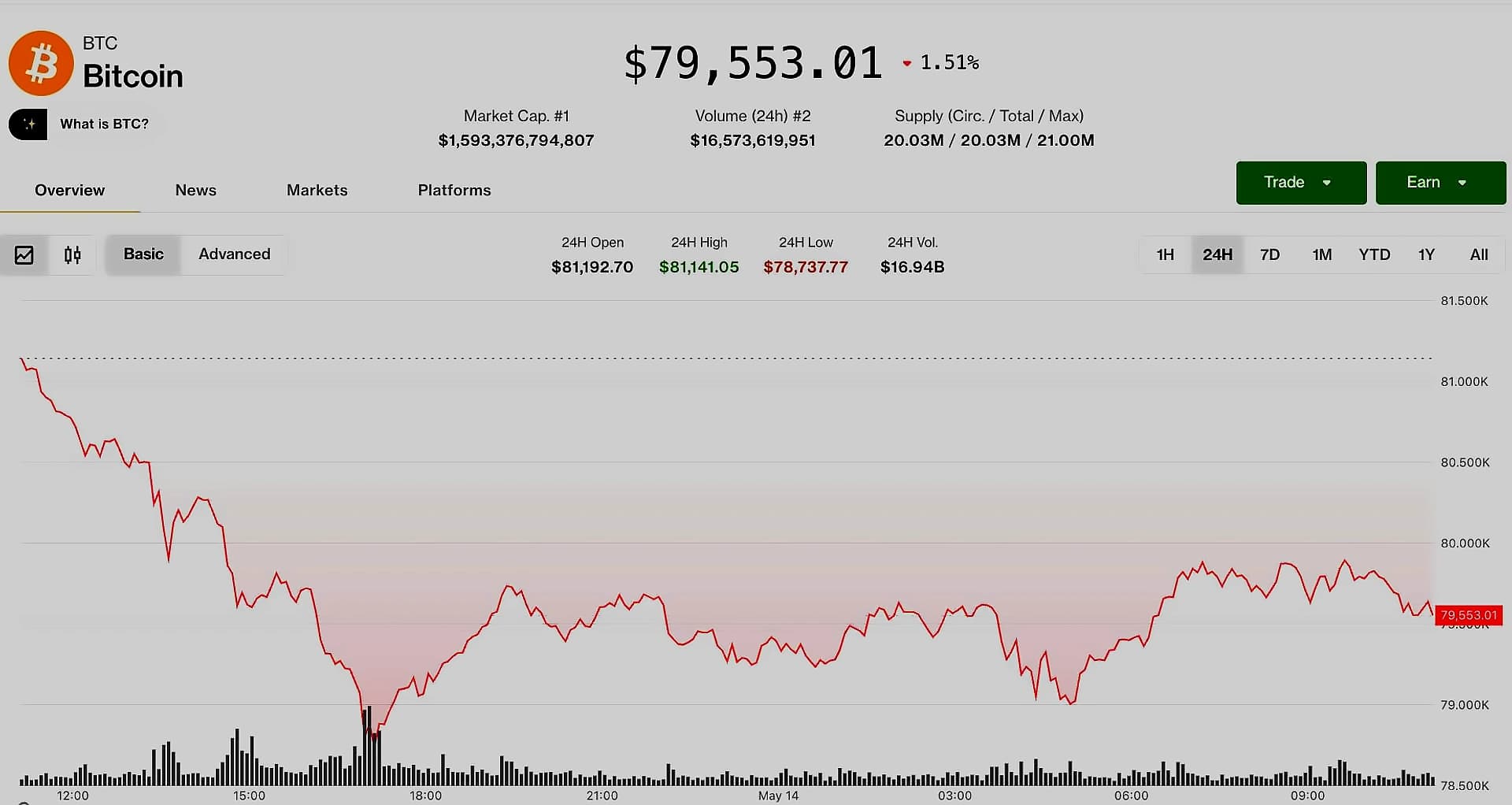
Bitcoin has rebounded to around $80,000 following a sharp selloff that pushed it below $79,000, with the recovery now directly tied to strong ETF inflow trends. After a period of outflows, Bitcoin ETFs recorded nearly $2 billion in net inflows in April, marking the strongest monthly demand of 2025. This institutional conviction appears to be reasserting itself, with over $600 million in net ETF inflows already seen in May. The price action follows an on-chain trigger when exchange outflows collapsed to just 19,995 BTC on May 11, creating a "positive netflow" that weakened the market's ability to absorb downward pressure. The rebound faces resistance from a significant $100 million sell order cluster stacked between $78,500 and $80,000, with the market needing to see exchange netflows turn negative again for sustained recovery.
The recent ETF inflow surge has a clear political driver behind it. The CLARITY Act passed the House in July 2025 with a 294-134 vote, establishing a bipartisan foundation for crypto market structure legislation. Analysts directly cite this progress as a key factor behind improved market sentiment and the six consecutive weeks of positive ETF inflows. The bill is now at a critical juncture, with the Senate Banking Committee expected to announce a markup hearing imminently. The odds of the bill clearing the Senate and becoming law in 2026 are estimated at roughly 50-50, as it must still navigate a 60-vote floor vote, reconciliation with other committees, and a presidential signature. Senator Cynthia Lummis has warned that failure could push market structure legislation into the next decade, with the legislative calendar tight and any delay beyond mid-May sharply reducing passage chances.
MicroStrategy (MSTR) has been a major institutional buyer, acquiring over 100,000 Bitcoin in March and April worth more than $7.7 billion, pushing the firm past BlackRock to become the largest holder of Bitcoin among publicly traded companies. However, the pace of that buying has slowed significantly, with Strategy acquiring just 3,273 Bitcoin for $255 million last week. The likely cause is a slowdown in sales of its STRC perpetual preferred shares, a key funding mechanism that trades below its $100 par value. When these shares trade at a discount, it becomes more expensive for the company to raise capital to buy Bitcoin. This shift highlights a direct link between corporate liquidity and on-chain flow, with Strategy's plan to pay dividends twice monthly aimed at smoothing out purchases, but its ability to fund that strategy now constrained by the market price of its own securities.
A major factor behind Bitcoin's latest correction was the rising selling activity from short-term holders (STHs) who began exiting positions near breakeven levels. Recent data from CryptoQuant shows that STH loss pressure surged sharply as BTC failed to sustain momentum above the $82,000 resistance zone, with many short-term holders reportedly selling near breakeven levels, increasing overall market supply. The latest spike in STH loss pressure suggests that weak hands were exiting positions amid growing uncertainty caused by macroeconomic concerns and declining bullish momentum. This additional selling pressure likely accelerated Bitcoin's downside move below the crucial $80,000 support level, as the current trend indicates that recent buyers are becoming increasingly cautious as volatility rises across the crypto market.
The rejection at the 200-day moving average has shifted short-term momentum back in favor of the bears, with Bitcoin now facing a critical technical crossroads. The latest rejection near $82,000 has raised concerns among traders, especially because BTC witnessed a massive correction the last time it failed to reclaim this indicator decisively. A similar rejection earlier in the cycle triggered a sharp 44% correction, pushing BTC from the local highs toward the $60,000 region. If Bitcoin continues trading below the 200-day MA, the next major support remains around $75,800, which previously acted as a strong breakout zone, with losing this level potentially exposing BTC to a deeper correction toward $71,500 or even the $63,000 region - a level that aligns with the previous consolidation base. On the bullish side, Bitcoin needs to reclaim and hold above $82,000 to invalidate the current bearish structure, with a strong recovery above this resistance potentially opening doors for a rally toward the $86,000 zone.