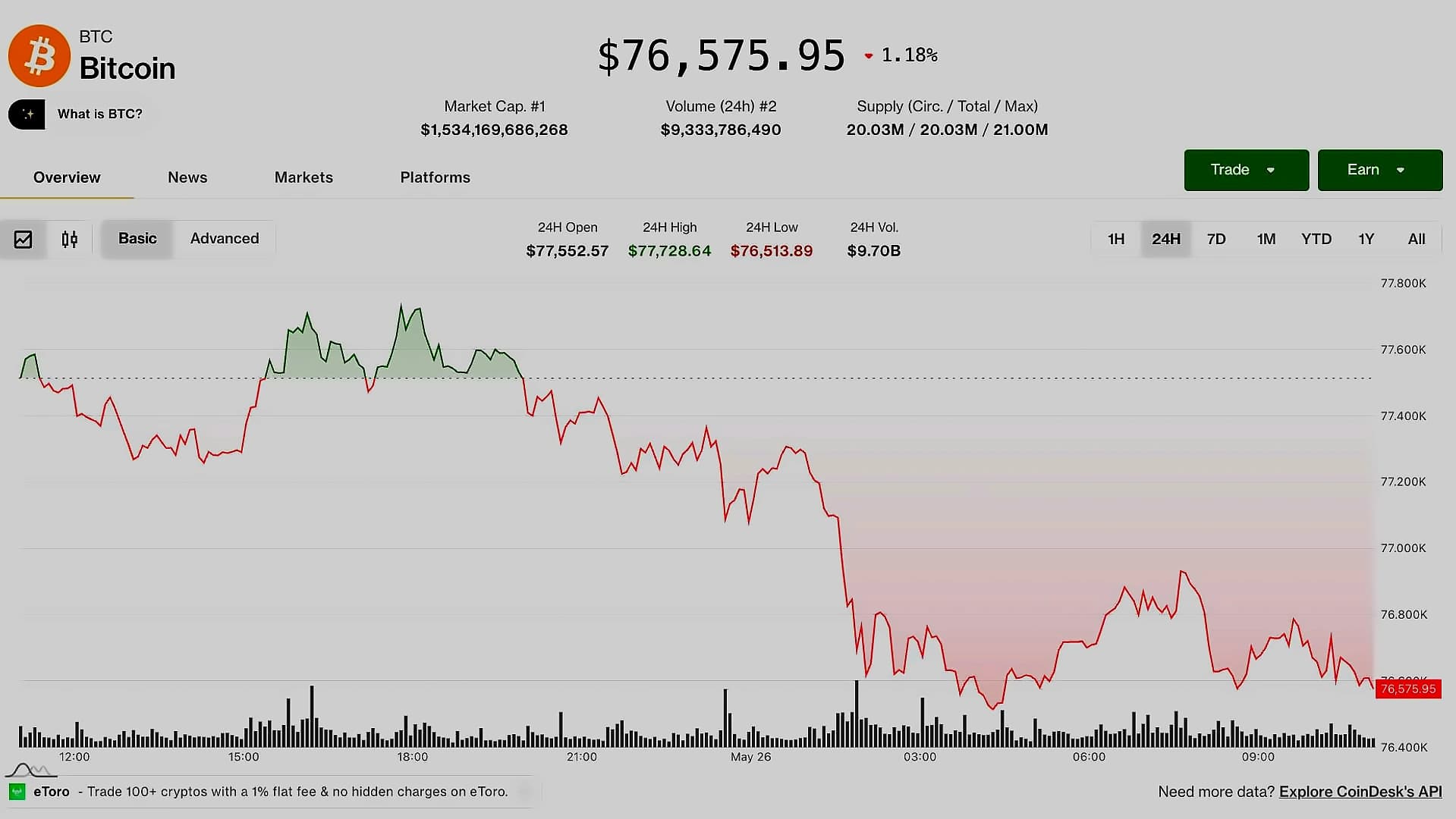
Bitcoin experienced its lowest level in over two weeks on Monday, 18 May, dropping to as low as $76,711 before recovering partial losses. According to reports from Mint, the world's largest cryptocurrency fell to its weakest level since May 1, as escalating macroeconomic concerns linked to the US-Iran conflict led traders to trim their exposure to risk assets. The latest data shows Bitcoin trading at $76,764, with the cryptocurrency slipping 2% in the past 24 hours as part of a broader market selloff. Other major digital assets, including Ether and Solana, also traded lower during the session, with Ether going down 3% to trade at $2,114. As per BTC Markets analyst Rachael Lucas, Bitcoin's pullback represents a macro story where risk appetite has repriced, with Bitcoin moving in tandem with broader market sentiment.
The cryptocurrency market witnessed nearly $661 million worth of liquidations in the past 24 hours, according to CoinGlass data, with 107,275 traders liquidated during this period. Coinglass data showed that nearly $550 million in long positions were liquidated between 6:30 a.m. and 10:30 a.m. Singapore time. US-listed spot Bitcoin exchange-traded funds recorded over $1 billion in outflows last week — the first such occurrence since late January, according to Mint reports. Bearish bets were concentrated at $77,500 with traders buying about $38 million in Bitcoin put options for May 18 expiry, as reported by Deribit data. The global crypto market capitalisation edged down 1% to $2.56 trillion, with the crypto fear and greed index dropping to 39, indicating the market sentiments are currently in fear.
The selloff intensified after Bitcoin breached a crucial support level near $77,800, with oil prices climbing to $111.35 per barrel amid stalled ceasefire talks between the US and Iran. As reported by Mint, investor sentiment remained weak due to the absence of progress on reopening the Strait of Hormuz, a vital global trade route. US President Donald Trump also warned that the 'clock is ticking' for Iran to reach an agreement, contributing to the risk-off sentiment across markets. According to FalconX Asia-Pacific derivatives trading lead Sean McNulty, the sudden fall in Bitcoin prices appears to have triggered a stop run in the absence of any macro headlines, with the weakness compounded by lingering downside hedging from the previous week. The sell-off was driven by global macro developments, as rising bond yields and inflation expectations in the US pushed investors toward a risk-off stance.
According to Harish Vatnani, Head of Trade at ZebPay, Bitcoin witnessed a decent rally from $65,000 to $82,850, surging by almost 27%. In the weekly time frame, the asset was trading in an uptrend, forming a 'Higher High Higher Low' pattern, but bulls failed to maintain their grip as last week saw profit booking at higher levels, causing the price to correct to $77,000. BTC Markets analyst Rachael Lucas noted that Bitcoin liquidations were triggered as the cryptocurrency fell through a key support level around $77,800, with structural support remaining between $76,000 and $76,800. Lucas emphasized that a close above $80,000 would be the first meaningful signal that selling pressure is exhausting. Vikram Subburaj, CEO of Giottus, noted that the market had slipped back below the psychological $80,000 level after failing to sustain last week's recovery, with the next trigger being the May 20 release of the FOMC minutes for the April 28-29 meeting.

Avinash Shekhar, Co-Founder & CEO of Pi42, emphasized that Bitcoin is currently navigating a crucial phase around the $80,000 mark, with markets closely watching whether BTC can sustain momentum above key resistance zones. As reported by Mint, he advised that this phase calls for patience, staggered participation, and a long-term approach instead of aggressive short-term positioning. Shekhar recommended that investors focus on portfolio allocation, liquidity management, and fundamentally strong digital assets with sustained ecosystem activity, noting that market cycles reward consistency and informed participation. Exchange inflows increased around recent highs, showing many traders were locking in profits while still remaining active in the market, with corporate and institutional activity remaining constructive in the crypto sector.