US forces struck Iranian missile and drone launch sites near the Strait of Hormuz on May 25, executing what Central Command described as a defensive operation amid ongoing peace negotiations in Doha. The strikes targeted command nodes, naval vessels, and assets preparing to deploy mines in one of the world's most critical shipping chokepoints, with no US forces harmed in the operation. According to CENTCOM, the trigger was an Iranian attack on three US Navy destroyers, marking the latest escalation in the ongoing US-Iran conflict that has included prior strikes against Iranian nuclear facilities and a tenuous ceasefire that began in April 2026. Bitcoin has historically behaved more like a high-beta tech stock than a safe haven during missile strikes, tending to sell off during acute escalations as traders de-risk across the board. However, Bitcoin surged past $72,000 during periods of diplomatic progress in the US-Iran conflict, with traders positioning around the event watching for concrete language from Doha about timelines for reopening the Strait or uranium enrichment caps.
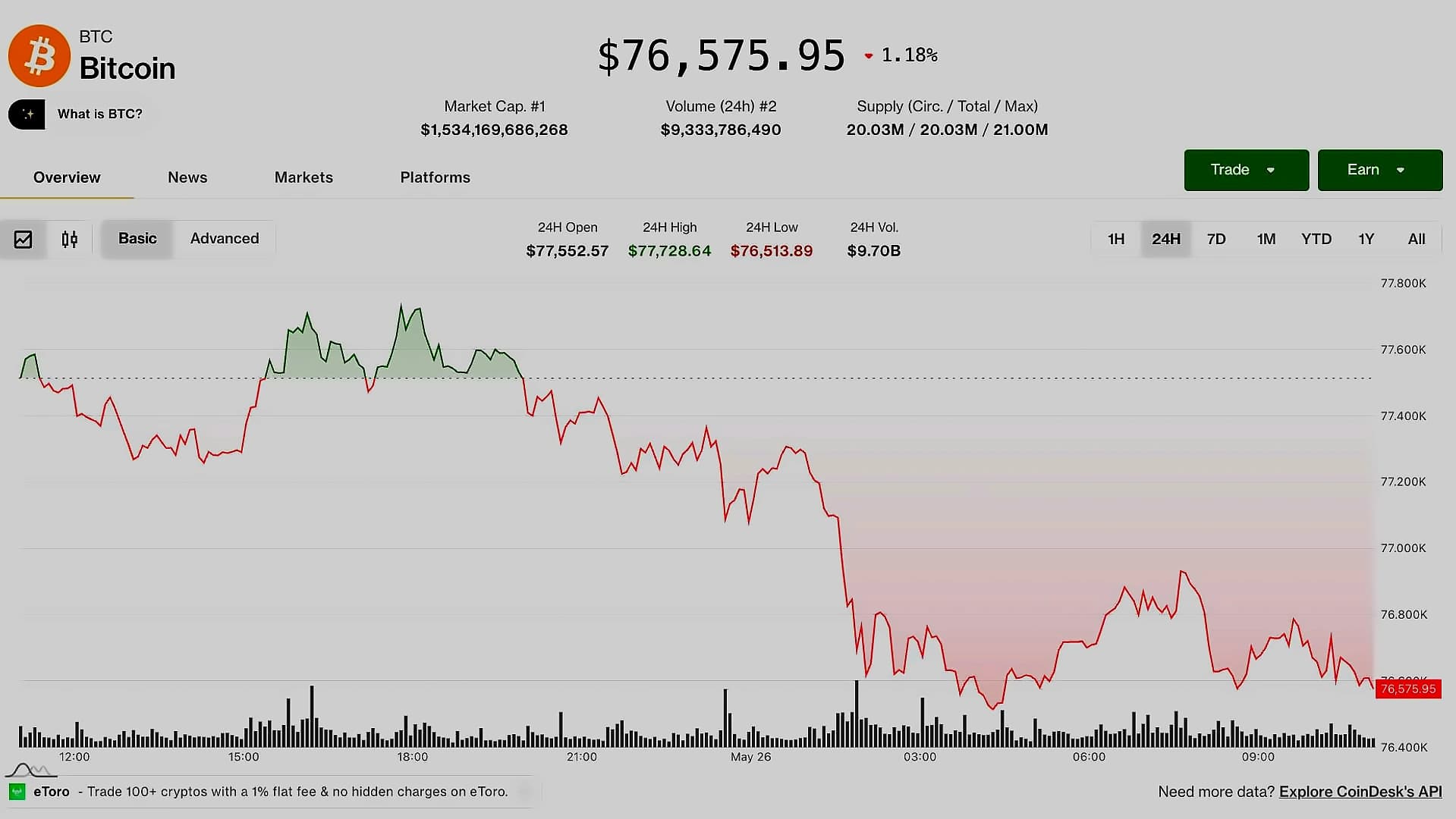
Bitcoin briefly fell below $77,000 on Tuesday as fresh U.S. strikes in southern Iran revived geopolitical uncertainty and put risk appetite on the defensive. Bitcoin had already whipsawed last week, falling from $79,000 to a local low near $74,000 before rebounding toward $77,000, with price momentum declining 21.7% and spot volume falling 10%, according to Glassnode. However, selling pressure is beginning to ease, with long-side funding payments surging 135.4% — pointing to renewed demand for long exposure even as broader activity cooled. Bitcoin is currently trading around $77,379 ahead of the U.S. market open, showing some recovery from recent lows. Bitcoin has spent the past week below the Short-Term Holder Realized Price near $78,600, leaving recent buyers underwater and likely to sell into any strength, as Bitfinex analysts noted.
The structural picture remains constrained by mounting leverage entering a weakening market structure. Bitfinex margin longs expanded to 82,681 BTC last week, the highest reading since November 2023 and an 88% increase from July 2025 lows — the kind of leverage accumulation observed during prior bear market drawdowns. This creates heavy breakeven resistance near $79,000, with the November–February cohort cost basis around $85,900 acting as the market's major structural ceiling. However, deeper supply metrics are notably constructive, with exchange reserves continuing to hover near a seven-year low of 2.21 million BTC and long-term holder supply holding steady at 14.43 million BTC. Neither dataset shows the aggressive distribution footprint of a sustained bearish regime, according to Bitfinex analysts.
AI-linked tokens are bucking the weakness, with the CoinDesk Computing Select Index adding 1.9%, led by RENDER and FET. As reported by CoinDesk, the DeFi Select Index gained 1.3%, suggesting investors are opting for more speculative bets while waiting for bitcoin and ether to resolve their current trading ranges. The Computing Select Index rose 2.7% over the past 24 hours, outperforming the broader crypto market. Meanwhile, Hyperliquid (HYPE) gained 28% over the past seven days and Near (NEAR) surged nearly 80% over the same period despite both being large-cap assets, pointing to selective accumulation around protocols with clear utility and demonstrable user and institutional demand. Capital continued to rotate into select altcoins even as most majors declined on Tuesday, further supporting the institutional rotation thesis.
The weakness is not reflected in broader financial markets, as S&P 500 index futures and Nasdaq 100 futures have gained more than 0.5%, pointing to crypto-specific headwinds rather than macroeconomic and geopolitical pressures. According to CoinDesk, the altcoin market is mixed, with notable gains across AI tokens and steep losses for privacy tokens like ZEC, XMR and DASH, which fell as much as 7%. On-chain activity reflects a similar consolidation trend, with declines in daily active addresses and transfer volumes suggesting reduced short-term engagement. However, unrealized gains rose slightly by 0.69%, which may indicate a stable or cautiously optimistic sentiment among TradFi investors, with limited immediate pressure from profit-taking. Liquidity metrics indicate a more stable market structure, characterized by stronger conviction among long-term holders and reduced speculation. CoinMarketCap's 'Altcoin Season' indicator is currently at 35/100, up from last week's low of 31/100 and below the monthly high of 50/100, with bitcoin rebounding from its 128-day moving average near $74,500 but remaining below key onchain resistance levels around $77,000.