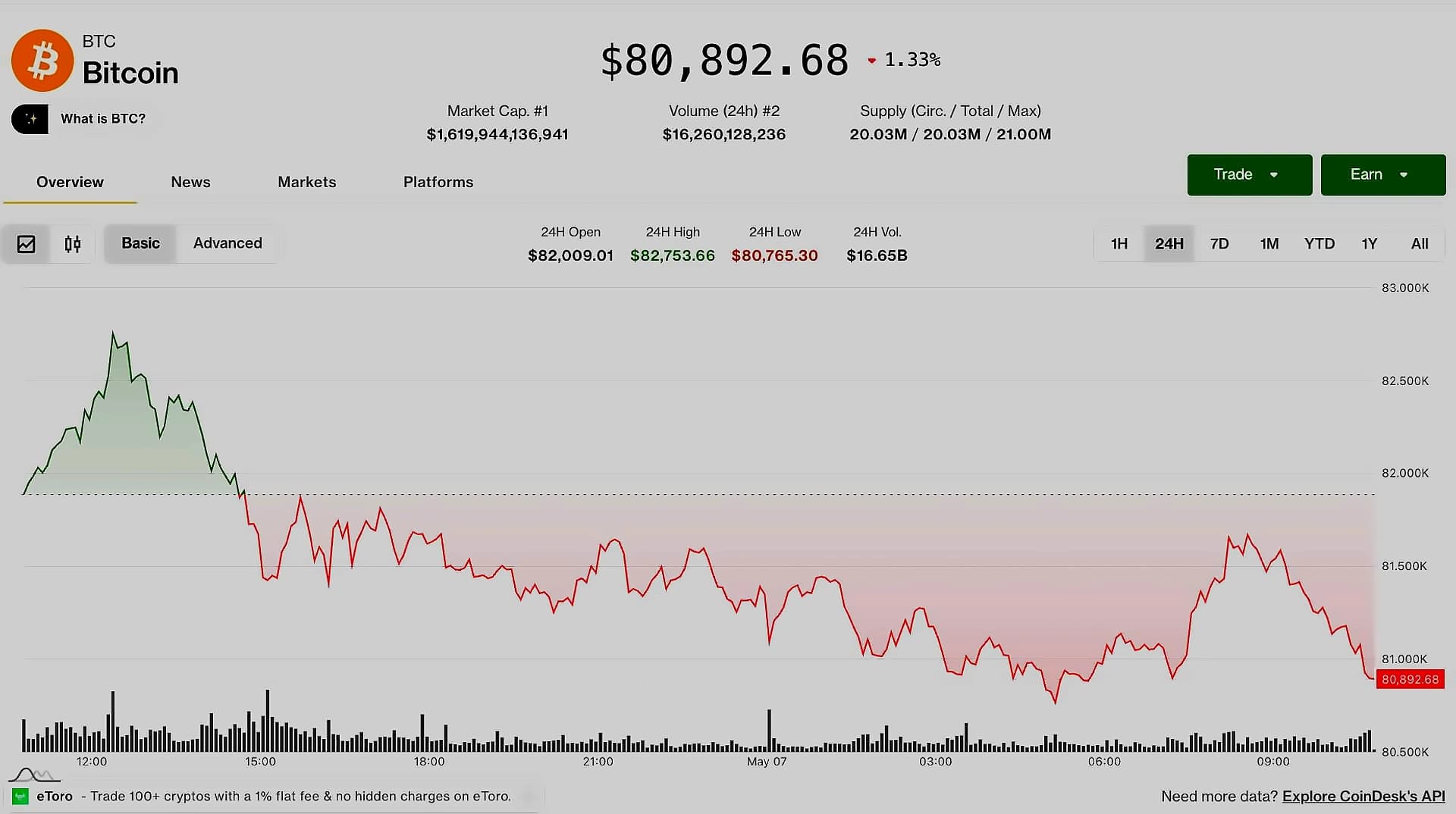
Bitcoin has achieved a clean break above the $74,000 resistance level that had capped price movements since February, marking a structurally significant development. This breakthrough represents the removal of Bitcoin from a consolidation block that had defined trade patterns since the start of the year. The $74,000 level is confluent with the 2026 yearly volume weighted average price (VWAP), which serves as a benchmark for institutional positioning and trend validation. The clean break above this level signals a potential shift from balance to expansion if acceptance above this level is sustained, with the 100-day moving average remaining a key dynamic resistance that must be surpassed for a sustained rally to fresh highs.
Bitcoin's order flow indicates significant buying pressure as it approaches $75,000, with early session activity showing a +663 active buy Delta near $73,800 that propelled the price above $74,600. However, a reversal was noted at higher levels, with active sell Deltas of -424 and -232 causing a pullback to $74,100. Key signals to monitor include a potential +400 to +600 active buy Delta breaking above $74,500, which could drive BTC towards $75,000. Conversely, an active sell Delta of -300 to -500 breaking below $74,100 might lead BTC to test the $73,500 liquidity zone. These dynamics are not visible on standard candlestick charts, providing insights into underlying market sentiment that traditional charts may miss.
Escalating US–Iran tensions have rattled global markets after US naval forces seized an Iranian-flagged vessel in the Gulf of Oman, prompting retaliation from Tehran and triggering fresh uncertainty around the Strait of Hormuz, one of the world's most critical oil transit routes. Conflicting narratives from Donald Trump and Iranian officials have only deepened the uncertainty, with Trump previously signaling that a deal was close but later threatening to destroy key Iranian infrastructure if negotiations collapsed. Iran has denied agreeing to core US demands, including abandoning its nuclear program, with the ceasefire itself now appearing fragile as its expiration approaches. The disruption to Hormuz traffic introduces a direct inflationary risk via higher oil prices, which could tighten financial conditions and pressure liquidity-sensitive assets like Bitcoin.
MicroStrategy's massive Bitcoin accumulation strategy faces a critical test as the company's ₹3.6 billion paper losses against its average cost basis of ₹75,577 per Bitcoin could trigger a negative feedback loop. The company recently purchased 13,927 BTC for approximately ₹1,000 crore, bringing its total holdings to 780,897 BTC, making it the largest corporate Bitcoin holder globally with over 3.7% of the entire Bitcoin supply. However, MicroStrategy's funding mechanism through ₹21.6 billion worth of STRC shares available for issuance creates a significant dilution risk, as the company continues to fund Bitcoin purchases by selling preferred shares. The primary risk is a reversal that would widen MicroStrategy's paper losses, potentially forcing the company to sell more equity to fund further Bitcoin purchases, creating a new wave of dilution.
According to reports from Hilbert Group, Bitcoin (BTC) is expected to face near-term pressure as liquidity conditions tighten in the cryptocurrency market. The assessment comes from Hilbert Group's Chief Investment Officer, who has identified specific factors contributing to the anticipated market challenges for the leading cryptocurrency. However, the current market is caught in a tug of war between "liquidity-driven rally" and "risk impact from the escalation of the Iran situation." The Federal Reserve and U.S. Treasury injected nearly $200 billion of liquidity into the financial system in a short period, driving a rapid rebound in the stock market and risk assets. This massive liquidity injection has provided traders with a "tax day buffer" and pushed the market sentiment indicator to a relatively fragile position, making it more prone to pullbacks. Despite the broader trend remaining bullish, the near-term outlook looks slightly to moderately bearish due to the combination of geopolitical tensions and technical weakness.