Bitcoin ETFs recorded $82.9 million in provisional net inflows for the week ended October 2, marking a significant decline from the $2.39 billion recorded in the previous week, according to Farside Investors data. The latest surge represents a substantial recovery from earlier levels, with Bitcoin climbing 3% to a weekly high of $86,912 on October 2, as reported by AMBCrypto. The weekly intake fell sharply from the preceding week's massive accumulation, with Bitcoin ETFs recording inflows on four of the five trading days during the current period. Friday's figures remained incomplete when checked on October 3, with blank entries for BlackRock's IBIT, ETHA and ETHB funds, keeping the Bitcoin weekly total provisional.
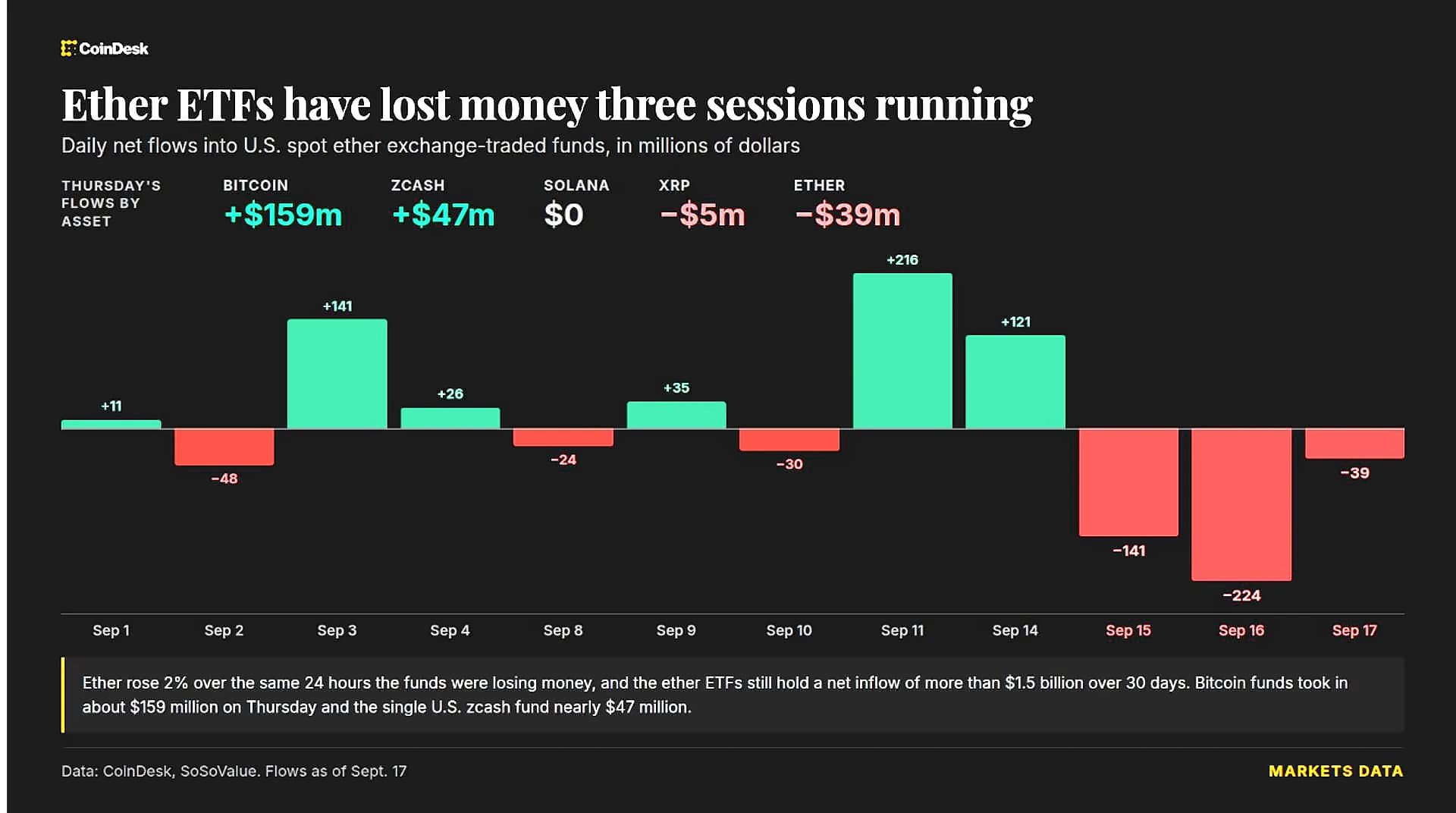
Ethereum ETFs posted $118 million in net outflows for the week ended October 2, reversing the previous week's strong performance when the sector attracted $689.8 million in inflows, according to Farside Investors data. The reversal began Monday with $17.1 million in net inflows before recording withdrawals during each subsequent session. Tuesday's outflow was $2.8 million, followed by $59.6 million on Wednesday and $55.4 million on Thursday, with a provisional $17.3 million recorded on Friday. Fidelity's FETH accounted for $74.1 million in weekly net outflows, with its largest withdrawal of $26.6 million on Wednesday, followed by $23.5 million on Thursday. Despite the SEC's approval of a 3x Ether ETF on October 2, ETF flows continued to show weakness with negative flows dominating for four consecutive days, accelerating from $59.58 million on September 30 to $37.36 million on October 2.
Bitcoin funds opened the week with $31 million in net inflows on Monday, followed by $66.2 million on Tuesday, before Wednesday brought $148.7 million in withdrawals. Investors then added $102.7 million on Thursday and a reported $31.7 million on Friday. BlackRock's IBIT recorded $292 million in net inflows across Monday through Thursday, with its largest intake of $195.6 million on October 1, following $9.5 million in withdrawals the previous day. Fidelity's FBTC posted $167.9 million in weekly net outflows despite receiving $29.3 million on Friday, while Grayscale's GBTC recorded $54.6 million in withdrawals. ARKB added $25.5 million over the week, and Grayscale's BTC fund attracted $24.9 million. ETF assets were not immune from the drawdown, as they slipped from $17.92 billion on September 22 to $17.46 billion, shedding a whopping $460 million.
On the TradingView daily chart captured October 2, Bitcoin traded at $86,272 after reaching a session high of $86,912, showing a 3.3% daily gain that places the price near the $84,012 Fibonacci level. The daily relative strength index reads 60.69, while the moving average stands at 64.92, showing momentum below the smoothed measure. According to Bitfinex, the daily chart places Bitcoin near the 0.618 Fibonacci level at $84,012.25, with the 50% retracement at $92,085.55 and the 38.2% level at $100,158.85. Ethereum structure remains resilient above $2,700 despite the massive outflows, as buyers are absorbing selling near the middle of a broader range. After nearing $2,777 on October 2, the price retraced toward the $2,625 support zone before recovering, showing demand remained strong enough to defend the $2,625–$2,650 area. However, buyers have struggled to turn that defense into a sustaining breakout, with each push toward $2,750 meeting renewed selling that keeps the altcoin below the $2,800–$2,825 ceiling.

According to reports from AMBCrypto, Bitcoin options traders are increasingly positioning for a move above $90,000, suggesting the market is beginning to price in a bull rally. On-chain data reveals that profit taking has just hit a 2026 high, while traders' unrealized profits are climbing to 33%. The market's focus remains on the FOMC, where shifting rate expectations have caused significant volatility, with rate-cut expectations dropping to 50% from 70% before the latest jobs report. The cautious mood also reflects a busy week of macroeconomic data releases, including U.S. core PCE inflation data expected to rise 0.3% month-on-month in August, ahead of ISM manufacturing PMI figures on Thursday and the key non-farm payroll report on Friday. For traders, softer inflation is supportive but not sufficient - lower yields would give a recovery more room to run. The U.S. nonfarm payrolls report due Friday represents a critical test for Bitcoin's Uptober rally, with September U.S. payroll growth at 29,000 below the 90,000 economists expected, and unemployment rising to 4.2% from 4.1%.
The U.S. nonfarm payrolls report due Friday represents a critical test for Bitcoin's Uptober rally, as reported by 99Bitcoins. September U.S. payroll growth was reported at 29,000, below the 90,000 economists had expected, with unemployment rising to 4.2% from 4.1%. August's payroll increase was revised to 133,000 from 162,000. Strong jobs data would give the Federal Reserve room to hike again after its September increase, lifting returns on safer assets and potentially pulling money away from speculative cryptocurrencies like Bitcoin. Weak data could have the opposite effect. Fed officials remain split, with some backing further hikes while others see no immediate need, and Polymarket now prices a 66% chance the Fed holds rates in October. The backdrop remains challenging with Treasury yields rising this week, inflation remaining sticky, and persistent U.S.-Iran tensions. For Bitcoin, the $85,000 level has proven critical, with the recent upswing showing Bitcoin's ability to flip this resistance zone. If the capital inflow holds steady and Bitcoin maintains momentum above $85K, the crypto is likely to reclaim $88K and eye $90K, while failure to produce a daily close above $85K could see Bitcoin revisit $82K.