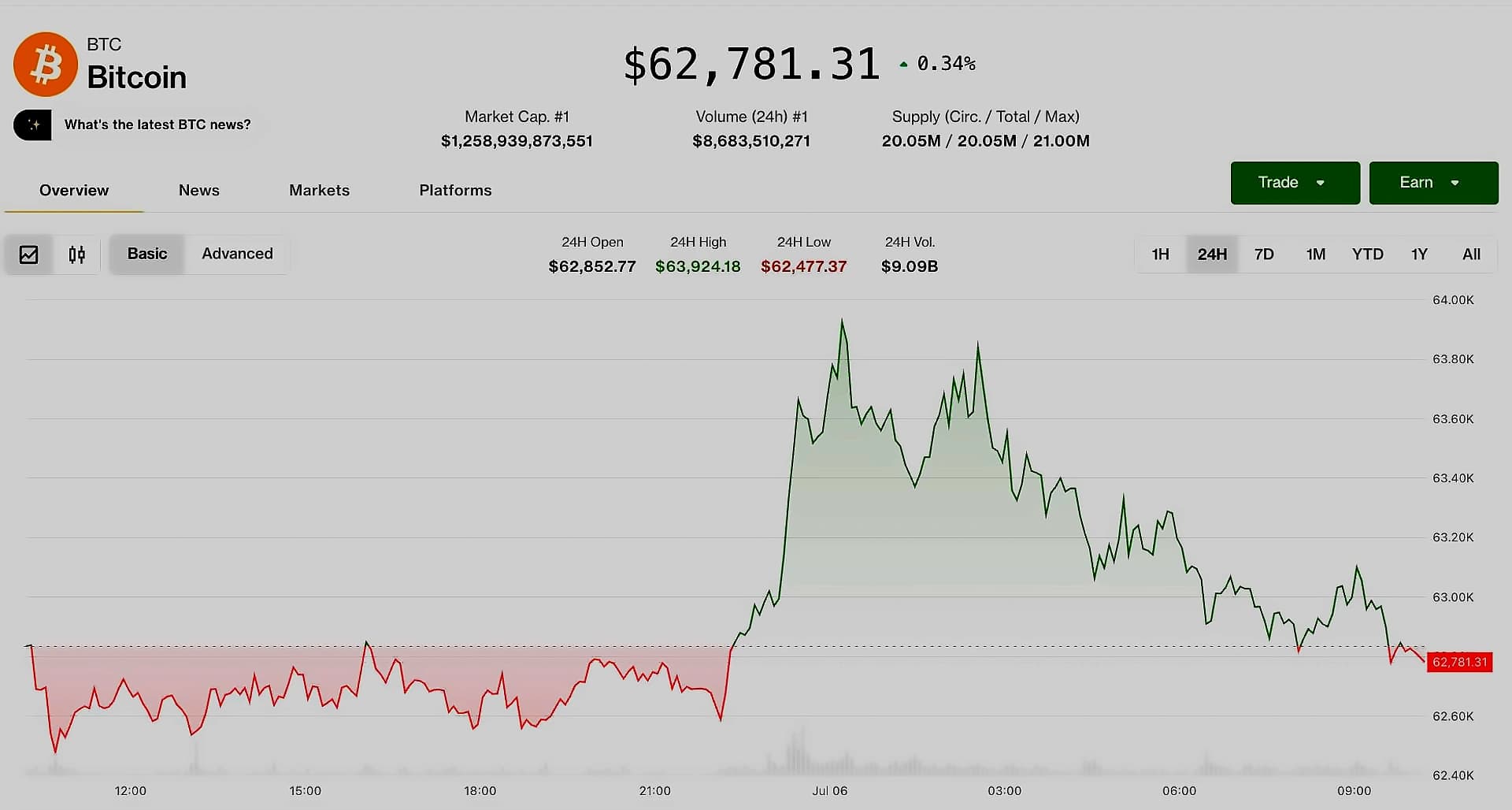
Bitcoin's recovery from last week's lows has triggered significant market movements, with $504 million in short liquidations over 24 hours representing the largest daily hit since late April. According to CoinGlass data, total crypto liquidations reached approximately $655 million and affected more than 104,000 traders, with bitcoin and ether positions accounting for the bulk of forced closures. The single biggest forced closure was a $12.3 million bitcoin futures position on the exchange OKX. Many traders had piled into shorts near the lows, then got caught when bitcoin rebounded to a high near $63,800 on Sunday, as reported by CoinDesk. Latest data shows the script has seemingly flipped, with daily liquidation volume dropping to just $629 million, of which only $160 million is from longs, while over $468 million is from shorts.
Bitcoin has recovered to around $63,000 following a sharp 19% decline from approximately $73,000 on May 31 to $59,000 on June 5, according to latest trading data. The cryptocurrency reached as high as $64,200 before sellers returned, with the daily range standing between $61,206 and $63,739. At the time of writing, Bitcoin traded near $63,000, up 1.39% over 24 hours, though the 14.06% seven-day loss remains a concern. The recovery shows signs of significant market participation, with 24-hour trading volume reaching 16,438 BTC, representing 47% of the 7-day average and 59% of the 30-day average. This substantial volume increase indicates the market is experiencing a more active consolidation phase compared to earlier quiet periods.
Bitcoin closed the week above its 200-week simple moving average near $62,800 after sweeping the February low, according to crypto analyst Crypto Rover. Holding above this average could support another test of $64,000 to $64,200, while a daily close below the average would return attention to $60,000 and the recent $59,100 low. The 14-day relative strength index stands at 26.43, below the 30 oversold threshold, showing that selling became stretched which can support a relief bounce. However, Bitcoin's MACD line sits near -4,019.58, below the signal line at -2,951.83, with the histogram remaining negative at -1,067.75, indicating sellers still control broader momentum. Analyst Ali Martinez lists the 300-week average at $55,000 and the 400-week average near $42,500 as the next broad support zones if the recent low fails. As per FxPro chief market analyst Alex Kuptsikevich, the current situation resembles mid-2022 conditions, where downward momentum weakened but a full-fledged reversal took months to materialize.

The broader market recovery hinges on Bitcoin's next move, with the cryptocurrency currently trading near its 200-week moving average, a level that has historically acted as a long-term support and key battleground between bulls and bears at major cycle turning points. Market stress is easing as implied volatility retreats, with the 30-day annualized implied volatility index BVIV retreating to 50% from a peak of nearly 59% on Friday, suggesting acute stress is fading. Ether's implied volatility also pulled back to 69% from 75%. The options market sentiment has shifted noticeably, with the five most actively traded instruments on Deribit in the past 24 hours all being calls, including a $170,000 strike expiring December 25, representing bets that Bitcoin will rally above that level before year-end. However, one risk factor remains - the dealer gamma profile around $60,000 continues to point to a setup where market makers may be forced to trade in the direction of price moves to rebalance their books.
Ethereum has bounced even harder than Bitcoin, surging +4% in the past 24 hours and trading at $1,670, according to 99Bitcoins data. While encouraging, this still leaves it needing a near-20% pump to reclaim $2,000. The Fear & Greed Index is back at near-all-time lows, sitting at 8/100, marking 'Extreme Fear' and one of its lowest levels since early May 2026, highlighting how fearful market participants are currently. ETF flows continue to lean bearish, with last Friday closing the week with a -$325 million outflow, leaving Bitcoin ETF products with just -$6 million sold via ETFs, while Ethereum fared slightly better. Ether slid from $2,000 to just over $1,500 from Friday to Sunday, bringing it to a $183 billion market cap compared with Tether's USDT's $186 billion, though it has since recovered above USDT.