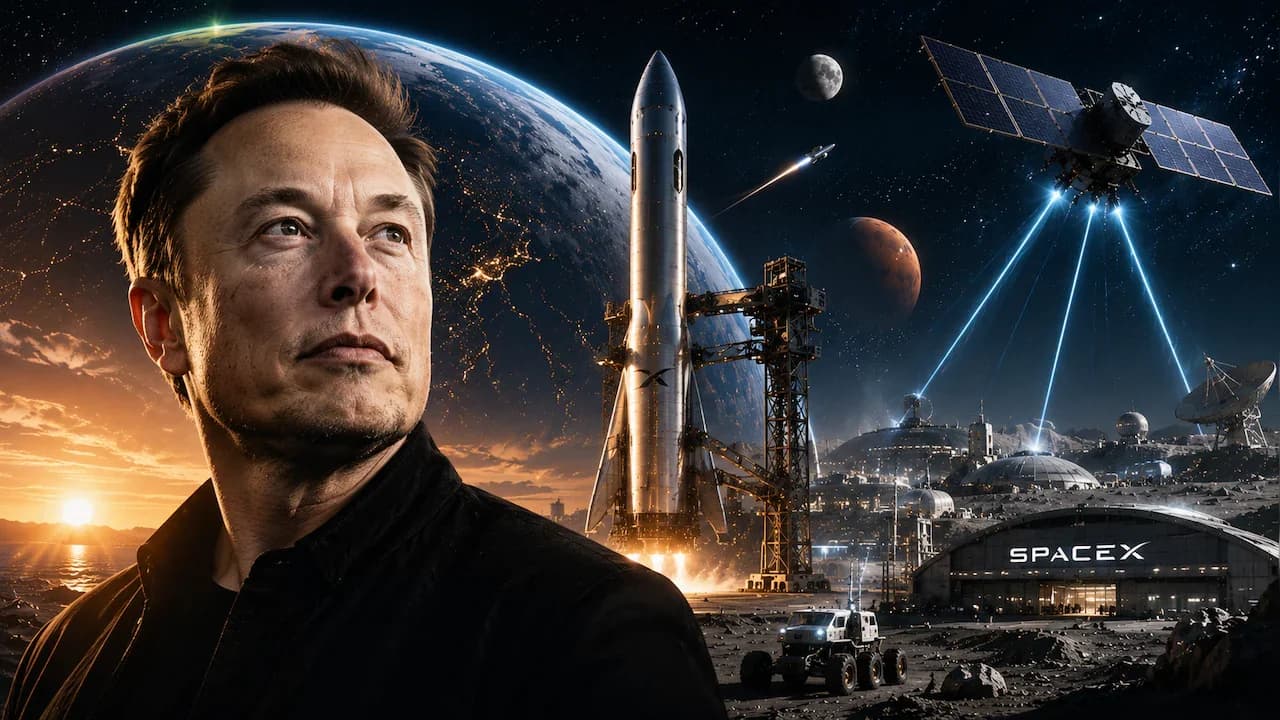
SpaceX has officially begun trading on Nasdaq under the ticker SPCX, opening at $150 per share - representing an 11% premium to its IPO price - in what is expected to be the largest IPO in history. The rocket maker raised $75 billion by selling 555.6 million shares at $135 apiece, valuing the company at $2 trillion, making it the sixth-most valuable listed company in the United States. At the IPO price, SpaceX ranks among the seven largest listed companies in the United States by market cap. SpaceX President Gwynne Shotwell and Chief Financial Officer Bret Johnsen rang the Nasdaq opening bell at 9:30 a.m. ET, while founder Elon Musk joined remotely from Texas. At a launch event in Starbase, Elon Musk promised he will take humanity to Mars, stating "SpaceX wants to be able to take you to the moon, take you to Mars, and ultimately beyond."
SpaceX shares surged more than 30% in their market debut, pushing the company's valuation to about $2.3 trillion and cementing its place among the world's corporate heavyweights. The rally propelled Elon Musk's rocket and satellite company to become the sixth-largest publicly traded company globally, behind only Nvidia, Alphabet, Apple, Microsoft and Amazon. The stock climbed as high as $176.52, or 31% above its offering price, less than two hours after the shares started trading shortly before noon in New York. This surge represents a significant turnaround from earlier market caution, with the pre-IPO SPCX perpetual contract having rebounded to approximately $176-$183 on Friday after hitting lows near $153 earlier this week. The recovery represents a significant turnaround from the 27% decline that brought the contract down from its mid-May launch price of around $216 to near $157 on Wednesday. Open interest stood near $216 million, with 24-hour volume above $150 million on Hyperliquid, reflecting renewed market confidence in the heavily oversubscribed offering. "For many investors, SpaceX is the closest thing to investing in the railroads during the Industrial Revolution and they are willing to pay the Elon Musk premium for that opportunity," said Seth Hickle, chief investment officer at Mindset Wealth Management in Indianapolis to Reuters. "The initial bump is within the range of normality for a technology stock," said Dec Mullarkey, managing director at SLC Management.
SpaceX generated about $19 billion in revenue last year from launch services, government contracts and Starlink operations, representing a significant increase from the previously reported $18.67 billion in 2025. The company dominates the global launch industry and says it has been responsible for more than 80% of the mass launched into orbit globally over the past three years. SpaceX said in its prospectus that its total addressable market is worth $28.5 trillion, which it described as the largest market opportunity in human history. Ahead of the listing, Musk said on a JPMorgan livestream that SpaceX has been cash-flow positive since around 2015 and is entering what he described as a "significant growth phase." The company plans to expand its satellite network, deploy more than 100,000 communications satellites and eventually build artificial intelligence data centres in space. Despite its rapid growth and dominant position in the commercial space industry, the company's prospectus shows that SpaceX has accumulated a total deficit of $41.3 billion since its founding.
SpaceX's valuation has crossed $2.5 trillion and reached its highest around $2.8 trillion before mildly pulling back, with the current valuation standing at $2.247 trillion. This immediately positions SpaceX as the world's sixth-largest company, surpassing Taiwan-based TSMC whose current market cap is around $2.206 trillion, while outrunning American giant Broadcom with a market cap of $1.818 trillion and Saudi Arabia's Aramco at $1.752 trillion. Notably, SpaceX's valuation has beaten Elon Musk's star-studded Tesla, which is currently the tenth largest company in the world with a valuation of $1.506 trillion. The shares ended the day at $160.95 a share to bring its value to $2.1 trillion, pushing SpaceX past Broadcom and with Amazon next in line at $2.6 trillion. If the bulls continue to rock over SpaceX, then soon this aerospace and defence behemoth will be dethroning Amazon and Microsoft from fourth and third rank respectively. The listing marks a major milestone for Musk's business empire, giving public market investors access to a company that spans commercial space launches, satellite broadband through Starlink and artificial intelligence through xAI.
Analysts and portfolio managers said investors should brace for volatility, particularly early in SpaceX's life as a public company, due to its small relative float and high valuation. SpaceX's $18.7 billion in revenue gives the company a price-to-revenue ratio of roughly 112, far above other megacap stocks. "The question remains is, what happens in a couple of weeks from now. Right now, people want to bid the stock higher because it's a winner at this point. Whether it stays that way, that remains to be seen," said Todd Schoenberger, chief investment officer at Crosscheck Management in Washington, D.C., to Reuters. In a best-case scenario, SpaceX could continue expanding Starlink, make its launch business more profitable, and generate annual returns of 25%-30%, potentially pushing its market value to $5 trillion by 2030. In a more moderate scenario, where the company delivers returns of around 5% and reaches a valuation of roughly $2.2 trillion, a ₹5 lakh investment would be worth about ₹6.08 lakh by 2030. However, if the company underperforms and investors face a 20% annual loss, the investment could shrink to ₹2.05 lakh by 2030. The valuation could increase further if underwriters choose to exercise their option to sell additional shares, a decision that is typically made within 30 days of an offering. The company is also expected to gain entry into the Nasdaq 100 under the exchange's fast-track inclusion rules, potentially making it a major holding for index funds and exchange-traded funds that track the benchmark.