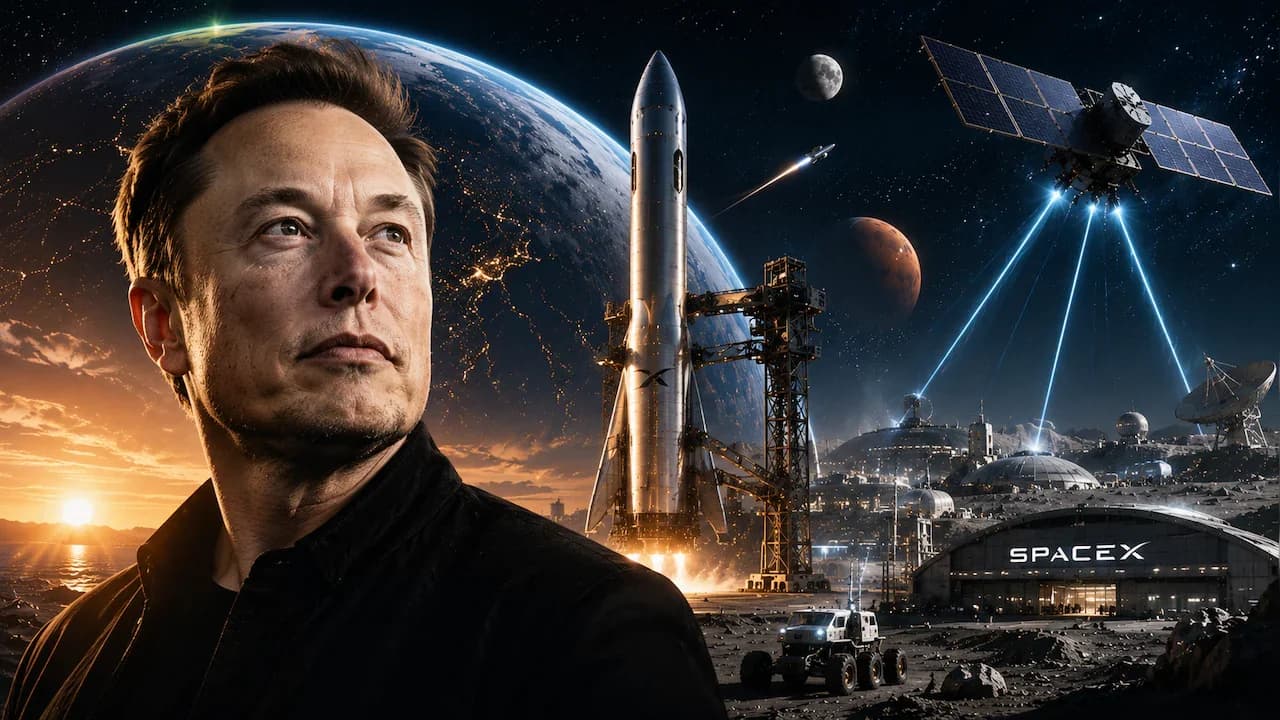
Elon Musk's SpaceX has achieved the largest US IPO ever, raising $75 billion and reaching a $1.77 trillion valuation in its historic Wall Street debut. The company's shares surged on market debut, opening at $150 against an IPO price of $135 and later climbing to $176.52, representing a 31% surge from the offering price. This exceptional performance pushed the company's market value above $2 trillion, making Elon Musk the first trillionaire on paper. The stock is trading under the ticker "SPCX" on Nasdaq, giving individuals the opportunity to freely trade in the company's shares. As per The Hindu BusinessLine, the IPO saw massive interest from both retail and institutional investors, with the company selling nearly 556 million shares priced at $135 each. The record IPO represents a significant shift in investor sentiment, as the market is placing a premium on future growth potential over established commodity-based businesses. The company has given banks handling the IPO the option to purchase an additional 83.3 million shares at the same IPO price, which would increase the offering size to approximately $86 billion if fully exercised.
The IPO has generated overwhelming demand, with individual investors showing tremendous interest and requesting more than $100 billion worth of SpaceX shares - far exceeding the 20% retail allocation that was reserved for them. According to Bloomberg News, the IPO drew demand for more than four times the available shares. SpaceX reserved an unusually large 30% of the offering for retail investors, giving everyday traders a much bigger slice than is typically seen in large public offerings. The company's order book closed on Wednesday, with banks managing the offering now deciding how shares will be distributed ahead of the planned Nasdaq debut. This retail allocation is designed to preserve strong founder control, with Musk holding the majority of a special class of shares that gives him control over company strategy, finances and personnel. The SpaceX IPO has also come as a boon for thousands of current and former employees by making them millionaires through the public listing. As per Goodreturns, the company's strategy for this IPO diverged significantly from established market norms by allocating 30% of its shares directly to retail investors and setting its share price before conducting traditional roadshows.
Japan emerged as a key participant in SpaceX's record-breaking global offering, with the company securing $2.2 billion from Japanese investors in what marked Japan's largest first-time share sale since JX Advanced Metals Corp.'s IPO last year. According to The Economic Times, SpaceX reserved 16.3 million Class A shares for the Japanese offering, representing about 3% of the total shares offered. The Japanese portion was led by Mizuho Financial Group, with the company aiming for $2 billion to $2.5 billion from Japanese investors. Japan was the only country in Asia, along with Australia, Canada and parts of Europe, where retail buyers had direct access to the offering. Mizuho Financial Group handled investor orders through its local brokerage as well as online brokers Rakuten Securities and SBI Securities. This international participation demonstrates the global appeal of SpaceX's business model and growth prospects across multiple markets.
SpaceX has demonstrated robust financial performance with revenue climbing 33% to $18.7 billion in the first quarter of CY2026 compared to $14.6 billion a year back. In CY25, revenue advanced 33% year-on-year to $18.67 billion. The company posted a net loss of $4.28 billion in the first quarter versus $791 million a year earlier, showing improvement in loss reduction. The company has received orders from around 1,000 institutional investors, demonstrating strong institutional confidence in the offering. SpaceX is set to debut on the Nasdaq Global Select Market and Nasdaq Texas on June 12, 2026, under the ticker symbol "SPCX". The IPO is being managed by leading investment banks including Goldman Sachs, Morgan Stanley, BofA Securities, Citigroup, J.P. Morgan, Barclays, Deutsche Bank Securities, RBC Capital Markets, UBS Investment Bank, and Wells Fargo Securities as book-running managers. According to The Economic Times, the stock's performance will be closely watched for signals on investor appetite ahead of forthcoming IPOs for AI heavyweights Anthropic and OpenAI, with SpaceX widely viewed as a dress rehearsal for a new generation of mega-listings.
SpaceX is set to begin trading on Nasdaq after investors poured $75 billion into the world's biggest IPO ever, betting that Elon Musk's lofty space, communications and AI ambitions can justify a $1.77 trillion valuation. As per The Hindu BusinessLine, shares opened at $150 against an IPO price of $135 and later climbed to $176.52, with the company becoming the maiden US company to list with more than a trillion-dollar valuation. The company priced the IPO at $135 apiece and sold 555.56 million shares. The record IPO represents a significant shift in investor sentiment, as Investing.com notes that the market is placing a premium on future growth potential over established commodity-based businesses. With the public listing, SpaceX has joined an elite club of companies having a valuation of over a trillion dollars. The company's president Gwynne Shotwell rang the market opening bell with Musk participating virtually from Texas. The stock's performance will be closely watched for signals on investor appetite ahead of forthcoming IPOs for AI heavyweights Anthropic and OpenAI, with SpaceX widely viewed as a dress rehearsal for a new generation of mega-listings. The company is expected to soon be a part of the Nasdaq 100 index as the stock exchange changed its rules in March for speedier entry of megacap listings, making it a major holding for passive funds and ETFs that track the index.
Despite SpaceX's historic achievement, market analysts are urging caution, citing historical patterns of major IPO declines. According to Investing.com India, five of the most anticipated IPOs over the past 15 years have all experienced significant declines after going public, with Uber dropping 70% below its IPO price, Meta Platforms falling 77% from their peak, Robinhood declining 92%, Coinbase losing 93%, and Rivian plunging 95%. However, the largest gains often came much later, after sentiment had turned negative and interest had faded - Robinhood surged 22-fold, Meta climbed 45-fold*, and Uber rose 7-fold* from their lows. As per Investing.com, the lesson is that patience often outperforms hype, and if history is any guide, the IPO won't be the opportunity, but the correction might be. The median major IPO has historically declined 31% during its first year as a public company and experienced a 53% drawdown at some point along the way. Despite these concerns, Deutsche Bank strategists note that issuance waves historically occur when market conditions are strong, with median market returns being +8% over the following three months and +20% over the next twelve months.