Welspun Corp's US Expansion: The $1.8 Billion Order That Changed Everything
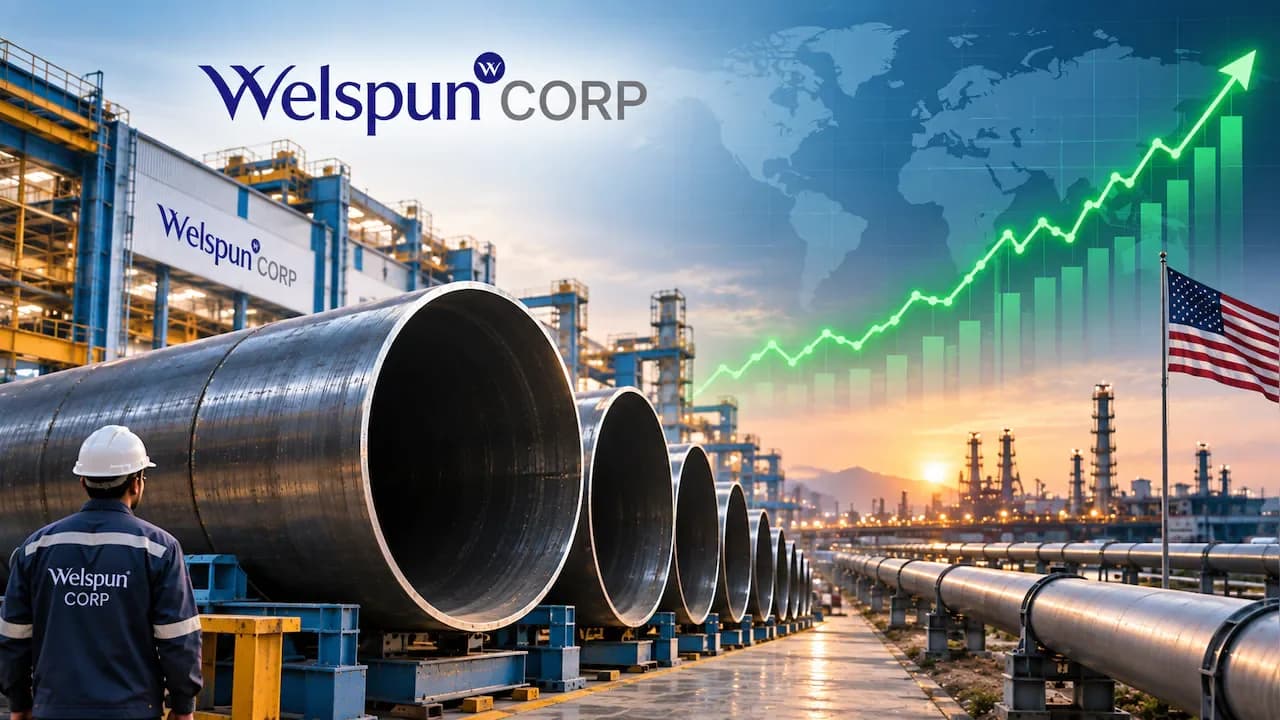
Here's the thing about Welspun Corp — it just pulled off something most Indian manufacturing companies only dream about. The company secured a massive $1.8 billion order for pipes from the US market, sending its stock surging 9% to Rs 2,193 in a single trading session. But this isn't just about one big order. It's about a fundamental shift in how the company makes money, where it makes it, and why the US market has become its golden goose.
The US Revenue Shift
Let's start with the numbers. In FY26, Welspun derived 27.2% of its revenue from the US market, compared to 71.7% from India. The remaining 1.1% came from other international regions. On the surface, this might look like India still dominates. But dig deeper, and you'll see why the US piece matters so much more.
That's a 39% premium. When you're talking about thousands of tons of steel pipes, that margin differential adds up fast.
This shift from 27.2% actual revenue to 66.7% order book representation shows where the future lies. Transcripts +1
Why the US? Why Now?
Three interconnected trends are driving this US opportunity, and management calls it a "paradigm shift" in American energy infrastructure.
First, LNG exports. Henry Hub natural gas prices hover around $3, while international LNG prices command $15-20. That's massive arbitrage, and it requires pipelines — lots of them. Midstream companies are planning approximately 9,000 miles of new pipelines to transport gas from producing basins like the Permian to Gulf Coast export terminals. LNG exports grew from 14.7 billion cubic feet per day in 2025 to 16.3 Bcf/d in 2026, with projections exceeding 25 Bcf/d within three years. Transcripts +1
Second, AI data centers. This one's fascinating. More than 5,000 data centers are planned across America, and they're power guzzlers. The US grid isn't reliable enough for them, so these facilities are building their own gas-based power plants on-site. Those plants need pipelines. It's an entirely new value chain that didn't exist five years ago. Transcripts +1
Third, oil pipeline revival. After years of underinvestment, US oil pipelines are making a comeback. America has become one of the world's largest oil producers, achieving surplus for exports after meeting domestic consumption. With production costs around $40 per barrel and prices exceeding $80, the economics justify new infrastructure. Transcripts
The Competitive Edge
Here's where it gets interesting. Why did Welspun win this $1.8 billion order over domestic US manufacturers? The answer lies in capabilities that competitors simply can't match.
The company provides complete solutions — line pipes, corrosion coatings, concrete coating, bends, and bend coatings. It's not just selling pipes; it's selling peace of mind. InvestorPresentations +1
The company also operates the only hydrogen laboratory in India, developed in collaboration with DNV Norway. This positions Welspun for the energy transition market before most competitors have even started thinking about it. When you combine this with an impeccable quality track record and relationships with marquee clients like Saudi Aramco, Qatar Energy LNG, Total, Shell, and Chevron, you get a compelling value proposition. AnnualReports +1
Manufacturing Footprint Strategy
Welspun's US manufacturing facilities in Little Rock, Arkansas, give it a crucial advantage — it's local. The company operates under 'Buy America' provisions, avoiding import tariffs and meeting domestic content requirements that foreign competitors can't navigate. A new greenfield LSAW (Longitudinal Submerged Arc Welded) facility is under construction and expected to be operational by the end of calendar year 2026. An HFIW (High Frequency Induction Welded) plant for small diameter pipelines was commissioned in Q1 FY27. AnnualReports +1
This local presence does more than just avoid tariffs. It puts Welspun "plugged into the market," enabling day-to-day customer interaction and awareness of upcoming projects. You can't build those relationships from 8,000 miles away. Transcripts
Financial Impact and Visibility
The $1.8 billion order, combined with other wins, has expanded Welspun's global order book to a record $4.4 billion. The US spiral mill is now booked through FY28, providing 5-7 years of revenue visibility. That's the kind of predictability investors pay premium multiples for. InvestorPresentations +1
The financial metrics tell the story.
The company has established a guardrail to maintain ROCE above 20%, and it's delivering. Q1 FY27 showed revenue growth of 15% year-over-year, but EBITDA grew 35%, demonstrating operating leverage. Net profit surged 199% to Rs 1,048 crore. InvestorPresentations +1
For FY27, management guidance targets revenue of Rs 20,000 crore (19% growth) and EBITDA of Rs 2,850 crore (20% growth). The company has consistently met or exceeded EBITDA guidance while maintaining revenue discipline. InvestorPresentations
The Stock Market Reaction
When the $1.8 billion order announcement hit, Welspun's stock jumped 9% to Rs 2,193. But the real story is the sustained momentum. The stock is up 44% over one month, 77% over three months, and 197% over six months. Trading volume on announcement day hit 14.1 million shares — nearly 20 times the monthly average.
This isn't short-term speculation. It's structural re-rating driven by fundamentals. The PE multiple has expanded to around 21x, up from two years ago. But given the 19-20% growth guidance, ROCE above 20%, and multi-year visibility, the valuation appears justified. InvestorPresentations
Execution Risks and Capacity Constraints
Of course, no story is complete without discussing risks. All existing plants are booked through FY28, which limits flexibility for new opportunities. The company has strategically kept some large diameter capacity available for high-value opportunities, but it's a delicate balance. Transcripts +1
Supply chain disruptions have been minor so far and haven't impacted project timelines. Long-term contracts protect against shipping cost increases. Management expresses confidence in delivering guidance despite the challenging environment, citing strong execution capabilities and operational rigor. Transcripts +1
The new LSAW facility in Little Rock will be crucial. It's already receiving inquiries and orders before commissioning, which suggests demand will exceed capacity from day one. The company expects revenues and margins from the new facility to start trickling in FY27, with full benefits visible in FY28. Transcripts +1
The Margin Story
Here's why this matters for profitability. As the geographic mix shifts toward higher-margin US operations, overall profitability improves. The current order book split (66.7% US, 33.3% India) compared to the FY25 revenue mix (26.7% US, 66.8% India) shows this transition is already underway. AnnualReports +1
Q1 FY27 EBITDA margins expanded to 18.5%, up 270 basis points year-over-year. This margin expansion occurred alongside 15% revenue growth, demonstrating the operating leverage from the US business. As more high-margin US orders flow through the income statement, expect this trend to continue. InvestorPresentations
What Lies Ahead
The company's strategy focuses on maintaining leadership in core products while leveraging geographical positioning to capitalize on the massive infrastructure build-out in US energy and data center sectors. Transcripts +1
The $1.8 billion order isn't just a one-time win. It's validation of a strategy that's been years in the making. Welspun positioned itself for this moment by investing in US manufacturing, building relationships with top-tier customers, and developing technological capabilities that competitors can't easily replicate.
For investors, the key question isn't whether Welspun can deliver on this order. It's what comes next. With the US spiral mill booked through FY28, new capacity coming online, and structural demand drivers in place, the company has created a multi-year growth runway that most industrial companies would envy.
The 9% stock surge on the order announcement? That's just the market catching up to what management has been building all along.