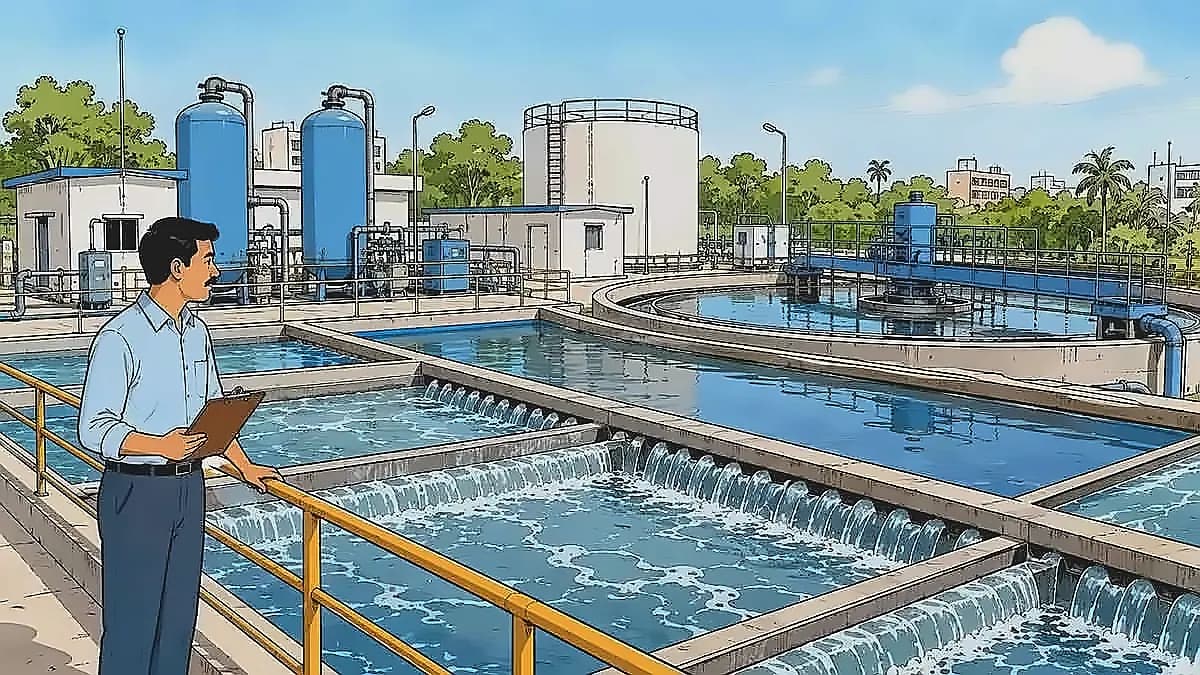
India's water infrastructure story is often painted with a broad brush—Rs 20 lakh crore of opportunity, decades of demand, and tailwinds everywhere. But if you look closer, the companies riding this wave are playing very different games. Va Tech Wabag and Jash Engineering both sit in the water ecosystem, yet their order books, business models, and valuation logic tell contrasting stories about how to turn opportunity into earnings.
The Order Book: Depth vs. Speed
That's roughly 4.7 times its trailing twelve-month revenue of Rs 4,263 crore. More importantly, about 32% of this backlog comes from operations and maintenance (O&M) contracts—recurring revenue that provides long-term visibility. O&M contributed about 18% of H1 FY27 revenue, and management targets 20% over the medium term. This isn't just a pile of orders; it's a multi-year earnings base. Investor Presentation +2
Jash Engineering operates in a different lane. Its confirmed order book is Rs 955 crore, about 1.2 times annual revenue. The company is export-heavy, with roughly 65% of orders coming from international markets. But here's the thing: Jash's business is more book-and-bill, with shorter execution cycles. The order book isn't a multi-year buffer like Wabag's—it's a near-term pipeline that needs constant replenishment. Management has guided for Rs 875 crore of sales in FY27, with H1 already at Rs 351 crore, so the second half needs strong execution and fresh orders. Investor Presentation +3
The negotiated orders you mentioned—Rs 46 crore negotiated and Rs 129 crore under negotiation—don't appear in the filings I retrieved. Even if accurate, these aren't confirmed orders. They add to upside potential but don't count as visibility. Wabag's approach is more conservative: it removed about Rs 600 crore of orders from its backlog because they weren't yet effective, counting only what's ready for execution. Transcript
Geography: Risk and Reward
Wabag's revenue split is roughly 46% India and 54% international in H1 FY27. Management says international orders typically execute faster because they're funded projects with tariff-based revenue. Analysts have raised concerns about Middle East execution risks—importing equipment, mobilising labour—but management calls the impact minimal so far. Investor Presentation +3
Jash is more exposed, with 65% of its order book from overseas. That brings currency risk. Wabag says it has no forex loans and no foreign-currency asset or liability positions, describing forex gains as operational. Jash, by contrast, has unhedged exposures in USD, SGD, and EUR. The company uses forward contracts but doesn't hedge everything. Shipping disruptions are already biting: material for Qatar has been stuck for over three months, and Middle East orders are held in stock due to vessel shortages. Singapore deliveries are on hold over payment issues. This is the price of an export-heavy model. Transcript +4
Business Model: EP vs. EPC and the Margin Puzzle
Here's where the narratives diverge sharply. Wabag's H1 FY27 order intake was about 91% EPC (engineering, procurement, and construction), not the 80% "Pure EP" figure you mentioned. The company doesn't report "Pure EP" separately; EP is treated as a sub-part of EPC. Management aims for EP to be 10-20% of revenue over time, noting that design-build orders often carry better margins because construction is a pass-through. Wabag's H1 FY27 ROCE was 20.5%, and it targets above 20% over the long term while staying net cash positive. Investor Presentation +4
Jash's reported ROCE of 17.7% isn't in the filings I found; FY26 ROCE was 19.38%, actually slightly higher than Wabag's 19.15% that year. The Vestec India integration and 21-23% EBITDA margin target also don't appear in the retrieved documents. The closest acquisition I found is WesTech Process Equipment India, renamed Jash Process Equipment, which the company is integrating to optimise capacity and cost. Jash's TTM EBITDA margin is 15%, well above Wabag's 11.3%, but the medium-term target you cited isn't confirmed. Annual Report +1
What is clear is that Jash's margins got a boost from a US tariff refund. Management received about Rs 5.6 crore, with another Rs 7.5 crore pending. This helped drive H1 FY27 profit up 234%. But a refund of previously paid duty looks non-recurring by nature. Management hasn't explicitly called it one-time, but it's safer to treat it as a boost rather than a sustainable margin driver. Transcript +2
New Frontiers: Semiconductors, Data Centres, and a US Plant
Both companies are looking beyond their core markets. Wabag is positioning itself as a complete water solutions provider, from raw water to ultra-pure water (UPW) and zero liquid discharge (ZLD). It has won a breakthrough order for a solar cell manufacturing facility and is pursuing opportunities with leading solar and green hydrogen players.
The target is 1-2 selective orders in the next 12-18 months, with a more significant contribution over 3-5 years. Investor Presentation +3
Jash's big bet is a new manufacturing facility in Houston, Texas. The plan targets USD 30 million rising to USD 75 million in sales over five years—not the USD 50 million figure you mentioned. The plant is needed partly because the existing Orange, Massachusetts facility faces staff shortages. Capex has ballooned from about USD 4.2 million to USD 7-8.5 million, with total US and Saudi capex now around USD 16 million. Funding will come from deposits, internal accruals, and modest debt. The plant is due by December 2027, with operations by March 2028. This local-for-local approach should mitigate US tariff exposure, currently around 15.6%, but it doesn't help with near-term shipping delays to the Middle East. Transcript +4
Jash has also entered the data centre cooling market with pressure vessels modified from its existing transmission-line products. The first order is for 4 vessels, with a second for 32 under negotiation. The company has quoted for more than 600 vessels. Management says it's capacity-constrained for this work and will consider further investment once order flow is sustained. The 20-30 vessels per year run rate isn't confirmed, but the pipeline suggests this could become a meaningful segment. Other +2
Valuation: Growth vs. Visibility
Here's the puzzle:
The market seems to be pricing Jash's faster recent growth—revenue CAGR of 19.7% over five years versus Wabag's 6.8%—and its margin expansion. Jash's H1 FY27 EBITDA rose 75%, and PAT jumped 234%. The data centre and US expansion stories add growth options for a smaller company (market cap Rs 3,511 crore vs. Wabag's Rs 12,546 crore). Investor Presentation
Wabag's valuation reflects its scale and visibility. A 4.7x order book coverage, 32% recurring O&M, and net cash position provide a cushion that Jash lacks. Wabag's PEG ratio (price/earnings to growth) is about 1.0, lower than Jash's 1.97, suggesting the market expects Wabag's growth to be more sustainable even if slower. The five-year median P/E figures you mentioned (20.6x for Wabag, 35.1x for Jash) aren't in the data I retrieved, so I can't verify how current multiples compare to history.
Balance Sheet: Funding the Growth
Net working capital days have improved to 101 days from about 130 over three years. Management says 100-110 days is normal for a construction business growing 15-20%. With H1 operating cash flow at Rs 225 crore and minimal capex needs (the model is asset-light), Wabag looks well-placed to fund its 15-20% revenue CAGR target internally. Investor Presentation +5
Jash's balance sheet is tighter. Cash and investments total about Rs 123 crore, against borrowings of Rs 77 crore and lease liabilities of Rs 20 crore. That's roughly Rs 27-46 crore of net cash, depending on whether you include leases. The company needs to fund about USD 16 million (roughly Rs 140 crore) of capex for the Houston and Saudi plants. Funding will come from deposits, accruals, and USD 3-4 million of debt. It's manageable, but there's little room for error or large acquisitions. Working capital is Rs 303.5 crore, but operating cash flow data wasn't available in the retrieved documents. Investor Presentation +4
The Bottom Line
Wabag and Jash are both beneficiaries of India's water infrastructure push, but they're playing different games. Wabag offers scale, recurring revenue, and a balance sheet that can support steady growth. Jash offers higher margins, faster recent growth, and ambitious global expansion—but with thinner visibility and more execution risk. The market has priced them accordingly: Wabag for stability, Jash for upside. The question for investors isn't which story is better, but which one you believe in.