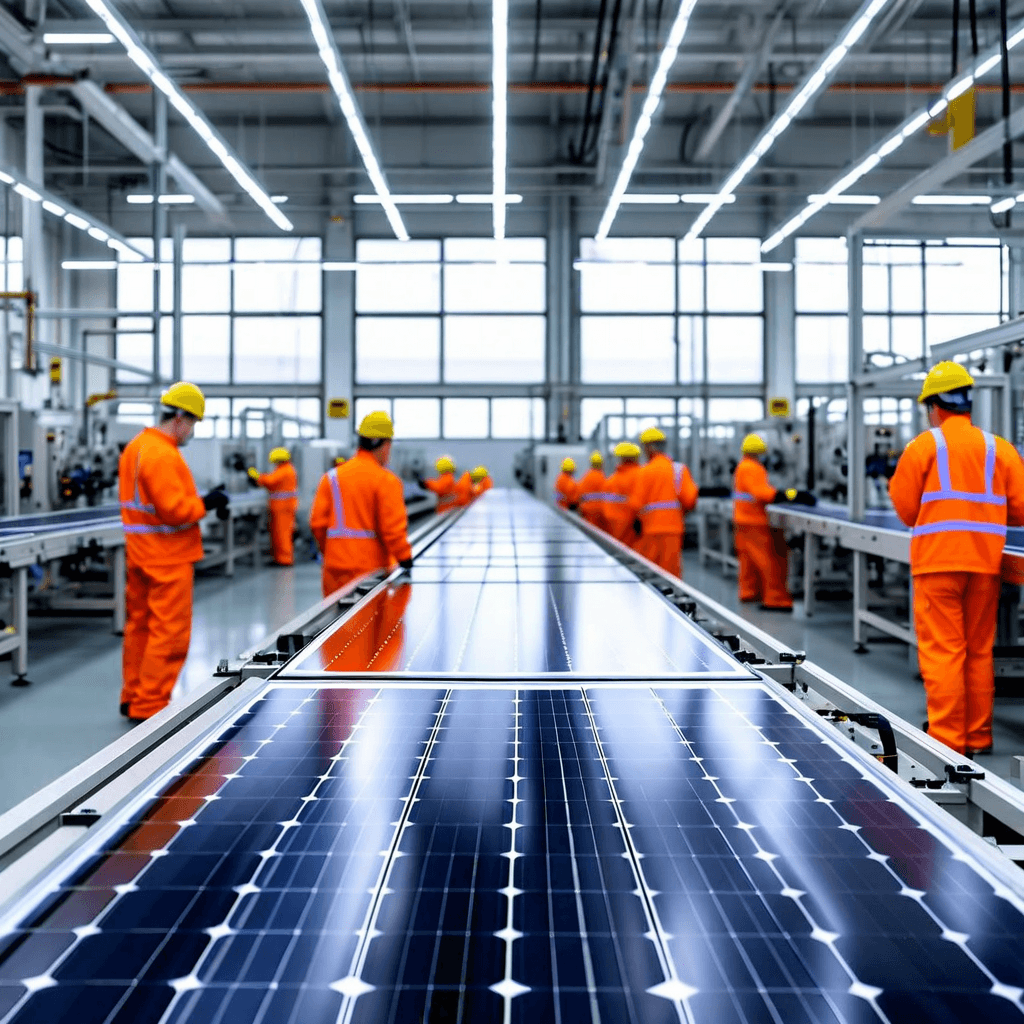
The US Department of Commerce has announced preliminary anti-dumping duties of 123.04% on crystalline silicon solar cells imported from India, adding to previously announced countervailing duties of 125.87% . This creates a combined duty burden of approximately 234%, effectively eliminating the cost advantage that made Indian solar modules competitive in the US market. The final determination is scheduled for July 6, 2026, but the preliminary phase requires importers to post cash deposits or bonds equal to these rates, creating immediate working capital challenges for exporters .
India exported 2.3 GW worth $792.6 million of solar cells to the US in 2024, representing more than 95% of India's total solar cell and module exports . The US accounts for 5-7% of total Indian solar production, but this market has been the primary driver of export growth. With modules imported from India now becoming at least 30% costlier than US-made modules, Indian manufacturers face an existential threat to their US export business unless they can restructure their operations .
Divergent Impact on Indian Manufacturers
The stock market reaction on April 24, 2026, revealed the fundamental differences in exposure among India's leading solar manufacturers. Waaree Energies declined 3.14%, Vikram Solar fell 2.49%, while Premier Energies actually gained 0.60% . This divergence reflects their vastly different export profiles and business models.
Waaree Energies has the highest US exposure, consistently exporting 2-3 GW annually to the US market InvestorPresentations. Overseas revenue accounts for 32.6% of its total revenue in Q3 FY26, with the US representing the primary international market InvestorPresentations. In contrast, Vikram Solar's overseas revenue plummeted to just 1% in FY 2024-25, with US shipments of only 11.97 MW (0.6% of total shipments) AnnualReports +1. Premier Energies has reduced its export share to almost zero, with exports comprising less than 1% of revenue in Q3 FY26 InvestorPresentations.
Waaree's Strategic Response: US Manufacturing Localization
Waaree Energies is pursuing the most aggressive response to the trade barriers through accelerated US manufacturing localization. The company currently operates 2.6 GW of module manufacturing capacity in the US, including facilities acquired through the Meyer Burger transaction, and is expanding to 4.2 GW by the end of FY26 Transcripts. This US production is duty-free and benefits from Inflation Reduction Act tax credits of approximately ₹7 per watt ($0.08-0.09/W), which partially offsets higher US production costs InvestorPresentations.
The company's strategy leverages a "natural hedge" between its Indian and US manufacturing plants. Management stated they will "always play with the mix, depending on how I'm able to maximize my bottom line" Transcripts. This geographic flexibility allows Waaree to optimize production based on duty structures while maintaining its EBITDA guidance of ₹5,500-6,000 crore for FY26 Transcripts.
Supply Chain Diversification and Compliance
Beyond US manufacturing, Waaree has implemented sophisticated supply chain strategies to mitigate duty impacts. The company sources cells from neutral jurisdictions where duty exposure ranges from 10-15%, rather than from India-origin cells that would face the full 234% combined duty InvestorPresentations +1. This diversified sourcing strategy includes a $30 million investment in United Solar Holding in Oman to secure fully traceable, non-Chinese polysilicon supply InvestorPresentations.
Waaree has also aligned its supply chains to meet US Foreign Entity of Concern (FEOC) requirements, which become applicable from April 2026 InvestorPresentations. This compliance ensures the supply chain is free of restricted entities while minimizing tariff exposure. The company explicitly states it does not use India-based cells with Chinese sources, avoiding the highest tariff rates InvestorPresentations.
Contractual Protections and Customer Relationships
Despite the trade uncertainty, Waaree maintains a substantial and stable order book of approximately ₹60,000 crore, with more than half attributed to US business InvestorPresentations +1. Most line items have received advances, providing execution certainty. The company's long-term supply contracts include sophisticated risk management mechanisms, including pass-through provisions for tariff changes, change of law clauses, and margin protection features Transcripts +1.
US clients remain "quite unphased" by the trade changes, according to management, with robust demand continuing Document. Waaree serves the US market through a strategic mix of manufacturing locations—currently fulfilling orders from both India and US facilities, with plans to shift more production to US locations over time Transcripts. The company positions itself as one of the few suppliers capable of consistently supplying at large scale while maintaining FEOC-compliant supply chains InvestorPresentations.
Acceleration of India's Supply Chain Restructuring
The US duties are acting as a catalyst for accelerating the restructuring of India's solar manufacturing supply chain. India currently has 120-172 GW of module manufacturing capacity and 29-65 GW of cell capacity, but upstream integration lags significantly . The country produces only 3.3 GW worth of polysilicon and has 5.3 GW of wafer capacity, with both segments heavily dependent on Chinese imports .
The government is responding with new policy initiatives. The Ministry of New and Renewable Energy is in discussions with the Finance Ministry to design a Production Linked Incentive scheme specifically for polysilicon manufacturing to plug this critical gap . The ALMM (Approved List of Models and Manufacturers) framework is being extended to solar cells from June 2026 and to ingots and wafers from June 2028, creating protected domestic markets for vertically integrated manufacturers .
Capital Expenditure Plans Remain Unchanged
Despite the trade barriers, Waaree has maintained its comprehensive capital expenditure program of ₹25,000+ crores over the next 24 months Transcripts. The spending is back-end loaded, with approximately 10-15% in FY26, 50% in FY27, and the balance in FY28 Transcripts +1. Management confirmed "no change in capex plan for Indian cell manufacturing despite US trade considerations" InvestorPresentations.
The expansion strategy includes increasing solar module capacity from 22.8 GW to 28.4 GW by FY27, expanding solar cell capacity from 5.4 GW to 15.4 GW, and adding 10 GW of ingot and wafer manufacturing capacity InvestorPresentations +1. The company is also investing heavily in adjacency businesses, including expanding battery storage capacity to 20 GWh, electrolyzers to 1 GW, and inverters to 4 GW InvestorPresentations.
Competitive Positioning and Future Outlook
Waaree's strategic investments position it as a leader in the restructured solar supply chain. The company's US manufacturing footprint of 4.2 GW is the largest among Indian manufacturers, providing duty-free access to the premium US market InvestorPresentations. Its vertical integration strategy, from polysilicon through modules, offers supply chain control and cost optimization that will become increasingly valuable as trade barriers persist InvestorPresentations.
The US solar market is projected to grow to approximately 500 GW by 2030, with data center power demand expected to increase to 176 GW by 2035 from 33 GW in 2024 InvestorPresentations. This growth, combined with IRA tax credits supporting domestic production, provides a substantial long-term opportunity for manufacturers with US manufacturing capabilities.
While the short-term volatility is significant, the US trade barriers are accelerating the maturation of India's solar manufacturing ecosystem. The shift from fragmented module assembly to comprehensive, vertically integrated manufacturing ecosystems spanning ingots, wafers, cells, and modules is creating national champions with global competitiveness . Waaree Energies, with its balanced global presence, substantial financial resources, and strategic US manufacturing investments, is well-positioned to emerge as a leader in this transformed landscape.