Let's start with the headline figures. Urban Company reported revenue from operations of ₹537 crore in Q2 FY27, up 41% from ₹380 crore a year earlier. That's the kind of growth most companies would kill for. But here's the twist: the net loss widened to ₹182.5 crore, more than three times the ₹59.3 crore loss from the same quarter last year.
Total expenses climbed 61% to ₹745.7 crore, outpacing revenue growth. So what's going on? The story isn't about the core business struggling—it's about a deliberate, expensive bet on the future.
What's Driving the 41% Revenue Growth?
The growth story breaks down into three main chapters. First, the India consumer services business (excluding InstaHelp) grew revenue to ₹336 crore, with net transaction value (NTV) up 26.3% to ₹963 crore. This is the steady, reliable engine—salon services, home repairs, cleaning. The adjusted EBITDA margin here improved to 3.5% of NTV, up from 2.4% a year ago. This business is actually profitable on an adjusted basis.
Second, international operations are on fire. Revenue jumped 82% to ₹75 crore, with NTV growing 66% to ₹267 crore. The margin improved to about 2% of NTV. This growth came from densifying existing markets, expanding service categories, and a favorable currency tailwind that management expects to fade next year. Investor Presentation
Third, Native—the smart home products business—grew revenue 40% to ₹105 crore, with NTV up 35% to ₹132 crore. The adjusted EBITDA loss margin narrowed to 6.8% of NTV from 9% a year ago. Management expects this business to approach breakeven in the next few quarters. Investor Presentation
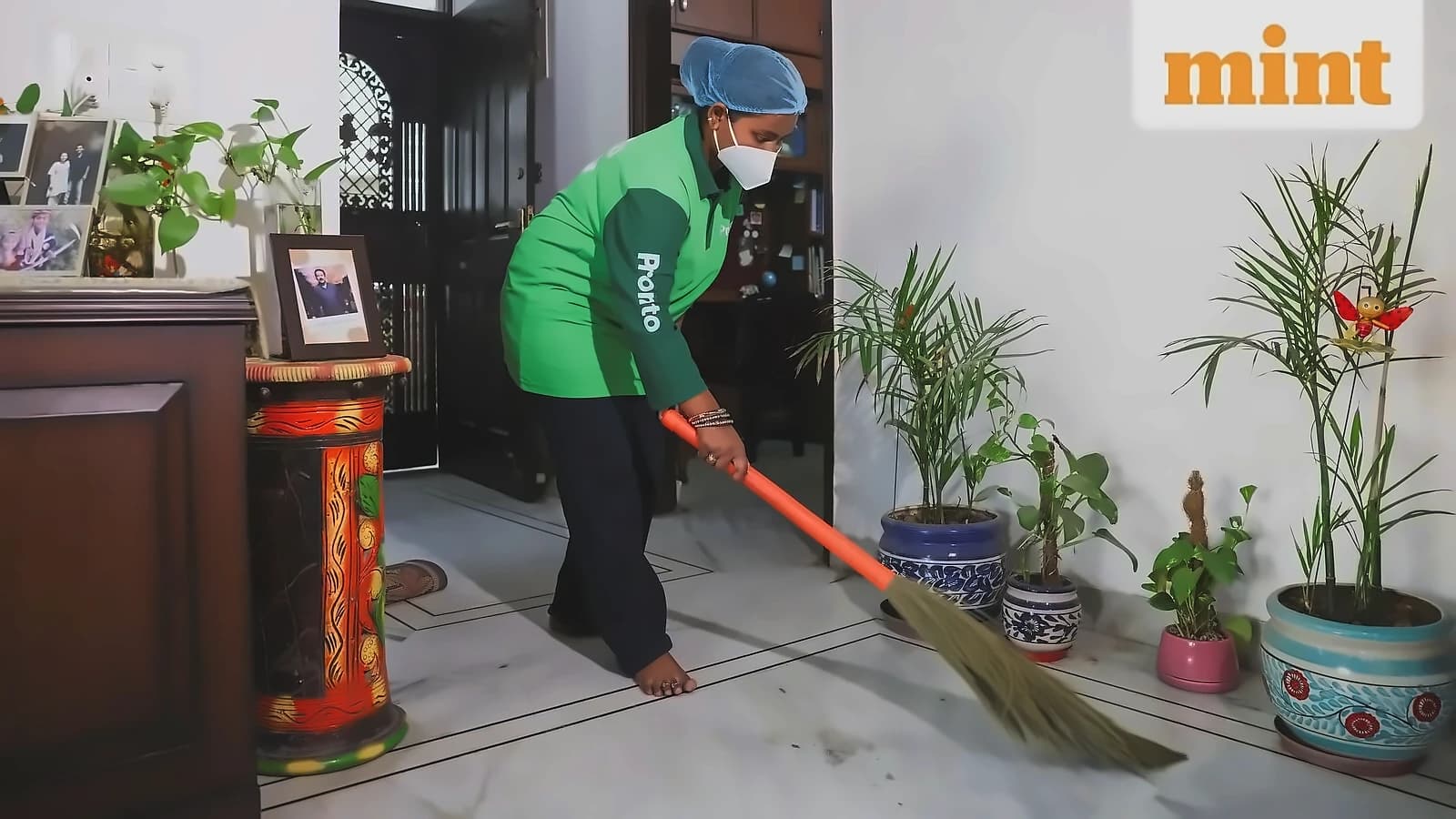
Then there's InstaHelp. This quick home services vertical generated only ₹20.5 crore in revenue but posted a segment loss of ₹173.1 crore. It's the reason the consolidated numbers look so different from the core business performance.
Order Frequency vs. Order Value: The Real Growth Driver
Here's where it gets interesting. Orders delivered more than doubled to 15.1 million, up 103% year-on-year. Annual transacting users reached nearly 10 million, up 35%. But NTV grew only 39% to ₹1,432 crore.
Do the math, and you'll see NTV per order actually fell—from roughly ₹1,385 to about ₹950. That's a 30% drop. Why? Because InstaHelp orders are small-ticket. In Q2, InstaHelp delivered 6.2 million orders with just ₹71 crore of NTV. That's about ₹115 per order, compared to the much higher average for core services.
For the India business excluding InstaHelp, NTV per annual transacting user rose only 3.2%. So roughly 85% of the growth came from adding more users, not from getting existing users to spend more. The company doesn't disclose order frequency or average order value directly, but these numbers tell the story: growth is volume-driven, not value-driven. Investor Presentation
Why Losses Widened Despite Revenue Growth
The expense breakdown tells a clear tale. Salaries and employee benefits rose 54% to ₹162 crore. Customer marketing spend climbed 55% to ₹87 crore. General and administrative expenses jumped 62% to ₹94 crore. These three categories alone account for most of the ₹284 crore increase in total expenses. Investor Presentation +1
Marketing intensity is rising—customer marketing now consumes about 6.1% of NTV, up from 5.4% a year ago. The company is spending aggressively to acquire new users, with new user acquisition growing 46% over the past three quarters. Investor Presentation +1
But the real story is InstaHelp. The consolidated adjusted EBITDA loss was ₹144 crore, including a ₹174 crore investment in InstaHelp. Strip out InstaHelp, and adjusted EBITDA was actually ₹30 crore, up 213% year-on-year. The core business is profitable; the consolidated loss is almost entirely due to the quick services vertical.
InstaHelp's unit economics are improving but still painful. The adjusted EBITDA loss per order narrowed to ₹279 from ₹346 in the previous quarter, driven by better network density. But with net order value falling to ₹114 from ₹138 due to competitive pricing pressure, the loss per order is still about 2.4 times the revenue per order.
The ₹2,500 Crore Question: Why Raise Money Now?
Here's where things get strategic. The board approved raising up to ₹2,500 crore through equity shares or convertible securities, subject to shareholder approval. The stated purpose: flexibility to invest across businesses, strengthen InstaHelp, and pursue selective acquisitions. Other
But is the money needed urgently? Cash and treasury investments stood at ₹1,901 crore at quarter-end. At the current burn rate, that's roughly 16 quarters of runway—even at double the burn, it's about 8 quarters, which takes the company past its Q3 FY28 breakeven target.
The raise looks opportunistic rather than desperate. It's about building a war chest for a competitive battle that management expects to last years, not quarters. On the Q1 call, management said InstaHelp "will continue to take investments" over the next two years or longer. Transcript
What This Means for Shareholders
Let's talk dilution. With about 154.3 crore shares outstanding and a current price around ₹158, raising the full ₹2,500 crore at market price would dilute existing shareholders by about 9.3% [stock_agent data]. At a 10% discount, dilution would be around 10.2%. Promoters currently hold 19.02%—if they don't participate, their stake could fall to about 17.1-17.3%.
The shareholding pattern shows foreign institutional investors at 52.51%, domestic institutions at 15.17%, and the public at 7.02% [stock_agent data]. The raise will shift these percentages, but the exact impact depends on who participates and at what price.
Competitive Landscape: David vs. Goliath?
Urban Company isn't fighting this battle alone. Private competitors like Snabbit and Pronto are raising their own war chests. Snabbit has raised about $112 million (roughly ₹940 crore) across multiple rounds, with a reported valuation of $350-400 million. Pronto raised $25 million at a $100 million valuation and is reportedly in talks for another $15-20 million at a $200 million valuation.
Snabbit claims to have completed 1.51 million orders in June, slightly ahead of InstaHelp's roughly 1.5 million and Pronto's 950,000. But Urban Company still has the larger overall user base. The competitive intensity is driving unsustainable pricing across the industry—management calls current pricing "unsustainable for anyone". Investor Presentation
The Path to Profitability
Management has set clear targets: consolidated adjusted EBITDA breakeven by Q3 FY28, and ₹1,000 crore of adjusted EBITDA by FY31. But they haven't disclosed the revenue or NTV scale required to hit these numbers.
Here's some rough math. With the core business generating about ₹30 crore of adjusted EBITDA, breakeven requires InstaHelp's loss to fall to about ₹30 crore or less. At Q2's 6.2 million orders, that means a loss of about ₹48 per order—down from ₹279 today. That's roughly an 83% reduction in loss per order, assuming order volume stays constant.
For the FY31 target of ₹1,000 crore EBITDA on annualized Q2 NTV of about ₹5,700 crore, the company would need an EBITDA margin of about 17.5%. The core business currently earns about 2.2%. So achieving the target requires both massive NTV growth and significant margin expansion.
The Bottom Line
Urban Company's Q2 results tell a story of two businesses. The core home services platform is growing steadily and profitably. The new InstaHelp vertical is growing explosively but burning cash aggressively. The ₹2,500 crore fundraise is a bet that the latter can become the former—that quick home services can be a profitable, large-scale business.
The company has the cash to fund this bet for years. The question isn't about survival—it's about whether the investment will pay off before competitors consolidate or pricing rationalizes. For investors, the next few quarters will be crucial to watch: can InstaHelp's unit economics improve fast enough to justify the mounting losses? Or will this become another expensive lesson in the dangers of growth at all costs?
The board has made its choice. Now the market will decide if they're right.