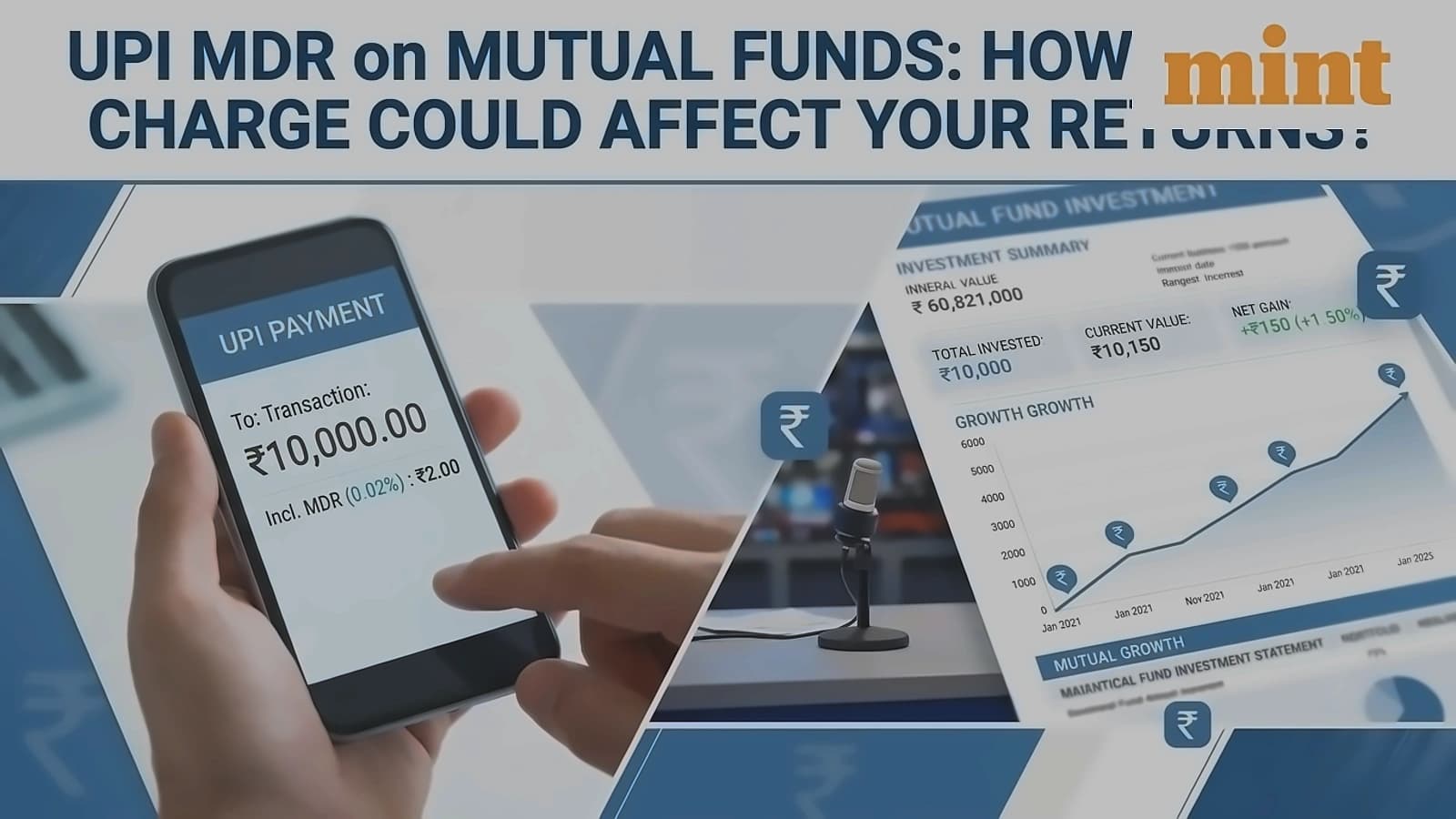
India's digital payments landscape is shifting. From October 15, 2026, a Merchant Discount Rate (MDR) of 0.4% applies to Person-to-Merchant UPI transactions above ₹2,000, capped at ₹300 for transactions of ₹75,000 and above. However, capital market transactions—including mutual funds, securities, stockbrokers, and dealers—receive a concessional rate of just 0.02%, subject to the same ₹300 cap. The framework exempts transactions up to ₹2,000 and recurring UPI AutoPay mandates, meaning approximately 96% of all UPI merchant transactions remain unaffected.
The policy marks the end of a zero-MDR regime in place since January 2020, which banks and fintech companies had long criticized as unsustainable. The National Payments Corporation of India estimates the annual cost of maintaining UPI infrastructure—including server bandwidth, fraud-prevention systems, and technical support—at around ₹20,000 crore. The MDR revenue aims to create a sustainable funding model for this ecosystem while keeping UPI affordable for small-value transactions.
HDFC Securities: The Insulated Majority
HDFC Securities finds itself in an enviable position.
Approximately 51.4 million transactions flowed through its HDFC Bank-linked 3-in-1 mandate or net banking—both exempt channels—while UPI accounted for only 960,000 transactions, or less than 2% of the total.
This payment mix fundamentally alters the cost calculus. The 3-in-1 mandate route alone processed about 51 million transactions, with net banking contributing another 360,000. For HDFC Securities, the company stated the new framework is "unlikely to result in any material change to customer-facing pricing" because customers have consistently gravitated toward payment channels built for ease and reliability.
Mutual Funds: SIPs Exempt, Lumpsum Affected
The impact on mutual fund investors depends entirely on how they use UPI. Recurring SIP payments made through UPI AutoPay remain exempt because recurring mandates fall outside the prescribed MDR charge. An investor with a ₹10,000 monthly SIP registered through UPI AutoPay will continue to see exactly ₹10,000 debited each month—the MDR framework does not suddenly transform it into a ₹10,040 payment.
One-time mutual fund investments through UPI attract the 0.02% capital market MDR. A ₹1 lakh lumpsum investment generates an MDR of ₹20, compared to ₹400 at the standard 0.4% merchant rate. The mutual fund industry is expected to absorb much of this additional cost rather than pass it directly to investors. However, fund houses may encourage investors to use alternative payment methods such as net banking or bank transfers, particularly for frequent one-time transactions. The concessional rate reduces the risk that UPI becomes uneconomical for larger investment transactions while still allowing revenue to flow through the payment ecosystem.
Brokers: The Cost-Benefit Calculus Shifts
For brokers, the MDR structure introduces a complex cost-benefit analysis. The fundamental issue: a fund transfer to a trading account does not necessarily produce revenue. A customer can add money without placing an order, yet the broker still incurs the MDR. This becomes particularly problematic because SEBI rules require brokers to periodically settle unused client funds, creating the possibility of repeated MDR costs on the same customer capital when funds are returned and later transferred back.
For discount brokers operating on thin margins—where brokerage on some transactions is already very low or nil—absorption would directly impact margins and could adversely affect low-cost offerings.
The framework explicitly prohibits merchants from passing MDR charges directly to customers while accepting UPI payments. MDR must be viewed as part of the firm's payment and operating cost structure rather than a customer transaction fee. This constraint forces brokers to absorb costs or find alternative solutions.
Market-Driven Resolution: No Government Intervention
This absence of government talks signals a deliberate regulatory approach allowing market participants to adapt to the new cost structure.
Chauhan expects some initial impact on transaction volumes in the short term due to MDR charges above ₹2,000, but anticipates activity will normalize over time.
The ministry is preparing a monitoring mechanism to ensure the UPI MDR burden is not passed on to customers.
Strategic Shifts: Payment Channel Migration
Brokers are expected to actively encourage clients to shift from UPI to alternative payment channels that remain outside the MDR framework. Bank-linked brokers with 3-in-1 account infrastructure have a significant structural advantage. HDFC Securities demonstrated that existing payment channel preferences can provide substantial insulation—less than 2% UPI transaction share versus the industry's 90% reliance.
Non-bank brokers will likely pursue partnerships with banks to offer co-branded 3-in-1 accounts, invest in technology to streamline net banking integration, and incentivize clients to switch payment methods through fee discounts or value-added services. Client education and behavioral nudges will become critical—explaining that UPI remains free for transactions up to ₹2,000, highlighting benefits of 3-in-1 accounts for larger transfers, and promoting UPI AutoPay for SIPs to maintain exemption.
Competitive Positioning: High vs Low UPI Volumes
The MDR framework creates a clear competitive divergence. Brokers with high UPI dependence—primarily discount brokers where approximately 90% of transactions occur through UPI—face significant margin pressure. These players must absorb costs on transactions that may not generate revenue, particularly when clients transfer funds but don't execute trades.
Brokers with lower UPI volumes—primarily full-service and bank-linked brokers—have inherent advantages. HDFC Securities' 98% insulation rate demonstrates how existing payment infrastructure can provide competitive protection. Full-service brokers also benefit from diversified revenue streams including research, advisory, and portfolio management services, making them better positioned to absorb payment processing costs.
The competitive dynamics will likely accelerate existing trends: bank-backed brokers leveraging existing infrastructure, standalone brokers forming partnerships for payment solutions, and market share shifting based on payment cost structures. New entrants may focus on payment-efficient business models to differentiate themselves.
Liquidity and Trading Volumes: Short-Term Friction, Long-Term Normalization
NSE's leadership has acknowledged that MDR charges are likely to weigh on transaction volumes in the short term. This impact will manifest through reduced fund transfer frequency as retail investors become more deliberate about moving money to brokers, behavioral friction from the perception that UPI is no longer "free," and indirect effects from brokers adjusting other fees or reducing promotional offers.
However, long-term normalization is expected for several reasons. Historical evidence from other payment systems shows volume recovery after initial adjustment periods. The concessional 0.02% rate for capital markets is specifically designed to encourage continued retail participation in formal financial markets. Capital market liquidity is driven by fundamental factors beyond payment costs—market sentiment, economic conditions, corporate earnings, and regulatory environment—meaning payment processing costs represent a small component of overall trading costs.
The feedback loops between MDR implementation and alternative payment adoption will create a self-correcting mechanism. As brokers promote exempt channels and investors adapt their behavior, UPI usage in capital markets will likely stabilize at a lower baseline level while alternative channels achieve critical mass. The market-driven resolution approach reflects regulatory confidence in the ecosystem's adaptive capacity to balance sustainability with accessibility.