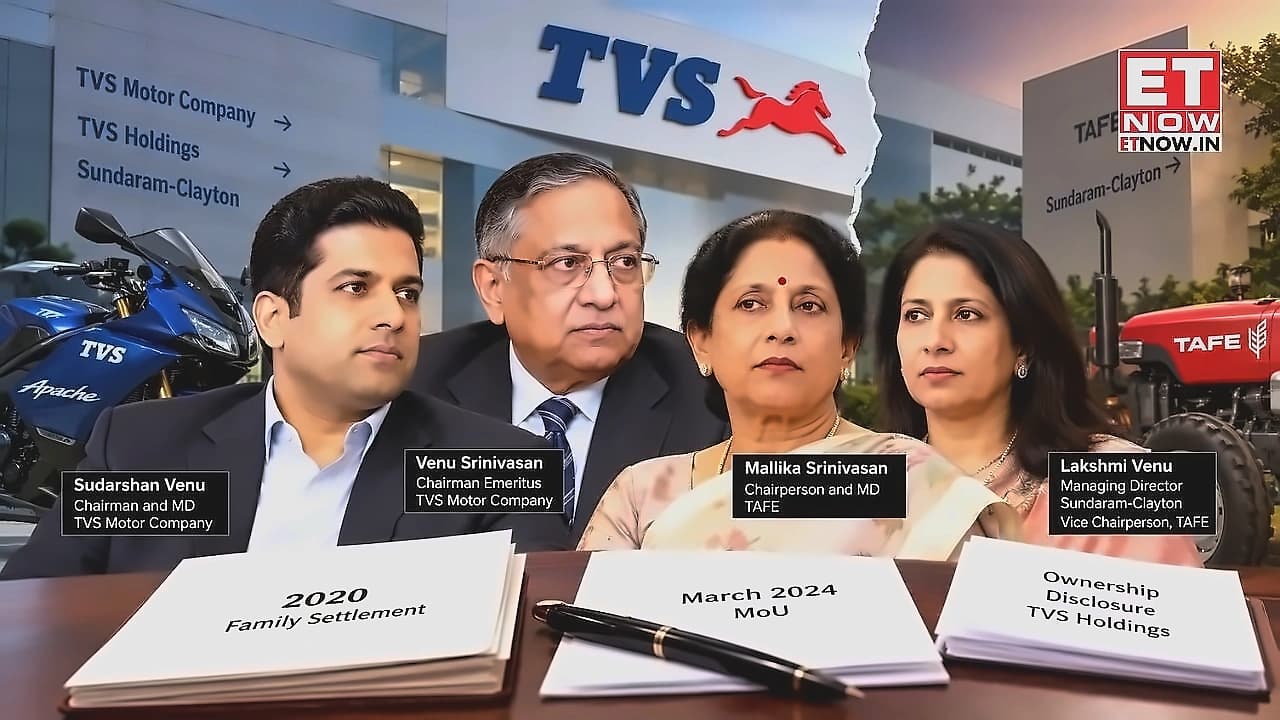
The TVS Group, one of India's most respected business conglomerates, is grappling with a succession dispute that has spilled from family discussions into public view. At the heart of the matter lies a stark wealth imbalance: TVS Motor Company has seen its market capitalization surge nearly four-fold in three years to approximately Rs 1.83 lakh crore, while Sundaram Clayton Ltd sits at around Rs 24,000 crore. This dramatic divergence has intensified disagreements between the siblings—Sudarshan Venu, who leads TVS Motor, and Lakshmi Venu, who manages Sundaram Clayton—over whether the division of family assets has been fair or final.
The dispute traces back to a December 10, 2020, Memorandum of Family Agreement (MFA) among the four branches of the TVS family. This agreement aimed to eliminate cross-holdings and align corporate ownership directly with the respective family branches managing them. Through a court-approved corporate restructure sanctioned by the NCLT Chennai Bench in March 2023, the shareholding of Sundaram Clayton was vested into TVS Holdings Pvt Ltd, effectively consolidating control under the Venu Srinivasan branch. As part of this settlement, the Venu Srinivasan family also inherited approximately Rs 2,000 crore of liabilities payable to other family branches. Annual Report
The MoU Ambiguity: Brand Rights or Asset Split?
In March 2024, the four nuclear family members—Venu Srinivasan, Mallika Srinivasan, and their children—signed a Memorandum of Understanding (MoU). Publicly, this MoU addressed trademark usage and non-compete clauses. Sudarshan Venu agreed not to use the TVS brand in die-castings and agricultural machinery, while Mallika and Lakshmi Venu agreed to stay out of two-wheelers, three-wheelers, financial services, and real estate. The company explicitly stated it was not a party to this agreement and that it would not impact operations.
However, interpretations diverge sharply. The camp aligned with Venu and Sudarshan views this MoU as a definitive division of family assets, formalizing the understanding that Sudarshan gets TVS Motor and Lakshmi gets Sundaram Clayton (and eventually TAFE from her mother's side). In contrast, Mallika and Lakshmi's camp insists the MoU dealt solely with brand protection and non-competition, never with the division of wealth. They argue that no economic settlement covering the siblings' assets was ever concluded, and both children retain equal rights over Venu Srinivasan's family wealth.
Governance Tensions Surface at Sundaram Clayton
The simmering dispute erupted into the open in March 2026 at Sundaram Clayton. The trigger was a governance concern raised by Lakshmi Venu regarding the company secretary, P.D. Dev Kishan. She reportedly flagged that Kishan was not a full-time employee of the listed entity and reported to the CFO of TVS Holdings (the parent company) rather than to her as Managing Director, creating a potential conflict of interest.
On March 27, 2026, the board accepted Kishan's resignation. Just 72 hours later, an emergency board meeting reversed this decision. Simultaneously, R. Gopalan, the independent chairman appointed in 2022 as part of the succession plan, stepped down from the chairmanship (remaining as a non-executive independent director). Venu Srinivasan, who had stepped back four years earlier, was re-designated Chairman and Managing Director. While sources close to the family described this as "institutional strengthening" and noted that Lakshmi retains full operational control, the swift reversal raised pointed questions about board independence and promoter influence. Other +1
The Beneficial Ownership Flashpoint
In April 2025, exchanges were notified that Sudarshan Venu had become a "significant beneficial owner" in TVS Holdings, the entity that holds 50.26% of TVS Motor Company. This regulatory filing marked the commencement of transferring promoter shares to Sudarshan. For Mallika and Lakshmi's camp, this move was problematic. They argued that management roles do not automatically translate into ownership rights and sought clarification on how this transfer occurred without a family-led settlement process, reportedly receiving no response.
The distinction between operational management and beneficial ownership lies at the core of the conflict. While Lakshmi runs Sundaram Clayton and is Vice-Chairman of TAFE (Tractors and Farm Equipment Ltd), and Sudarshan leads TVS Motor and TVS Holdings, the ownership of the underlying wealth—particularly the valuable TVS Holdings stake—is controlled through family trusts like VS Trust. Filings show VS Trust's stake in TVS Holdings rose from 57.01% to 66.55% in FY26, while Venu Srinivasan's personal holding was transferred out. The specific beneficial interests of the siblings within these structures remain opaque. Other +1
The Rs 2,000 Crore Settlement and TAFE's Role
The discharge of the Rs 2,000 crore settlement obligation adds another layer of complexity. According to reports, Venu and Sudarshan raised these funds by selling approximately 7% of TVS Motor shares. This sale, reportedly made at 2020-22 valuations (around Rs 500-600 per share), discharged the debt using stock that has since appreciated significantly.
The camp that funded the discharge argues they bore the burden and settled dues based on fair valuations as of December 2020. The opposing camp argues the sale used assets from the common family pool and does not prove a smaller share for Lakshmi.
Furthermore, the role of TAFE complicates the asset division framework. TAFE, part of the Amalgamations group, is independently controlled by Mallika Srinivasan, who inherited it from her family. Lakshmi was appointed Vice-Chairman of TAFE in March 2025, signaling her succession path there. Venu and Sudarshan's camp argues that including TAFE in discussions about Venu Srinivasan's assets is inappropriate since the Srinivasan group has no control over it. However, if TAFE is considered part of the balancing equation for Lakshmi's inheritance, the relative disparity between Sundaram Clayton and TVS Motor appears less severe.
Legal Outlook: Can a Settled Settlement Be Reopened?
With mediation attempts reportedly failing over 18 months and lawyers being briefed, the dispute may head to court. The central legal question is whether the December 2020 settlement, which was based on valuations preceding TVS Motor's rally, can be reopened. General legal principles, such as those established in the Supreme Court's Kale v. Deputy Director of Consolidation judgment, emphasize upholding bona fide family settlements to prevent perpetual strife. The doctrine of estoppel generally prevents parties who have benefited from a settlement from later challenging it.
Venu and Sudarshan's camp relies on these principles, arguing that subsequent changes in market performance cannot justify reopening a mutually agreed and implemented settlement. Lakshmi's camp, however, contends that no sibling-level economic settlement was ever reached or valued, meaning the estoppel argument may not apply to that specific layer of the dispute. The ambiguity of the 2024 MoU—whether it is a final asset division or merely a management agreement—will likely be a focal point for any legal adjudication.
For now, the businesses continue to operate. TVS Motor has stated the MoU has no adverse impact on its business. But the episode has exposed the fragility of even the most carefully planned successions when market dynamics outpace the structural agreements meant to govern them. As the TVS family navigates this internal rift, the business world watches closely, recognizing that the resolution of this dispute will set a precedent for how family-owned conglomerates manage the delicate balance between legacy, equity, and growth.