The Acquisition Question: Why Titan Prefers Organic Growth
Despite market speculation about potential acquisitions in the watch segment, Titan's official documents reveal no documented strategy for acquiring smaller watch brands. The company's approach to premium and luxury expansion focuses on organic growth and licensed partnerships rather than inorganic expansion. This contrasts sharply with its jewellery business, where the CaratLane acquisition demonstrated a methodical, staged approach—initially acquiring 72.3% before progressing to full ownership for approximately ₹4,600 crores. Transcripts +1
The CaratLane experience offers valuable lessons that could inform any future acquisitions: gradual ownership increases, founder-friendly transitions, brand autonomy within a portfolio, and patient integration. However, Titan has not explicitly connected these learnings to watch brand acquisition strategy. Instead, the watch division emphasizes premiumization through product innovation, international brand partnerships, and retail channel expansion. Transcripts +1
For international watch companies, Titan prefers licensed partnerships over acquisitions. The company has expanded its portfolio through collaborations with brands like Tommy Hilfiger, Police, Ducati, Anne Klein, Aigner, and Roamer. This approach allows Titan to leverage established international brand equity without capital-intensive acquisitions, focusing on partnerships to access premium positioning. Transcripts +1
Premium vs. Mass: A Tale of Two Markets
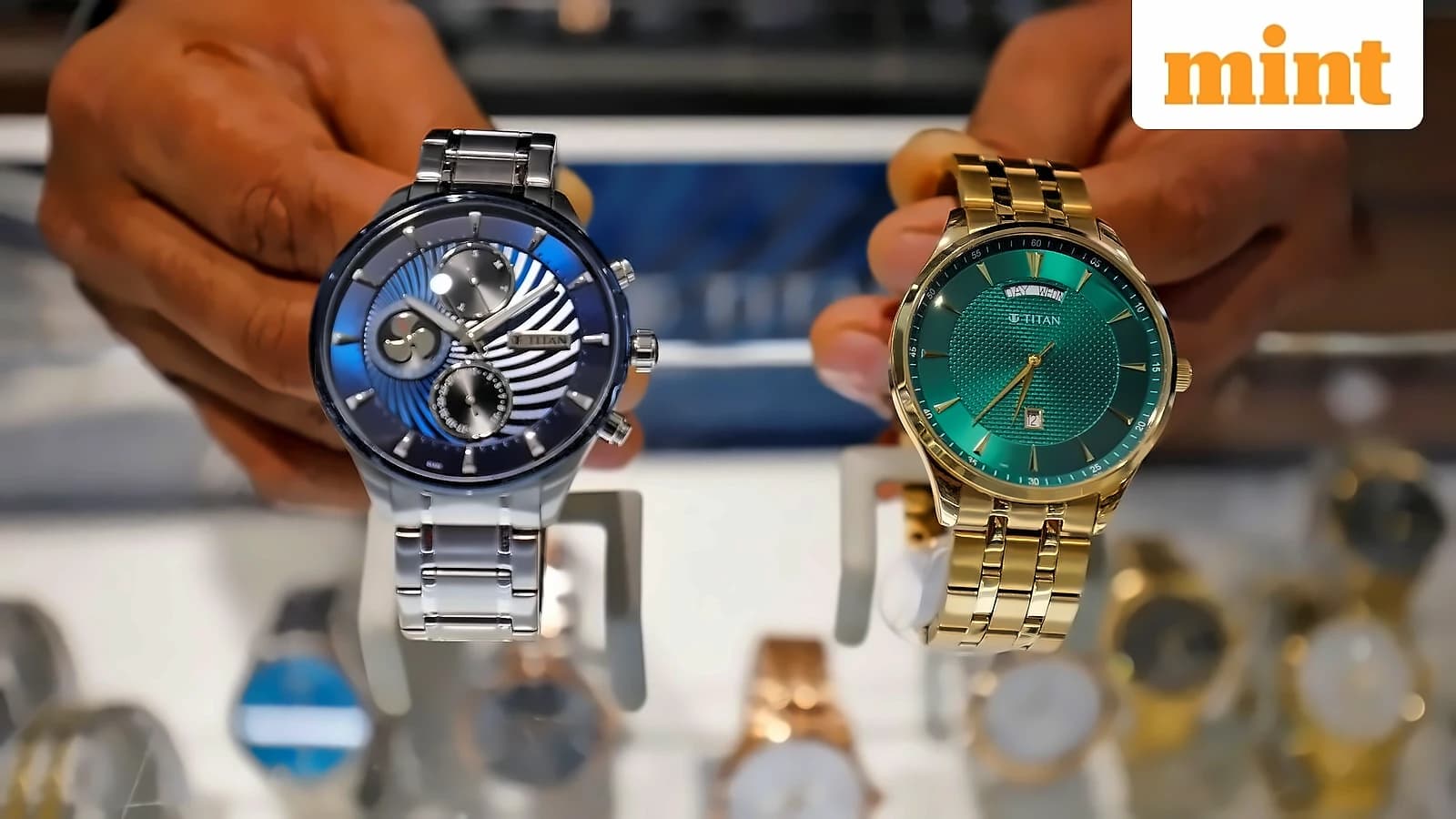
Titan's watch business is experiencing a dramatic shift in its revenue mix. While specific price-segment growth comparisons aren't publicly disclosed, premium brands like Edge, Nebula, and Xylys have reported over 50% growth. The premium channels—Titan World and Helios—delivered exceptional growth of 8% and 34% respectively in FY24, with international brands through Helios expanding 21% YoY in Q1FY26. Transcripts +1
This premiumization has transformed profitability. EBIT margins in the watch business surged from 3.6% in FY22 to approximately 12.5% in FY23—a remarkable 1,034 basis points improvement. Q1FY26 demonstrated exceptional performance with EBIT of ₹287 crores at 22.6% margin, compared to ₹111 crores at 10.9% margin in Q1FY25. Transcripts
The mass market segment initially faced sluggishness but has shown remarkable recovery. Sonata delivered 24% growth and Fastrack achieved 33% growth in Q3FY25, driven by extensive product restaging and new product launches. This turnaround was achieved through premiumization efforts even in value brands, with customers responding to "more interesting and more exciting products in even our lower-priced brands". Transcripts
Structural Shifts: Watches as Style Statements
Consumer behavior is fundamentally changing. Watches are increasingly viewed as fashion accessories and personal style statements rather than mere timekeeping devices. This shift is evident in Titan's strategy—the company notes that eyewear and watches share similarities where "both vision and fashion is equally important". Transcripts
The analog watch renaissance has been dramatic. Smartwatches went through a major correction in calendar year 2024, with the overheated growth phase of 2021-2023 subsiding due to oversupply and price undercutting. Analog watches now represent 85-90% of the watch business, achieving c.20% YoY growth in consumer prices with c.19% volume growth in Q3FY26. Transcripts +1
Wedding and gifting correlations remain strong. More than 50% of analog watch retail is for gifting purposes, with a large portion wedding-related. Interestingly, management observed no price difference between watches bought for wedding/gifting versus self-purchase, indicating wedding demand drives sales across premium segments without discounting. Transcripts
Scale Advantages: The Moat Against Micro Brands
Titan's competitive advantages against micro watch brands stem from its massive scale. The company operates 1,281+ stores across 300+ towns, including 738 Titan World stores, 251 Fastrack stores, 286 Helios stores, and 6 Helios Luxe stores. This retail footprint creates formidable barriers to entry that smaller brands find difficult to replicate. Transcripts
The distribution network extends beyond own stores to 7,000-8,000 multi-brand outlets across India, plus presence in Large Format Stores and e-commerce platforms. The after-sales service network includes 662 exclusive watch care centers across 241 towns—the largest in the industry. Manufacturing capabilities include 5 state-of-the-art plants for watches, with 3,600+ employees engaged in factory operations. Transcripts +1
Despite these advantages, Titan's management does not specifically address India-focused micro watch brands with Indian design sensibility as competitive threats in public disclosures. The competitive landscape discussions focus primarily on smartwatch competition from tech-first brands and general premiumization trends. Transcripts +1
Innovation Engine: Building Indigenous Capabilities
Titan has made significant investments in developing indigenous watchmaking capabilities. The company designed and engineered the Edge Mechanical movement over 5 years, creating what it described as a "mechanical marvel" and "our thinnest mechanical watch yet, also the slimmest by an Indian watchmaker". Transcripts
The company established dedicated engineering centers that have "significantly enhanced our in-house capabilities and also fostered an innovative culture within the organisation". Advanced manufacturing technologies include Pulsed Electrochemical Machining for complex watch case profiles, AI and IIoT-driven initiatives for automated watch running tests, and integration of advanced Swiss Witschi testing equipment. Transcripts +1
Titan showcased its global luxury watchmaking ambitions by debuting at Watches & Wonders Geneva 2026, marking its entry onto the global luxury watchmaking stage. The company launched India's first Tourbillon watch as part of the 40 Years of Joy Commemorative Collection—limited to just four pieces, each priced at ₹26 lakh, which sold out within a month. Transcripts +1
Seasonal Dynamics: Managing Wedding and Festive Demand
The timing of wedding seasons and Diwali significantly impacts Titan's watch business. When Diwali is delayed, wedding spending becomes back-ended, concentrated in later months rather than being spread across the festive period. Management noted that "most of the weddings this year would be somewhere around December and then from Jan to March because the Diwali is a little later". Transcripts
This creates extended peak demand periods requiring careful inventory management. Titan implements strategic inventory buildup in anticipation of festive seasons, with management specifically mentioning "inventory buildup is done for the festive season, in anticipation" for Dussehra and Diwali periods. The company maintains agile inventory planning that adapts to timing variations. Transcripts
The festive period delivered 16% growth over the previous year, compared to 12% growth in a regular quarter. This accelerated growth indicates robust consumer demand and willingness to spend on premium watch products. Management had anticipated that Q2 would be good, and the actual results exceeded expectations. Transcripts
Capacity Expansion: Meeting Robust Demand
Titan is implementing comprehensive capacity expansion to address robust festive demand. The watches division achieved a 20% capacity increase in the ultra-modern stainless steel case plant at Coimbatore during FY24. The company executed 115 new store expansions nationwide in FY24, including 43 Titan World stores, 39 Helios stores, and 33 Fastrack stores. Transcripts
Technology investments specifically target managing seasonal demand fluctuations. Advanced manufacturing equipment includes 5-axis 3D machining, Lost Wax Investment Casting for bracelet links, and multi-cavity die press blanks for hot forging. AI-enabled PVD process control and smart warehouse automation systems enhance operational efficiency. Transcripts
Despite these investments, capacity constraints remain. The most significant constraint appears in premium segment expansion through Zoya, where management noted that the pipeline "takes a little longer to materialize in the case of Zoya because some are built to suit". Execution quality constraints limit premium segment growth, with management identifying "the constraint is our ability to execute and execute it well with the right quality, with the right kind of neighborhood and also the staff and everything else". Transcripts
Trade Policy: Opportunities and Risks
Potential free trade agreements easing import costs could significantly strengthen Titan's Helios strategy. Lower import duties would directly reduce landed costs of Swiss watches, making them more price-competitive. This could accelerate premiumization trends already showing strong momentum and enable ultra-luxury expansion plans with better economics. Transcripts
Titan has significant experience with import duty impacts. The company recently experienced ₹275-280 crores loss in one quarter due to customs duty reduction on gold on lease inventory. Successfully leveraging the UAE trade agreement provided 1% concession on import duty with 200 tonnes allocation over 5 years. Transcripts
However, regulatory risks exist. There's a proposal to hike GST on luxury watches priced above ₹25,000. Management indicated that Titan's current proportion of watches above ₹25,000 is "not very high right now," but noted that given the continuing premiumization trend, this proportion will become "higher and higher over the next few years". Transcripts
The company is actively working to reduce import dependence, targeting a reduction from 49% in March 2020 to 30% by March 2024 through strengthening in-house and indigenous vendor capabilities. High import dependence exists for plastic watches, digital watches, and wearables, with associated risks of supply delays/disruptions from geopolitical developments and cost increases from currency fluctuations. Transcripts
The Road Ahead
Titan's watch business demonstrates strong resilience across price segments, with premiumization driving higher-margin growth while the value segment shows renewed strength. The geographic patterns suggest rural demand remains challenging in newer markets but strong in established Tier 2/3 centers. Transcripts
The company's strategy effectively balances building indigenous luxury capabilities through significant R&D and manufacturing investments while leveraging international brands to capture premium market segments. With premium brands growing over 50%, margins expanding dramatically, and global recognition through Watches & Wonders Geneva debut, Titan is positioning itself as a serious contender in the premium global watch market. Transcripts +1
The key question remains whether this organic, innovation-led approach can sustain momentum against potential competitive pressures from reduced import duties on Swiss watches and the emergence of micro watch brands targeting specific consumer segments. Titan's scale advantages, manufacturing capabilities, and growing premium brand portfolio provide competitive buffers, but the ultra-luxury segment above ₹10L remains dominated by established Swiss brands with centuries of heritage. Transcripts +1