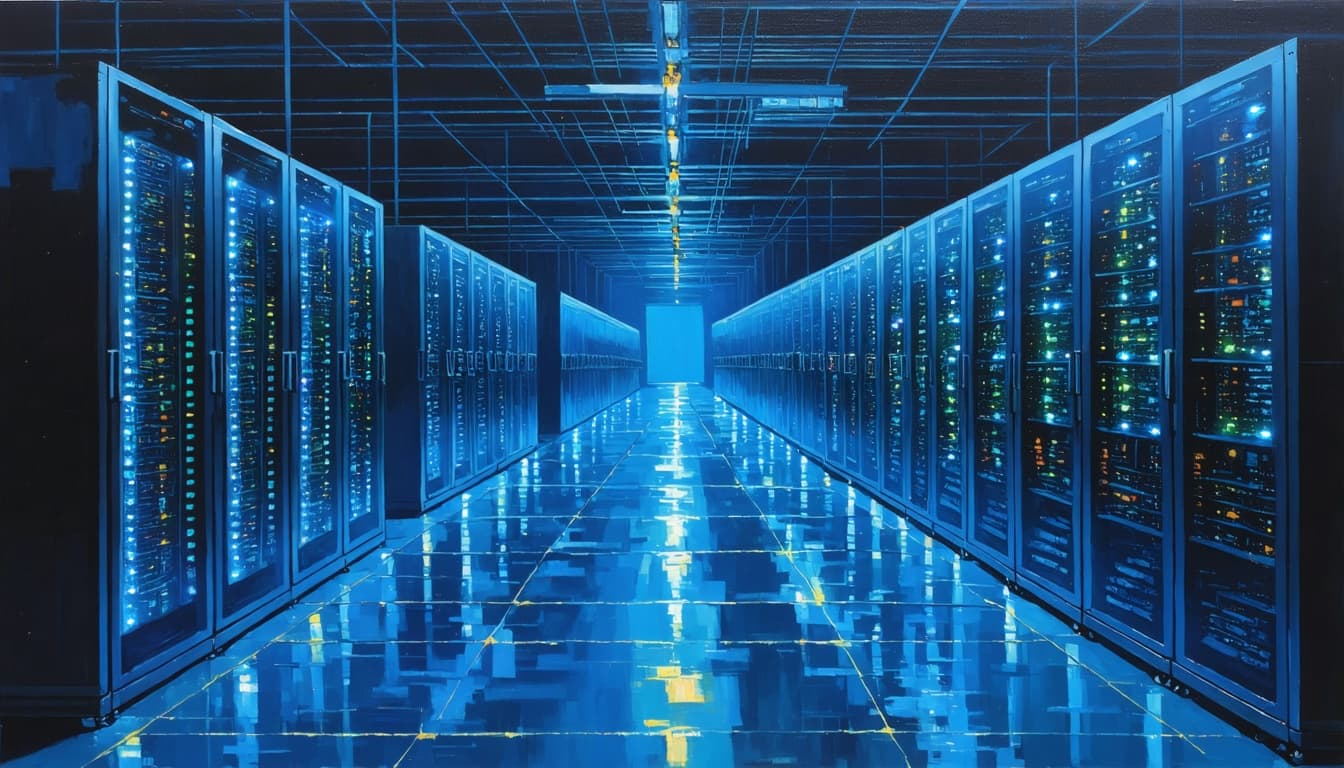
Larsen & Toubro has secured what it classifies as a "mega order" valued between ₹10,000-15,000 crore to build India's largest single-cluster AI infrastructure facility for US-based Together AI.
The project involves deploying 10,000 NVIDIA B300 GPUs at L&T's Chennai data centre campus, with Phase 1 designed for 250 MW capacity and power infrastructure readiness of 150 MVA.
This order alone represents approximately 15-22% of L&T's annual revenue based on FY27 Q1 figures, providing immediate revenue diversification away from traditional infrastructure projects. The move aligns with L&T's broader "Gigawatt AI Infrastructure Mission" and reflects the company's transition under its Lakshya 2031 strategic plan, which prioritizes high-growth technology verticals including data centers, green hydrogen, and semiconductors.
Financial Implications and Margin Dynamics
The revenue diversification impact is substantial. L&T's current revenue mix shows Infrastructure Projects at 32.59% and IT & Technology Services at 21.67% of total revenue. The AI infrastructure order establishes a new growth pillar that could reduce cyclicality associated with traditional EPC projects while providing exposure to the faster-growing AI infrastructure market.
However, profit margins present a nuanced picture. Management expects the data center business to generate about 13-14% returns at optimal levels, compared to L&T's historical EBITDA margins of 14-15% and recent ROCE of 19.30%. While initial margins may be comparable to legacy infrastructure, the margin sustainability profile is superior due to technology premiums, recurring revenue from operations and maintenance contracts, and barriers to entry in high-density AI infrastructure. Transcripts
The capital expenditure requirement is significant. Industry estimates suggest the total investment could range from ₹19,000-29,500 crore, with GPU hardware alone costing approximately ₹8,000-12,000 crore based on B300 pricing of around $53,000 per GPU. This investment will pressure free cash flow in FY27-28, potentially turning FCF negative during peak deployment phases. However, L&T's strong operating cash flow of ₹16,741 crore in FY26 and recent working capital releases of ₹21,838 crores provide substantial buffer capacity [stock_agent].
Competitive Differentiation and Market Positioning
L&T's partnership with Together AI creates several competitive advantages. The company controls a 5.5 GW land bank with 250 MW of power-ready infrastructure, providing scale that few domestic competitors can match. The vertical integration capabilities—combining EPC expertise, hardware procurement through NVIDIA partnerships, software stack integration, and operations—create cost advantages estimated at 15% capex reduction through in-house engineering.
The sovereign AI focus is particularly strategic. With over 60% of Indian enterprises citing data sovereignty as a deciding factor in cloud selection, and India's AI market projected to reach $7.8 billion by 2025, L&T's domestic infrastructure addresses critical regulatory requirements. The company's alignment with the IndiaAI Mission, which has allocated over $1.09 billion and targets 100,000 GPUs by end of 2026, positions it favorably for government contracts.
The integration of LTN Compute's AI-ready digital infrastructure with Vyoma.AI's data centre capabilities creates significant barriers to entry. These include technological barriers from managing 10,000 GPU clusters, capital barriers requiring ₹4,000-5,000 crore investment for a 100 MW AI data center, ecosystem barriers from strategic partnerships, and operational barriers from end-to-end execution capabilities.
Operational Challenges and Execution Risks
The deployment of 10,000 NVIDIA B300 GPUs presents substantial operational challenges. The B300 requires liquid cooling at 1,400W TDP per GPU, creating thermal management complexity that traditional air cooling cannot handle. Rack densities of 50-100kW are becoming normal for AI workloads, far exceeding traditional enterprise server capabilities.
Power infrastructure represents another critical challenge. India's data center capacity is projected to grow from 1.2 GW to 10 GW by 2030, requiring over $200 billion in investments. AI workloads can cause sudden spikes in electricity consumption during peak processing, leading to rapid load fluctuations that challenge grid balancing and frequency stability. L&T's requirement for 150 MVA scaling to 250 MW demands dedicated transmission infrastructure and significant power conditioning systems.
Supply chain dependencies on NVIDIA create additional risks. GPU supply constraints persist with lead times of 36-52 weeks for H100/H200 models, and B300 availability remains limited. The rapid succession of GPU generations—from H100 to H200 to B200 to B300 and the upcoming Vera Rubin—creates technology transition risks that could render infrastructure less economic than initial financing assumptions.
Market Opportunity and Order Book Growth
The Together AI partnership serves as a powerful reference customer, validating L&T's capability to deploy and operate India's largest AI infrastructure. The total addressable market for AI Factory services in India is projected to reach $60-80 billion by 2030, with the GPU-as-a-Service market growing at an estimated 63% CAGR from 2026 to 2032.
Demand drivers are substantial. Sovereign cloud requirements from government and enterprises, hyperscale AI data center needs, and GPU-as-a-Service demand from startups and research organizations are all expanding rapidly. Microsoft has announced $17.5 billion in India's cloud and AI infrastructure investments between 2026-2029, while Google unveiled a $15 billion AI Hub in Visakhapatnam.
L&T's order book growth projections reflect this opportunity. Government AI infrastructure orders could reach ₹16,000-18,000 crore annually by FY31, enterprise orders ₹12,000-13,000 crore, and hyperscale orders ₹11,000-12,000 crore, potentially totaling ₹39,000-43,000 crore annually. The company targets $1 billion (approximately ₹8,400 crore) in annual revenue from AI infrastructure by 2030.
Policy Environment and Commercial Structure
Indian government policies create significant tailwinds. The Union Budget 2026-27 proposes a tax holiday till 2047 for eligible foreign cloud providers using India-based data centers, infrastructure status for facilities above 5 MW, and various state-level incentives. Data localization requirements under the Digital Personal Data Protection Act and sector-specific regulations from RBI, IRDAI, and DoT mandate domestic infrastructure for sensitive data.
However, regulatory complexities exist. Approximately 30 regulatory approvals are required for cloud and data center operations, and power infrastructure approvals can take 12-18 months. US GPU export controls classify India as a Tier 2 country, requiring authorization for most shipments and creating ongoing compliance obligations for the operational life of equipment.
The commercial structure with Together AI likely includes take-or-pay commitments providing L&T with baseline revenue protection, performance-based SLAs allocating operational risk, and long-term renewal options creating revenue visibility. However, dependence on Together AI as an anchor tenant creates concentration risks that could affect L&T's bargaining power with future customers. The company must pursue aggressive customer diversification while leveraging the partnership as a reference customer.
The Path Forward
L&T's AI infrastructure investment represents a calculated bet on the future of computing in India. The ₹10,000-15,000 crore Together AI order provides immediate revenue diversification and establishes L&T as a serious player in the AI infrastructure market. The company's engineering capabilities, financial strength, and first-mover advantage position it well to capture significant share of India's rapidly growing AI infrastructure opportunity.
Success will depend on executing complex operational challenges, managing technology transitions, and diversifying beyond the initial anchor customer. With the right execution, L&T could transform from a traditional infrastructure company to a leading AI infrastructure provider, capturing the substantial market opportunity created by India's digital sovereignty push and AI adoption acceleration.