On July 13, 2026, Tata Consultancy Services announced a multi-million, multi-year agreement with Swiss industrial technology giant ABB to transform its global network operations using artificial intelligence. The announcement sent TCS shares surging 6%, making it the top gainer in the Nifty IT index, which itself climbed 3.78% that session—significantly outperforming the benchmark Nifty 50. This wasn't just another contract win; it was a validation of TCS's AI-first strategy at a time when investors were hungry for evidence that India's IT giants could successfully monetize the artificial intelligence revolution.
The contract expands a partnership that spans two decades, marking the next phase of a relationship that has previously seen TCS consolidate ABB's accounting systems onto a unified SAP platform and accelerate cloud transformation initiatives. Under the new agreement, TCS will scale its role from managing infrastructure and applications to delivering end-to-end global network operations through an integrated Network-as-a-Service (NaaS) model. While the exact financial value remains undisclosed, industry sources suggest such multi-million dollar network transformation contracts typically span three to seven years and carry healthy margins relative to traditional application services.
Financial Impact: More Than Just Headline Numbers
The ABB deal contributes to TCS's financial position in several meaningful ways. For context, TCS reported FY26 total deal wins of $40.7 billion, with Q4 FY26 alone seeing $12 billion in contract value. The ABB engagement adds to this robust pipeline, providing 12-24 month revenue visibility that investors crave in uncertain times.
From a margin perspective, the deal is particularly noteworthy. TCS currently maintains an operating margin of 25%, above its 3-year median of 24.6%. Management has articulated a long-term margin aspiration of 26%, and AI-driven services like the ABB engagement are key to achieving this.
The network-as-a-service model, with its recurring revenue characteristics, also supports margin stability through predictable cash flows. Others
The revenue recognition pattern will follow TCS's standard approach for large transformation contracts: milestone-based recognition tied to completion and client acceptance. In complex multi-year engagements, management acknowledges that "the revenue profitability dynamics may not be synchronized" from a financial reporting perspective. However, the stable conversion rates management maintains—consistent with historical patterns—provide confidence in revenue visibility. Others
Why the Market Cheered: Beyond the Deal Itself
The 6% stock jump wasn't merely about the contract value. It was about what the deal represented. TCS stock had been under significant pressure, trading near its 52-week low and breaking below the critical ₹2,000 psychological support level in early July. The positive announcement triggered a short-covering rally as traders who had bet against the stock rushed to exit positions. Market commentary suggested that "shorters are rushing to cover their positions" as TCS showed signs of structural stabilization.
But the technical factors were only part of the story. The ABB deal provided tangible validation of TCS's AI-first strategy. The company reported annualized AI revenue of $2.6 billion in Q1 FY27, continuing strong growth trajectory. Management highlighted a growing pipeline of AI deals worth $2.6 billion, indicating accelerating enterprise adoption. The ABB engagement specifically demonstrates TCS's ability to secure high-value, transformational contracts that go beyond traditional IT services—addressing investor concerns about the company's ability to monetize AI investments.
The timing was particularly fortuitous. The ABB deal announcement coincided with TCS's biggest leadership reshuffle in three years, involving over a dozen senior executives. The restructuring included splitting the BFSI Americas business (contributing over 30% of revenue) into two separate groups for sharper focus and creating new AI-focused business units. This dual announcement—strategic deal win plus organizational restructuring—sent a powerful signal that TCS was both winning in the market and organizing to execute on its AI-led transformation strategy.
The Competitive Edge: Why TCS Won
Securing the ABB contract wasn't about being the lowest bidder. It was about demonstrating capabilities that competitors couldn't match. The 20-year partnership foundation provided unparalleled trust capital—ABB had seen TCS execute complex transformations before, including SAP consolidation and cloud modernization. This track record significantly reduced vendor transition risk, a critical consideration for mission-critical network infrastructure.
Scale mattered too. TCS generates consolidated revenues exceeding $30 billion with 608,000 employees across 55 countries. This global footprint is essential for supporting ABB's operations in 100+ countries.
But the real differentiator was AI expertise. TCS's WisdomNext AI platform provides enterprise-grade GenAI aggregation capabilities, unifying multiple LLM services under a single governance layer. The company has 217,000 AI-skilled employees and has been named a Leader in Everest Group's PEAK Matrix® for Artificial Intelligence and Generative AI Services. This isn't just marketing—TCS reported $2.6 billion in annualized AI revenue in Q1 FY27, demonstrating proven AI monetization capability.
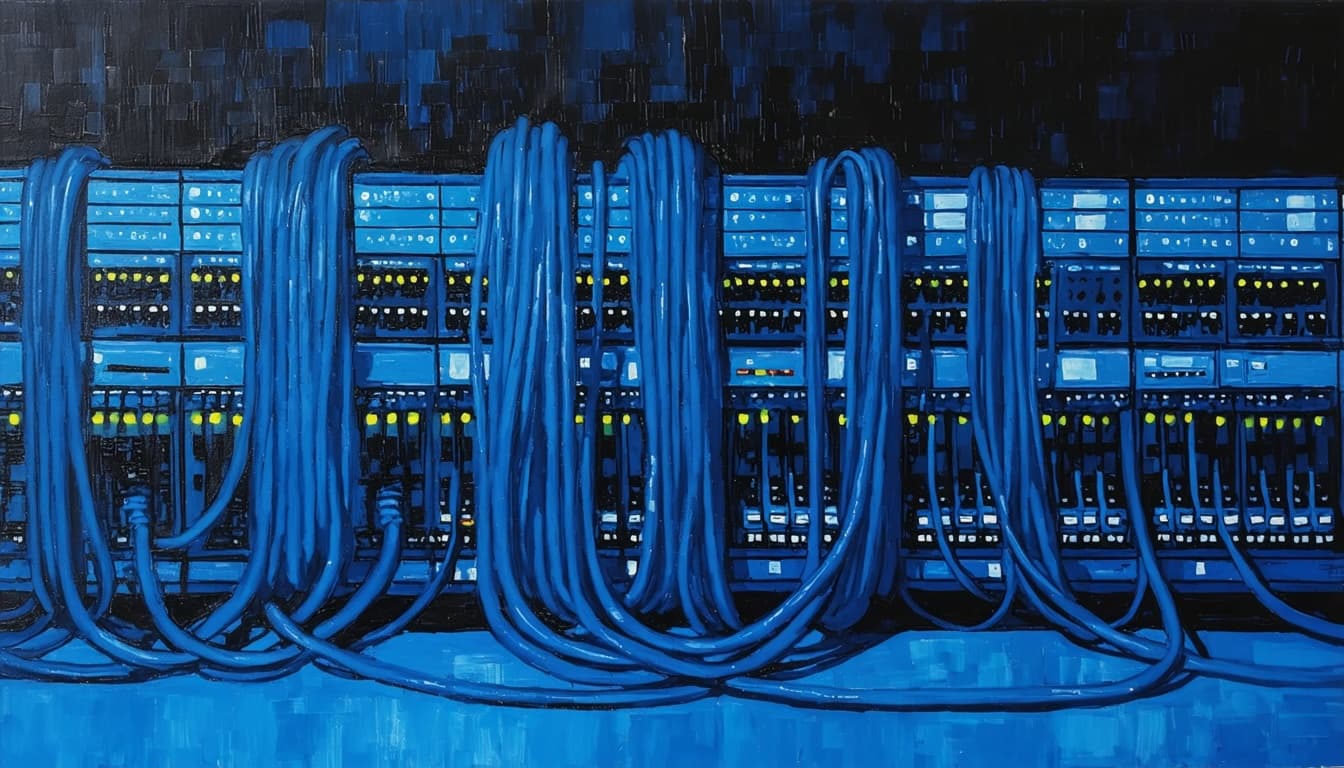
The technical capabilities TCS brings to ABB are comprehensive. The engagement centers on ABB's Future Network Model programme, an enterprise-wide initiative to transform global network into a standardized, centrally managed digital infrastructure. TCS will design, integrate, and operate ABB's global network ecosystem using AI-driven technologies, including modernized LAN, WAN, and Software-Defined WAN infrastructure. The company will enable end-to-end monitoring and orchestration to deliver high-performance connectivity, replacing fragmented network environments with a secure, scalable, and service-driven architecture.
What This Signals for the Industry
The TCS-ABB deal is more than a single contract—it's a bellwether for industrial AI transformation demand. The industrial & manufacturing sector is projected to spend $224.7 billion on digital transformation in 2026, representing 13.8% year-over-year growth. Automotive manufacturers alone will invest $87.3 billion, accounting for 39% of total spending across ten industries studied. There's "urgency to implement AI across manufacturing operations" as AI deployments mature with more robust capabilities.
The deal also signals how competitive dynamics will evolve. IT services providers will need to articulate clear AI value propositions rather than general digital transformation offerings. Domain specialization will become imperative—deep manufacturing expertise combined with technical capabilities. Success will require demonstrating proven AI capabilities with tangible business outcomes, not just technical expertise.
For TCS specifically, this deal positions the company as a leader in Cognitive Business Operations (CBO), a higher-margin niche than traditional application maintenance. It provides a high-profile reference case for TCS's ability to deliver complex, AI-driven managed services, setting a competitive benchmark against peers like Infosys, Wipro, and HCLTech who are pursuing similar industrial digital-transformation deals.
Other IT stocks participated in the rally, with HCL Tech jumping nearly 6% and Infosys gaining 3%. The deal demonstrates that AI-led growth stories can drive sector performance even amid broader market challenges.
Looking Ahead
The TCS-ABB deal represents a watershed moment for India's IT services industry. It signals that the massive investment in AI capabilities is beginning to pay off in high-value, transformational contracts. It demonstrates that deep domain expertise combined with cutting-edge technology can win against global competition. And it provides a roadmap for how traditional IT services providers can evolve into AI-powered transformation partners.
For investors, the deal offers reassurance that TCS's AI-first strategy is more than rhetoric—it's generating real revenue with healthy margins. For the industry, it sets a competitive benchmark that will force peers to accelerate their own AI capabilities. And for industrial enterprises worldwide, it shows that AI-driven network transformation is not just possible but already happening at scale.
The question now isn't whether AI will transform industrial operations—it's how fast, and which providers will capture the opportunity. With this deal, TCS has staked its claim as a leader in that transformation.