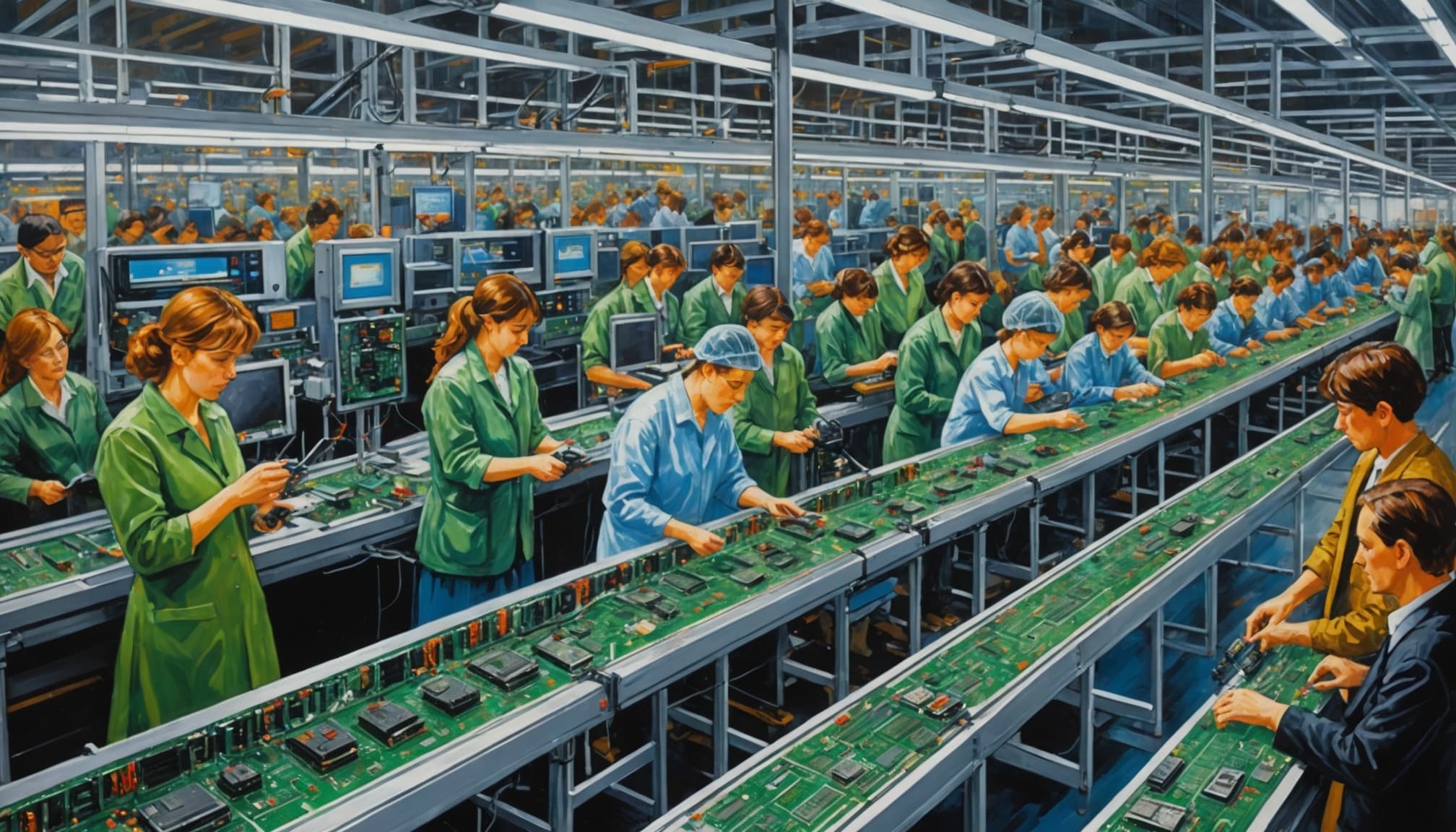
Here is the thing about Tata Group's semiconductor bet: the numbers are staggering, but the story isn't just about money. It is about a 155-year-old conglomerate trying to reinvent itself as a high-tech manufacturer while its own boardroom turns into a battleground.
That is not pocket change, even for a group with over $150 billion in annual revenue. The problem is, this money is going into projects that will take years to pay back, precisely when some shareholders are asking for faster returns.
The headline project is India's first commercial semiconductor fabrication plant in Dholera, Gujarat. Tata Electronics, a wholly owned subsidiary, is building this mega-fab in partnership with Taiwan's Powerchip Semiconductor Manufacturing Corporation (PSMC). The official investment figure for the Dholera fab alone is up to INR 91,000 crore (about $11 billion), with a planned capacity of 50,000 wafers per month. Add the INR 27,000 crore assembly and test facility in Assam, and you are looking at roughly INR 1.18 lakh crore (about $14 billion) in disclosed commitments. The $120 billion figure likely includes a broader, multi-fab vision and related ecosystem investments, but it is not a single, verified cheque. Either way, the scale is unprecedented for Indian manufacturing.
The Governance Collision
This capital commitment has collided head-on with a governance dispute that has split the Tata Sons board. On one side is N. Chandrasekaran, the executive chairman since 2017, who has championed these "nation-building" bets. On the other is Noel Tata, chairman of the philanthropic Tata Trusts, which owns 66% of Tata Sons. Noel Tata voted against Chandrasekaran's reappointment for a third five-year term in September 2026, and the Trusts have called the resolution "illegal" and "void".
The dispute centers on Tata Sons' Articles of Association, specifically Article 121, which the Trusts argue requires an affirmative vote from a majority of their nominee directors on major decisions. With two nominee directors on the board—Noel Tata and Venu Srinivasan—a split vote (1-1) means the condition was not met. The board, however, passed the resolution 4-1, with Srinivasan supporting Chandrasekaran. Independent director Harish Manwani reportedly used a casting vote to break the tie. The Trusts have cited a legal opinion from former Chief Justice D.Y. Chandrachud to back their position, setting the stage for a potential legal battle.
But this is not just about who sits in the chairman's chair. It is about the future structure of Tata Sons itself. The Reserve Bank of India has rejected Tata Sons' application to surrender its registration as a Core Investment Company, keeping the pressure on for a mandatory stock market listing. Noel Tata and the Trusts oppose listing, arguing it would "destroy" the group's character and dilute the Trusts' control. Chandrasekaran and the board, facing the RBI's deadline, have backed steps toward listing. A listing would bring in fresh capital and market discipline—exactly what a capital-intensive semiconductor strategy might need—but it would also fundamentally alter the ownership model that has allowed the Trusts to direct dividends toward philanthropy for over a century.
Capital Allocation: The Core Tension
At the heart of the dispute is a classic corporate dilemma: growth versus returns. Chandrasekaran's strategy involves massive, long-term investments in semiconductors, aviation (Air India), and digital businesses (Tata Neu). These are "nation-building" projects that align with India's strategic goals but come with heavy upfront costs and uncertain payback timelines. Noel Tata, representing the Trusts, has reportedly questioned continuing losses at unlisted businesses, particularly Air India and Tata Digital, and has sought assurances that Tata Sons would stay private.
The semiconductor project is the ultimate example of this tension. Building a fab is one of the most capital-intensive endeavors in industry. The Dholera fab is targeting trial production by December 2026, with commercial output expected to scale through 2027 and 2028. That means years of negative cash flow before meaningful revenue arrives. Meanwhile, Tata Sons' consolidated profit attributable to equity holders fell from INR 28,898 crore in FY25 to INR 17,763 crore in FY26. The group is absorbing losses from Air India (reportedly over INR 22,000 crore in FY26 alone) and dealing with the fallout from a cyberattack at Jaguar Land Rover that halted production for weeks.
The Trusts' income depends directly on dividends from Tata Sons. If the holding company is funneling cash into a fab instead of paying dividends, the Trusts' ability to fund their charitable activities takes a hit. Noel Tata's statement to the board emphasized that the Tata Group was "conceived as national service carried on through business" and that its unique ownership structure has allowed it to act in ways "a purely commercial calculus would not have supported". That is a philosophical argument, but it has very real financial implications.
Execution Risks at the Fab
The semiconductor project is not just facing boardroom headwinds; it is also navigating the brutal realities of building a first-of-its-kind manufacturing facility. The Dholera fab was officially approved in February 2024, and construction began in March that year. By April 2026, the government notified a Special Economic Zone for the project, and construction was reported to be past the 50% mark. But building the shell is the easy part. The hard part is installing and calibrating the ultra-clean rooms, the lithography scanners, and the thousands of interconnected systems that must work in perfect harmony.
Tata Electronics has secured critical partnerships to mitigate these risks. It has a Build, License, Transfer agreement with PSMC for technology, a strategic partnership with ASML for lithography tools, and collaborations with companies like Intel, Qualcomm, Bosch, and ROHM for product development and customer demand. The government's India Semiconductor Mission provides 50% fiscal support on eligible costs, and Gujarat offers additional state incentives. These are significant advantages, but they do not eliminate execution risk.
Industry reports suggest the fab may initially start at a more mature process node, such as 90 nm, rather than the originally targeted 28 nm, with full commercial production potentially slipping toward mid-2028. Process qualification, yield improvement, and customer certification are all hurdles that must be cleared before the fab can generate sustainable returns. Any delay pushes the payback timeline further out, increasing the pressure on Tata Sons' balance sheet.
The Competitive Landscape and the Shortage
Despite the risks, the strategic logic for entering semiconductors is compelling. The global semiconductor market is undergoing a structural shift. A surge in demand for AI infrastructure is pulling foundry capacity toward advanced nodes, creating acute shortages in the mature nodes (28 nm and above) that automotive, industrial, and consumer electronics rely on. Lead times for power management ICs have extended beyond 50 weeks, and analysts forecast that up to 600,000 vehicles could be cut from production in 2026 due to chip scarcity.
India, which currently imports almost all of its semiconductor needs, is desperate to build domestic capacity. The government has approved 13 semiconductor projects under the India Semiconductor Mission, but Tata's Dholera fab is the only true front-end fabrication plant. The others, including facilities from Micron, Kaynes, and CG Power, are focused on assembly, testing, and packaging. Being the first mover gives Tata Electronics a significant advantage in securing government support, attracting partners, and building an ecosystem. It also positions the Tata Group as a key player in India's ambition to become a global manufacturing hub.
What Lies Ahead
The immediate future will be defined by two parallel tracks. On the operational track, Tata Electronics must navigate the complex final stages of fab construction, equipment installation, and process qualification. The next 12 to 18 months are critical. If the fab hits its milestones and begins commercial production by late 2027 or early 2028, it will validate Chandrasekaran's strategy and could unlock significant value. If it faces further delays or technical issues, the financial pressure on Tata Sons will intensify.
On the governance track, the dispute over Chandrasekaran's reappointment and the future listing of Tata Sons must be resolved. A prolonged legal battle or leadership uncertainty could create decision paralysis at the worst possible time. Capital-intensive projects like semiconductors require stable leadership and clear funding commitments. The Trusts' push to protect their control and dividend stream is understandable, but it could also constrain the group's ability to raise the capital needed to compete on a global scale.
The Tata Group is at a crossroads. It is trying to balance its legacy as a philanthropic-driven conglomerate with its ambitions as a high-tech manufacturing powerhouse. The semiconductor bet is a bold statement of intent, but it comes with a price tag that is testing the limits of its traditional governance model. How this tension is resolved will determine not just the fate of the Dholera fab, but the future shape of one of India's most iconic business groups.