Tata Sons Chairman N Chandrasekaran has defended the group's nation-first approach to semiconductor manufacturing, emphasizing long-term strategic importance over short-term financial returns. Speaking at the Bloomberg New Economy Forum 2026 in New Delhi, Chandrasekaran stated that 'direction is certain, need is certain, ability to execute is certain' and that 'chips will be fundamentally required, and advanced manufacturing is here to stay'. According to reports from Bloomberg, he made these remarks during a panel titled 'The End of Predictability' alongside former UK Prime Minister Rishi Sunak and Blackstone President and Chief Operating Officer Jonathan Gray. The session was moderated by Erik Schatzker, editorial director at Bloomberg New Economy. As reported by ET Now, Chandrasekaran framed semiconductor manufacturing not as an optional industrial ambition but as a foundational necessity for India's technological and economic development, stating 'Chips are the future. Chips are going to be fundamentally required for domestic institution'. He acknowledged that 'the world has faced hard times before, but what sets this moment apart is that geopolitical disruption, commodity shocks and supply chain crises are all happening at the same time'. Speaking at the forum, Chandrasekaran emphasized that 'there are many decisions that have been taken by various chairmen in the group which have all proved to be right in the long term' and that semiconductor manufacturing and advanced manufacturing were critical to India's future, 'should not be judged solely by whether they meet targets over the next two to three years'. When asked about current global uncertainty, Chandrasekaran noted that 'at the same time the connected world is trying to decouple itself, it has never been decoupled. And tackling all of these things now is unique'. At the latest event, Chandrasekaran reiterated that investments in semiconductors and electronics are important for India, businesses and the future, although they may not generate the numbers in two or three years. He emphasized that 'everyone recognises that chips are the future and the decisions were financially prudent' and cautioned against reckless investment, stating 'You can't be reckless and say I will put a two nanometre chip, it's just not going to work'.
Chandrasekaran highlighted India's significant progress in the electronics sector, noting that India's electronics exports have risen from about $12 billion five years ago to $48 billion this year. As reported by Bloomberg, he drew on the group's historical approach to explain their semiconductor strategy, referencing how founder Jamsetji Tata saw steel, power, and science and research as fundamentally important, though he did not live to see the steel plant come up in 1907 or the hydroelectric plant in 1911. He emphasized that 'directionally, if you design it on the belief that it is needed for India, it is needed for mankind and for enterprises, you will get it right. It doesn't mean that everything will be smooth'. According to ET Now, Chandrasekaran identified two structural strengths that position India to participate meaningfully in the global chip industry: its talent base and its large domestic market. India produces hundreds of thousands of engineering graduates annually, many of whom are already employed in semiconductor design and related disciplines, while domestic demand for chips across automotive, telecommunications, consumer electronics and AI-driven devices is growing at a rate that could justify significant indigenous manufacturing capacity. Speaking at the forum, Chandrasekaran emphasized that 'We are in a beautiful spot in India, because we have the talent, we have the domestic market, we can play a part in every global supply chain'.
Chandrasekaran's defense of nation-first projects comes amid significant boardroom tensions over capital allocation decisions. Tata Trusts Chairman Noel Tata, who owns about 66% of Tata Sons, has been pressing for quicker returns on investments, including the group's ₹10,000 crore ($120 billion) wager on future growth, which includes India's first chip-making unit. In September, the Tata Sons board reappointed Chandrasekaran for another five-year term, despite opposition from Noel Tata. The Trusts, which own about 66 per cent of Tata Sons, later termed the decision illegal, arguing that it violated the company's Articles of Association. Tata Sons has disputed this claim, while Noel Tata voted against the reappointment decision. Chandrasekaran announced in August that he would not seek another term when his current one ends in February 2027, citing a lack of unanimous support on the Tata Sons board, though the board subsequently reappointed him. The tensions reflect broader challenges facing the nearly 160-year-old group that posted $185 billion in revenue last fiscal. According to Live Mint, Noel Tata has reportedly differed with Chandrasekaran in recent board discussions over capital-allocation decisions and investments that can deliver returns more quickly, with the Trusts now reviewing their approach to capital allocation.
Chandrasekaran emphasized the importance of maintaining financial discipline while pursuing strategic investments, stating that 'you need to keep an eye on balance sheet. So you can't be reckless' and noting that 'the numbers won't be tidy: You need to feel the stones and cross the river'. He explained that Tata has to follow demand, and India needs global partners because it does not yet have all the technologies. The chairman acknowledged operational challenges, citing 'a rough run, citing an air crash, a cyberattack and supply-chain disruptions', but emphasized that 'the group still delivered double-digit growth, with margins holding up'. He added a note of caution, stating 'We have to also be careful because you need to keep an eye on management. We need to also see where the demand is', stressing that investment decisions must account for actual market requirements and operational capacity. The caution is well-calibrated given that semiconductor manufacturing is among the most capital-intensive and technically demanding industrial activities, with fabrication facilities costing billions of dollars to build and requiring years to reach full capacity. According to Business Standard, Chandrasekaran cautioned against investing recklessly in advanced chip technologies, stating 'You can't be reckless and say that I am going to be putting a two-nanometre chip. It's just not going to work'. He also cited specific examples of operational disruptions, noting 'shortages of magnets that can disrupt vehicle production and the cyberattack that affected Jaguar Land Rover (JLR), saying the company had almost lost six weeks of production because of the incident'.
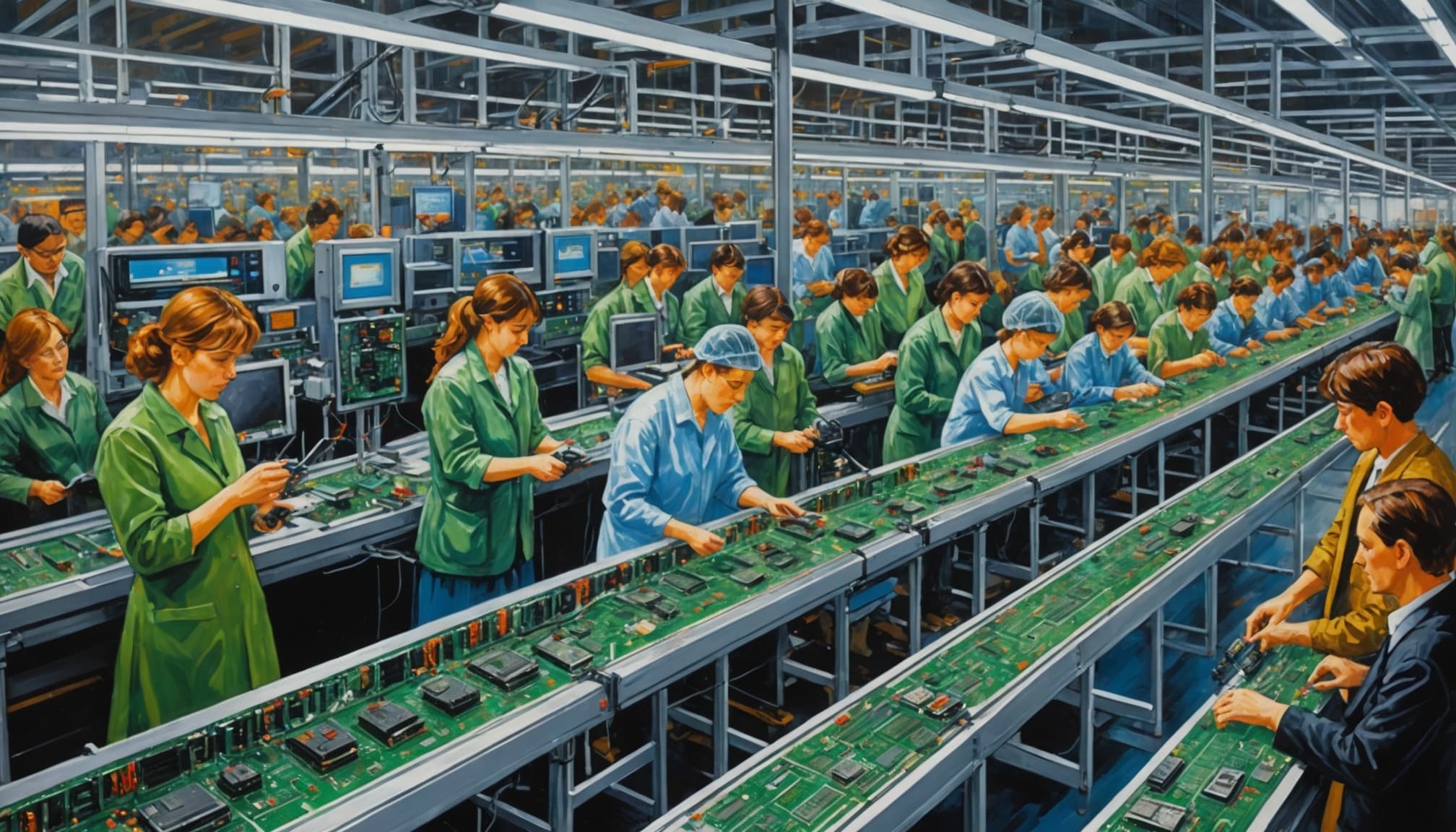
The chairman's remarks are not theoretical - Tata Group is actively constructing the semiconductor infrastructure he described as fundamental. Tata Electronics is establishing India's first large-scale chip fab in Dholera, Gujarat, with the company signing an agreement in May with Dutch semiconductor equipment company ASML to support the facility's establishment and expansion. ASML is the global monopoly supplier of extreme ultraviolet lithography machines, the equipment essential for manufacturing the most advanced chips, making its involvement in the Dholera project a significant signal about the facility's ambitions. The Dholera project involves an investment of around ₹91,000 crore and will manufacture chips for automobiles, mobile devices, consumer electronics, artificial intelligence and other industrial applications. Separately, Tata's semiconductor assembly and testing facility in Jagiroad, Assam, is expected to produce up to 48 million chips per day when fully operational. The Assam facility is intended to serve the automotive, telecommunications, consumer electronics and AI device sectors, representing Tata's effort to build end-to-end semiconductor manufacturing capabilities spanning the full production cycle from chip making to final packaging. According to Business Standard, the chip fabrication plant in Dholera, Gujarat, being built with Taiwan's Powerchip Semiconductor Manufacturing Corporation, is expected to begin commercial operations in mid-2028, while the assembly and testing facility in Assam is slated to start production in December. However, as reported by Business Standard, Tata Electronics' revenue nearly doubled to ₹1.31 trillion in FY26, but its net loss widened to ₹1,611 crore from ₹70 crore a year earlier, with its two major semiconductor projects yet to begin production.