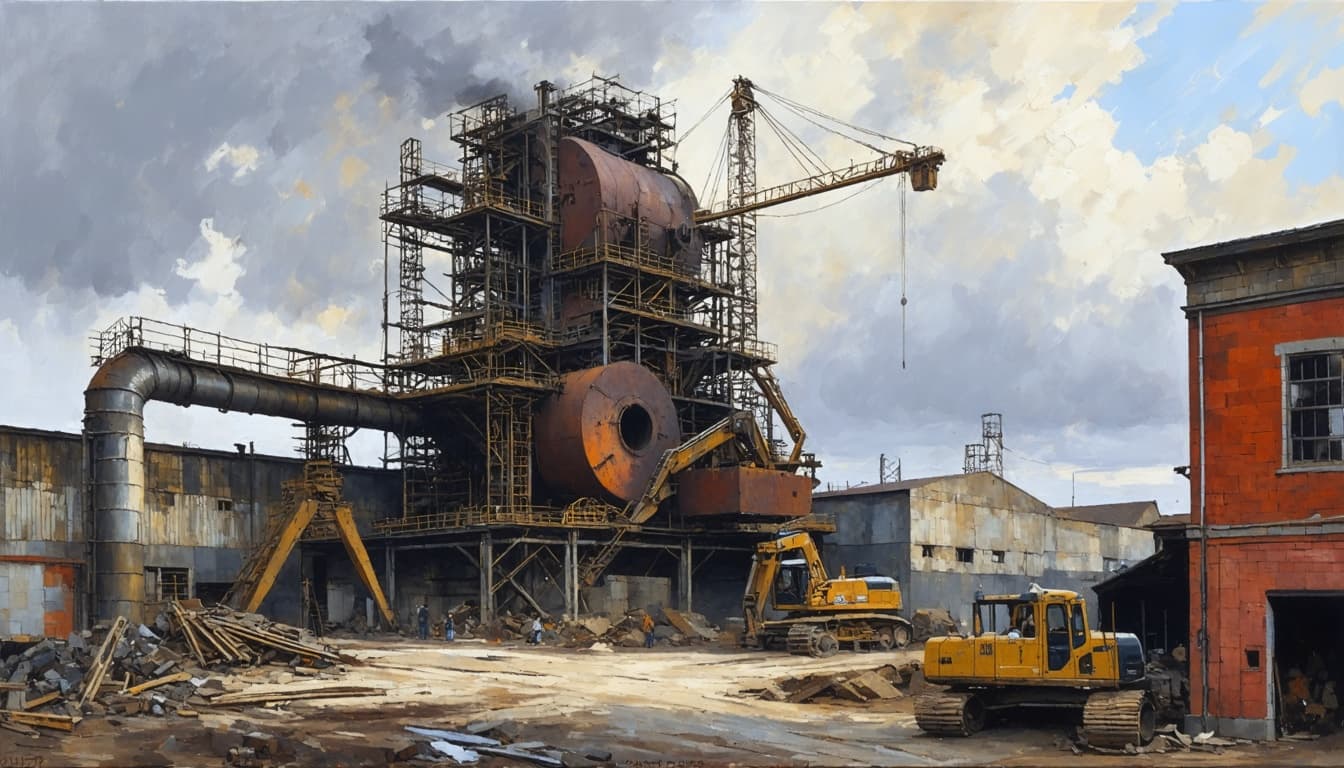
The company recently confirmed that securing access to the high-voltage electricity required to power the facility will be delayed by six to eight months, pushing the commissioning timeline from late 2027 or early 2028 to mid or late 2028.
The root cause lies not within Tata Steel's control, but with the UK's electricity transmission infrastructure. In May 2024, Tata Steel signed a connection offer with the Electricity System Operator (ESO), under which National Grid Electricity Transmission (NGET) agreed to build the necessary new electrical infrastructure by the end of 2027. However, NGET has formally alerted Tata Steel that this connectivity project is now delayed.
The problem is systemic. The UK's grid connection queue has exploded, growing by 460% in just six months to June 2025, swamped with speculative applications that are blocking viable projects. Industry sources indicate that NGET is "hitting a brick wall and is totally overwhelmed," lacking the engineering teams to physically deliver the infrastructure despite administrative reforms. The National Energy System Operator (NESO), which manages the connection process, has had to revise its timeline for issuing connection offers due to the sheer volume of projects and the complexity of reassessing construction planning assumptions.
Financial Fallout
The delay carries a hefty price tag. Tata Steel UK is already losing more than £1 million a day. Extending the construction period by six to eight months means the company must sustain these elevated losses for longer before the EAF begins generating revenue to offset them.
The financial impact is multifaceted. The company faces extended carrying costs, including continued fixed costs and interest on deployed capital. Tata Steel had already reduced its UK fixed costs from £995 million in FY24 to £762 million in FY25, targeting £540 million for FY26. The delay means sustaining these costs for an additional half-year or more.
Furthermore, the deferral of revenue generation is substantial. The EAF facility will have an annual production capacity of 3.2 million tonnes. Assuming conservative estimates of steel prices and capacity utilisation, the six to eight-month delay could result in £770 million to £1.37 billion in deferred revenue.
The £500 million government grant is structured as progress payments, meaning Tata Steel receives funds only as the project advances. While the delay may spread these disbursements over a longer period, creating potential working capital pressure, there is currently no explicit evidence of cost-sharing mechanisms for delays attributable to grid infrastructure. The government has a mechanism to claw back some funds if Tata Steel breaks promises, but since the delay stems from National Grid's challenges, there may be scope for milestone adjustments without penalty.
Operational Contingencies
Despite the power infrastructure delay, Tata Steel is not standing still. The company has implemented robust operational contingencies to manage the transition period. Both blast furnaces at Port Talbot have now been permanently closed, ending over 100 years of primary steelmaking at the site.
To ensure continuity of supply for customers, Tata Steel is utilising imported semi-finished steel from its plants in the Netherlands and India, as well as other strategic suppliers. The company has agreed to continue operating the hot strip mill through the transition period, allowing it to process imported materials and maintain downstream capabilities.
On the construction front, progress continues. Major demolition works are complete, and fabrication and delivery of equipment are proceeding at pace. Tata Steel has placed orders for the EAF, ladle metallurgy furnaces, and associated equipment with technology providers like Tenova, ABB, and Clecim. Sir Robert McAlpine has been appointed as the main contractor to manage civil, structural, and building works.
The primary challenge now is sequencing. Equipment may be ready for installation before the electrical infrastructure is available, requiring careful staging and storage solutions. The delay has shifted electrical infrastructure to the critical path, requiring resynchronisation of multiple work packages and contractor schedules.
Environmental and Safety Balance
The delay also has environmental implications. The EAF project is projected to reduce site-level CO2 emissions by 90%, equivalent to 5 million tonnes annually. Deferring commissioning by six to eight months means deferring these emissions reductions by 2.5 to 4.2 million tonnes. This occurs within a challenging regulatory context, as the EU's Carbon Border Adjustment Mechanism (CBAM) entered its definitive enforcement phase in January 2026, and the UK ETS continues to impose carbon costs.
Adding to the complexity, a fire incident at the Pickle Line facility on June 3, 2026, has forced Tata Steel to shift from routine transition management to emergency damage assessment. While there were no injuries, the company is reviewing the impact on its £13,125 crore asset. If the fire damaged shared utility lines, it could pose further risks to the EAF project timeline.
Throughout these challenges, Tata Steel is maintaining a safety-first approach. The company has a robust governance structure, including a Board-level Safety, Health and Environment Committee and an Apex Safety Council. The company's long-term objective is 'Zero Harm,' and it is balancing the pressure to expedite commissioning with the need for comprehensive infrastructure readiness verification and safety protocols.
Governance Challenges
The coordination between Tata Steel, the UK government, National Grid, and NESO faces significant limitations. Tata Steel is working with all stakeholders to mitigate the impact, but it has limited leverage to accelerate National Grid's infrastructure delivery.
The Tata Steel / Port Talbot Transition Board, established to support affected workers and communities, explicitly excludes oversight of the £1.25 billion decarbonisation project delivery, which is led separately by the Department for Business and Trade. There is currently no unified governance body with the authority to reallocate resources or reprioritise grid infrastructure projects for strategic industrial decarbonisation.
As Tata Steel navigates this complex landscape, the company's strong internal governance and risk management frameworks provide a foundation for managing these compound risks. However, addressing the systemic challenges in multi-stakeholder coordination and timeline protection may require structural reforms beyond Tata Steel's direct control, potentially necessitating UK government intervention to establish more effective governance mechanisms for critical infrastructure projects.